

Volume 27, Issue 2 (7-2026)
Arch Rehabil 2026, 27(2): 198-217 |
Back to browse issues page




Download citation:
BibTeX | RIS | EndNote | Medlars | ProCite | Reference Manager | RefWorks
Send citation to:


BibTeX | RIS | EndNote | Medlars | ProCite | Reference Manager | RefWorks
Send citation to:
Amini Z, Purmohammad M, Mordi A, Ghasisin L. Development and Psychometric Evaluation of the Persian Receptive Figurative Language Test (P-RFLT) in Healthy Adults. Arch Rehabil 2026; 27 (2) :198-217
URL: http://rehabilitationj.uswr.ac.ir/article-1-3681-en.html
URL: http://rehabilitationj.uswr.ac.ir/article-1-3681-en.html

1- Institute for Cognitive Sciences, Shahid Beheshti University, Tehran, Iran.
2- Department of Psychology, MacEwan University, Edmonton, Alberta, Canada.
3- Department of Educational Psychology, University of Alberta, Edmonton, Alberta, Canada., , Cognitive Science Research Institute, Kharazmi University, Tahran, Iran
4- Department of Speech Therapy, Musculoskeletal Research Center, Faculty of Rehabilitation Sciences, Isfahan University of Medical Sciences, Isfahan, Iran. ,ghasisin@rehab.mui.ac.ir
2- Department of Psychology, MacEwan University, Edmonton, Alberta, Canada.
3- Department of Educational Psychology, University of Alberta, Edmonton, Alberta, Canada., , Cognitive Science Research Institute, Kharazmi University, Tahran, Iran
4- Department of Speech Therapy, Musculoskeletal Research Center, Faculty of Rehabilitation Sciences, Isfahan University of Medical Sciences, Isfahan, Iran. ,
Full-Text [PDF 1838 kb]
(241 Downloads)
| Abstract (HTML) (1214 Views)
Full-Text: (219 Views)
Introduction
Figurative language is a cognitive and discursive tool that operates beyond literal meaning and depends on an individual’s ability to interpret implied meanings in a context-dependent manner. Understanding figurative language requires advanced linguistic and cognitive skills [1]. According to the lexical concepts and cognitive models theory (LCCM), figurative language processing results from the simultaneous interaction of linguistic knowledge and cognitive structures, whereby individuals interpret the non-literal meaning of utterances by drawing upon lexical items, syntactic structures, and prior experiential knowledge. In this framework, metaphors, idioms, proverbs, and similes are considered a shared cognitive–linguistic construct [1, 2]. According to Giora, the comprehension of figurative language depends more on the salience degree of meaning, which is shaped by an individual’s experience, rather than on the distinction between literal and non-literal meaning. This salience [3]. Similarly, Lakoff and Johnson considered figurative language to be an inseparable part of everyday language and thought, arguing that humans rely on it to express abstract concepts [4].
Metaphor is one of the most prominent topics in cognitive semantics and is defined as the understanding of one conceptual domain in terms of another. For instance, in the metaphor “Love is a journey”, the abstract concept of love is understood through the concrete concept of a journey [5]. Metaphors are systematic mappings between a source domain and a target domain and, beyond the linguistic level, play a pivotal role in organizing the mind’s conceptual structures. They vary in terms of the degree of familiarity and novelty [6]. Conventional metaphors, such as “Time is gold”, are more frequent and processed more rapidly, while novel or unconventional metaphors, such as “Zeal is lava”, require more extensive cognitive processing [7, 8]. Moreover, although many conceptual metaphors are shared across cultures, language and culture play a significant role in their formation and interpretation [9, 10].
Idioms are another important manifestation of figurative language [11]. Phrases such as “Āb-ghureh nagir” (in Persian) carry a meaning that extends beyond the sum of their constituent words [12]. Research has demonstrated that an individual’s familiarity with idioms plays a fundamental role in the speed and accuracy of comprehension, such that familiar idioms are understood more quickly and with greater ease [13].
Proverbs are another form of figurative language that, compared to idioms, have a more fixed syntactic structure and are employed as completely fixed expressions. In contrast, idioms can be used in terms of person and tense [14]. Proverbs reflect metaphorical structures as well as cultural and collective knowledge and are considered a type of “compressed knowledge” that conveys abstract and empirical concepts in a metaphorical form [15, 16]. Understanding familiar proverbs usually requires less cognitive processing, whereas unfamiliar proverbs require greater inferential effort [17]. Proverb-based tests can serve as effective tools for assessing cognitive and linguistic functioning [18].
Similes are another form of figurative expression characterized by an explicit comparison. In Persian, these expressions are considered a subcategory of proverbs with a culturally established, fixed structure. Unlike many proverbs, similes often create an explicit comparison between two phenomena by using words such as “like”, “as”, or “than”. For instance, “A teacher is like a lantern in a dark night” is a simile [19]. Despite the greater structural clarity of similes, their comprehension remains dependent on inferential processes, particularly when the similarity between the two concepts is not obvious [20].
Studies in cognitive neuroscience have demonstrated that the brain hemispheres play different roles in processing figurative language. The left hemisphere is predominantly engaged in processing familiar metaphors, whereas the right hemisphere plays a more prominent role in processing novel and complex metaphors [21, 22]. This distinction is more closely related to factors such as novelty, difficulty, and the need to integrate information, rather than to the metaphorical nature of language per se [23]. The investigation of these processes is also clinically important and can help distinguish healthy individuals from those with cognitive disorders [24].
Given the critical role of figurative language in abstract thinking and human communication, its assessment in both research and clinical settings is essential. In this regard, the figurative language interpretation test (FLIT) was designed to measure the comprehension of metaphors, similes, proverbs, and personification [25]. Also, the assessment of pragmatic abilities and cognitive substrates (APACS) was developed in 2016 to evaluate pragmatic skills and figurative language, including metaphor and irony, in Italian adults [26]. In Iran, several instruments have also been designed to assess certain aspects of figurative language. Nejati and Ramesh developed a proverb test to assess executive functions and language abilities in school-aged children [27]. Ghavami et al. prepared the Persian version of the Delis–Kaplan executive function system (D-KEFS) test battery for ages 16-40 [28]. Rahimifar et al. also designed the High-Level Language Skills Test for neurological patients and adults, which comprises seven subtests for repeating long sentences, sentence construction, inference, comprehension of complex grammatical sentences, comprehension of ambiguous sentences, word definitions, and proverbs [29].
Despite the availability of the aforementioned instruments, there is still a lack of comprehensive, standardized tests for the simultaneous assessment of metaphors, idioms, proverbs, and similes in the Persian language. This gap has limited the precise evaluation of figurative language abilities, particularly in patients with schizophrenia, traumatic brain injury, and neurological diseases such as frontotemporal dementia and amyotrophic lateral sclerosis [30, 31]. Accordingly, the present study aimed to develop and evaluate the psychometric properties of the Persian receptive figurative language test (P-RFLT) for healthy Persian-speaking adults aged 25-65 years. This age range was selected due to the influence of developmental changes prior to age 25 and the effects of the aging process after age 65 on figurative language processing [32]. By providing a comprehensive instrument for assessing figurative language, this study has broad applicability in clinical evaluations and future research.
Materials & Methods
This is a methodological study with a cross-sectional design. To develop the P-RFLT, figurative language items were first generated across four domains—metaphor, proverb, idiom, and simile—and then their psychometric properties were evaluated. The study was carried out in three phases: item development, content and face validity assessment, and final test administration.
Participants
The study population comprised 418 adults aged 25-65 years, of whom 41 participated in the item familiarity rating phase, 40 in the pilot study, and 337 in the final phase. The sample size was determined based on Morgan’s table [33]. Convenience sampling was conducted over six months during 2023–2024 by attending various locations in Tehran Province, including parks, workplaces, shopping centers, and companies. The inclusion criteria were as follows: age 25-65 years, being a monolingual Persian speaker, at least a primary school education to ensure the ability to respond to the test items, and no uncorrectable visual or auditory impairments—all of which were ascertained through self-report. Additionally, participants’ cognitive health was confirmed using the Persian version of the clinical dementia rating scale (CDR-P) [34].
Procedure
Phase 1: Test item development
The P-RFLT items were developed based on Cieślicka et al.’s test, which encompasses four main components of figurative language: metaphor, idiom, proverb, and simile [35]. In the initial phase, expressions pertaining to these components were extensively extracted from various sources and texts using a deductive approach. To control for confounding linguistic variables, the structural features of the items (word count, sentence length, and grammatical pattern) were kept as similar as possible, such that all items were formulated in the form of short and simple sentences with 4-7 words. Given that the number of items should ideally be 2-3 times the final required number [36], a total of 86 metaphors, 112 idioms, 48 proverbs, and 48 similes were initially selected. Metaphors and idioms constitute an extensive and fundamental part of the conceptual and lexical system of language; hence, a larger number of items were selected for these two categories [4].
Phase 2: Content and face validity assessment
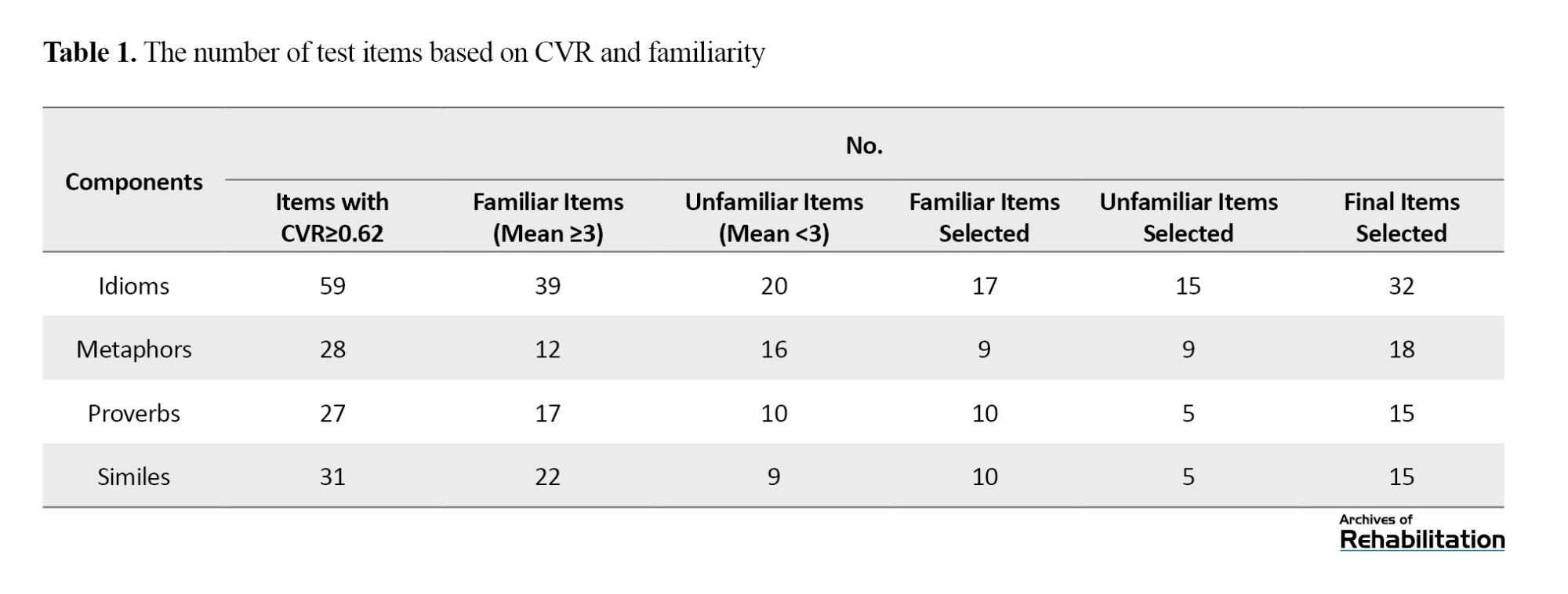
In this phase, the items were submitted to 10 doctoral students in cognitive linguistics, of whom 5 were university lecturers, 3 had experience at various research institutes, and 2 had clinical experience in speech-language pathology. The panelists evaluated the items for relevance, clarity, representativeness, and alignment with the test objectives. Subsequently, the content validity ratio (CVR) was calculated using Lawshe’s method, and items with a CVR below 0.62 were eliminated. Additionally, the face validity of the items was assessed with respect to clarity, comprehensibility, simplicity of wording, readability, layout, and overall organization. Based on the feedback received, modifications were made, including disambiguation, sentence simplification, and structural rearrangement of certain items. After content and face validity assessment, 28 metaphors, 27 proverbs, 31 similes, and 59 idioms were retained as test items. Subsequently, to prevent ceiling and floor effects, item difficulty was controlled for familiarity level [37]. To assess familiarity, the initial draft of the test was administered to 41 eligible adults, who were asked to rate their degree of familiarity with each item on a five-point Likert scale from “very low” to “very high”. Items with a mean score >3 were classified as familiar, and those with a mean score <3 were classified as unfamiliar [35]. Finally, based on the results of the familiarity analysis and the research team’s judgment, the test was compiled, comprising 18 metaphors, 32 idioms, 15 proverbs, and 15 similes, organized sequentially from easy to difficult levels.
To assess the cognitive processing of figurative language, test items were designed in two formats:
Multiple-choice format (three options): In this format, each item was designed as a unit consisting of a stimulus sentence (containing a figurative expression) and three response options: Relevant (reflecting the figurative or expected meaning), a literal-meaning distractor, and irrelevant. Participants were required to select the correct option. Scoring was conducted on a dichotomous basis (0–1). This format was employed to assess the comprehension of metaphors, idioms, and a subset of proverbs and similes. For example, for the Persian item “Amoye man az donya raft” [My uncle left the world], the correct response was “Amoye man mord” [My uncle passed away].
Sentence completion format: A subset of items related to proverbs and similes was designed in a sentence-completion format. In this format, an incomplete sentence is given, and participants are asked to complete it with one or two words. This format was employed to assess deeper semantic processing, access to meanings stored in long-term memory, and the ability to infer semantic relationships [38]. Scoring in this section was also dichotomous (0–1), and orthographic errors were disregarded in the evaluation. For example, for the Persian proverb “Payane shabe siah…” [The end of the dark night…], the expected response was “sepid ast” [Is white] (the proverb means every cloud has a silver lining).
The developed sample items were administered in a pilot study to 40 eligible participants. Prior to administration, participants were asked to provide feedback on font size, font type, and line spacing to optimize the word readability. All participants approved the prepared draft.
Following the pilot study, the frequency and percentage of selection for each option were calculated, and the attractiveness of the distractors was evaluated. Furthermore, the correlation between the selection of each option and the total test score was examined to determine the discriminative validity of the options. Options that exhibited very low selection frequency, inadequate discriminative power, or were indistinguishable from the distractors were identified and revised, and the final draft of the test was prepared.
Phase 3: Test administration
The final draft of the test was administered to 337 participants who met the inclusion criteria to examine internal consistency, test re-test reliability, and construct validity. Test administration was conducted in a quiet environment. Initially, the purpose of the study was explained verbally to the participants, and upon agreement, they completed an informed consent form, followed by a demographic form and the CDR-P test. The prepared test was then provided to participants in a paper-and-pencil, self-administered form. To familiarize participants with how to respond, two sample items (one with a multiple-choice format and one with a sentence completion format) were placed at the beginning of each section of the test. To mitigate the participants’ fatigue, the items were divided into two equal sections, with a brief rest interval between them. Upon completion of test administration, item scoring was conducted by an independent rater with no involvement in the sampling process. To examine test re-test reliability, the test was re-administered to 67 participants at a two-week interval.
Data analysis
Data entry into SPSS software, version 20 was performed by a person unaware of the sampling and scoring processes to enhance data accuracy. For data analysis, both descriptive and inferential statistics were employed. Descriptive statistics, including the Mean±SD, and median, were used to present participants’ performance across the subtests. Internal consistency was assessed using Cronbach’s α. Test re-test reliability was assessed by calculating the intraclass correlation coefficient (ICC), and construct validity was examined by exploratory factor analysis (EFA).
Results
Participants were 418 healthy adults aged 25-65, including 293 females (70%) and 125 males (30%). In terms of age, 18% were in the 25-34 age group, 51.6% in the 35-44 age group, 23% in the 45-54 age group, and 7.4% in the 55-65 age group. Regarding education level, 1% had lower than high school education, 16.6% had a high school diploma, 7.4% had a postgraduate degree, 47.4% had a bachelor’s degree, 22.6% had a master’s degree, and 5% had a PhD degree.
After determining the test’s content validity based on expert opinions and the calculation of the CVR, familiarity of items was assessed, and the final items were selected (Table 1).
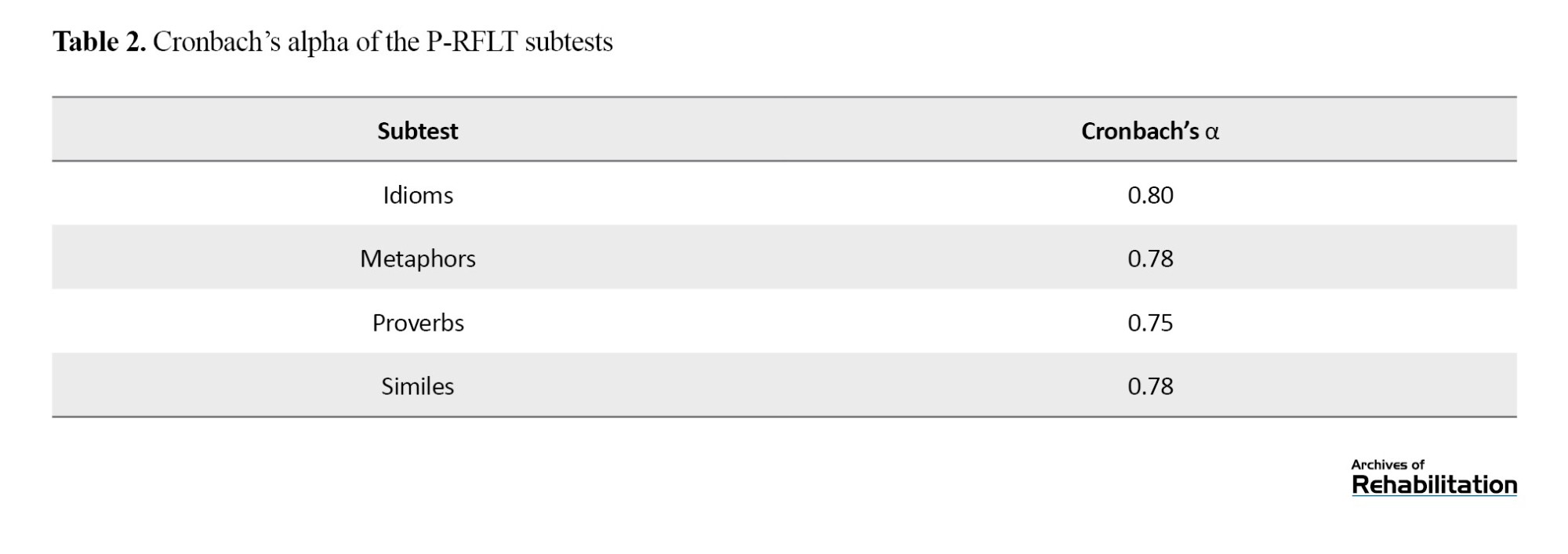
The internal consistency of the subtests, measured using Cronbach’s α coefficient, is presented in Table 2, indicating that each subtest of the P-RFLT had adequate internal consistency (α>0.7).
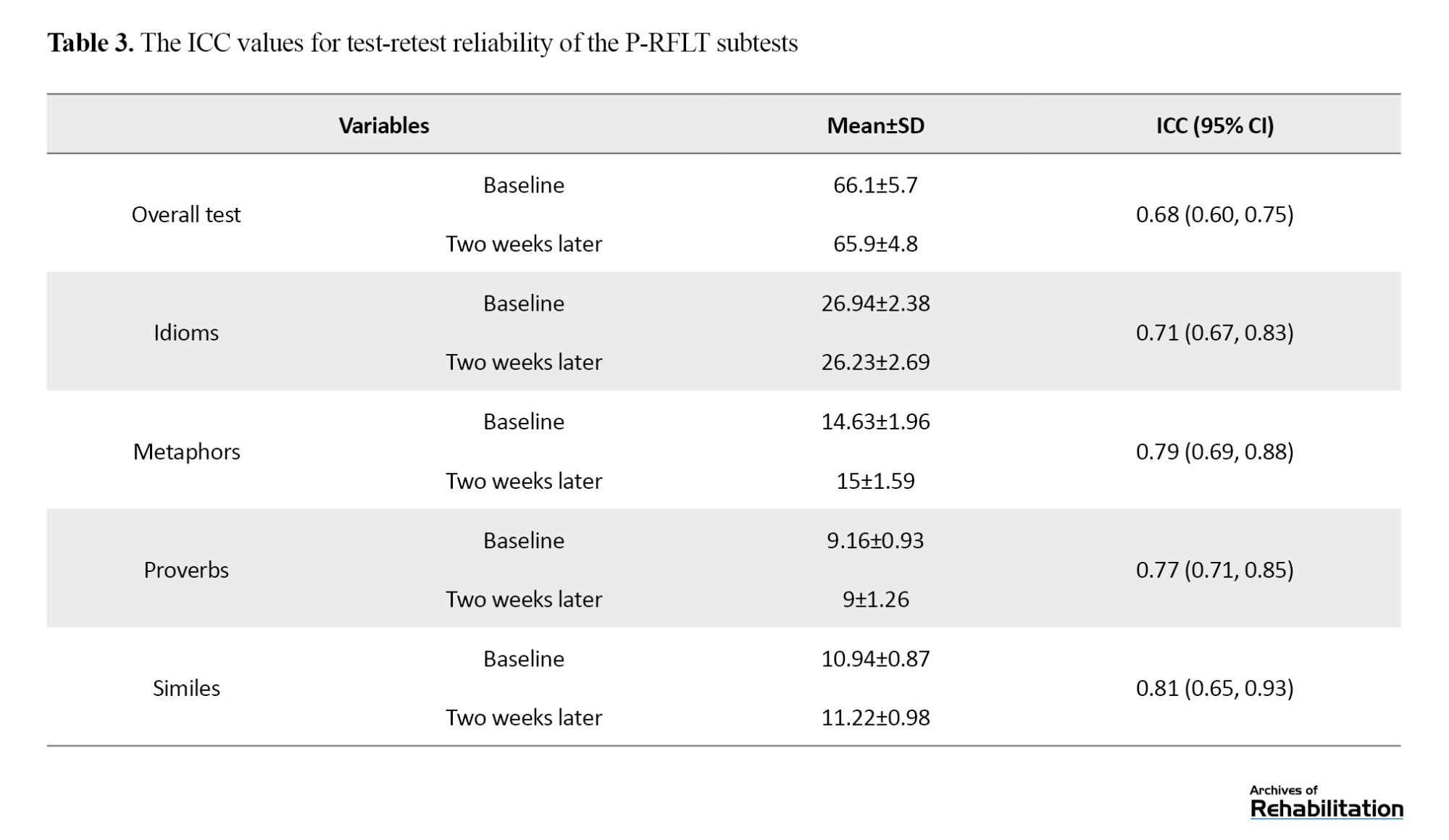
To evaluate test re-test reliability, the ICC at a 95% confidence interval was calculated using a two-way mixed model with absolute agreement (Table 3). The ICC values for the four subtests ranged from 0.71 to 0.81, reflecting adequate test re-test reliability.
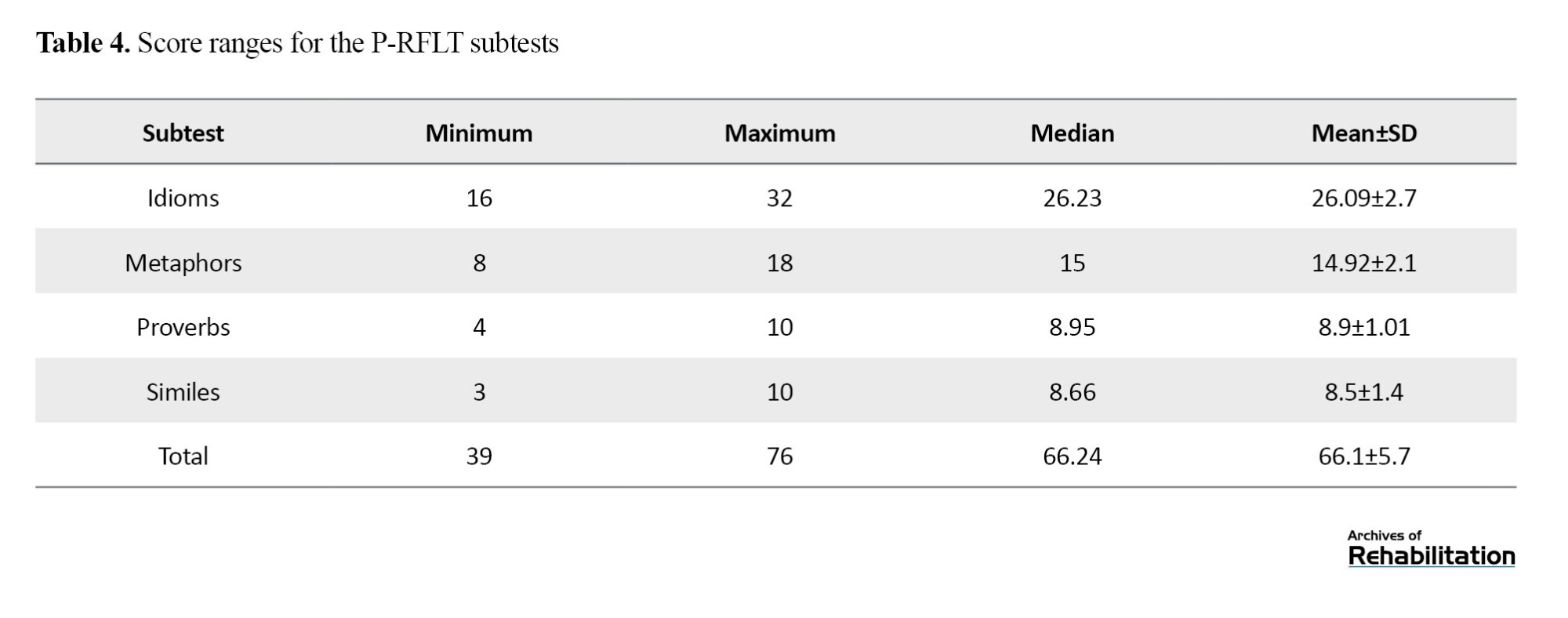
Construct validity, assessed using the EFA, demonstrated that the data for each subtest independently supported the intended structure. The Kaiser–Meyer–Olkin (KMO) values for each subtest were 0.739, 0.778, 0.740, and 0.804, respectively. Bartlett’s test of sphericity yielded a significance level for all components (P<0.05). Given that the factor loadings for each item within its respective domain were above or close to 0.4, the items for each domain were adequate. Furthermore, to establish normative reference ranges for the healthy sample, the minimum, maximum, mean, and standard deviation were calculated, as shown in Table 4. Based on the obtained mean and median values, the normative reference scores were as follows: 26 for the 32-item idioms subtest, 15 for the 18-item metaphors subtest, 9 for the 10-item proverbs subtest, 9 for the 10-item similes subtest, 4 for the 5-item proverb sentence completion subtest, and 3 for the 5-item simile sentence completion subtest.
Discussion
In the present study, we developed and validated the P-RFLT, comprising four components—metaphors, idioms, proverbs, and similes—for Persian-speaking adults. The findings demonstrated that the developed test had adequate content validity, face validity, and construct validity, with satisfactory internal consistency and test-retest reliability.
The analyses indicated that the test items coherently covered various types of figurative language and that the four-factor structure obtained after EFA was consistent with cognitive and pragmatic theoretical frameworks, although differed at the linguistic level. The types of figurative language depend on shared semantic processing networks at the cognitive level. The congruence of the factor structure with the theoretical framework indicated that the empirical data support the conceptual model of figurative language within cognitive linguistics and pragmatics [4, 5].
A comparison of the present test with the FLIT [25] revealed that both instruments directly assess figurative language types, including metaphor, simile, and proverb, and are aligned in terms of design. Both tests have acceptable face and content validity, confirmed by experts, and comparable psychometric properties, including internal consistency. However, the FLIT primarily focuses on the global assessment of the ability to process metaphorical and indirect items, with results presented as a total score or on a limited set of subscales, while in the P-RFLT, figurative language was delineated as a multi-component construct, with each component subjected to independent psychometric analysis.
The findings of the present study are consistent with the results reported by Arcara and Bambini [26] for the APACS regarding reliability. Moreover, from a structural standpoint, the factor analysis results are consistent with those of the APACS, in which figurative language types were similarly reported as measurable components. This suggests that the cognitive organization of figurative language in both instruments is amenable to structural modeling. Nevertheless, the APACS study employed more advanced psychometric models as part of instrument standardization in English. In contrast, we used EFA to yield a four-component structure in Persian. In comparison with the study by Ghavami et al. on the Persian D-KEFS test battery [28], both studies emphasized the importance of figurative language and the role of cultural context in its comprehension. However, their study focused on a specific dimension of figurative language and pragmatic analyses, whereas we examined figurative language as a multi-component construct within a structured psychometric instrument.
The variation in psychometric tests, particularly reliability tests, across components can be explained in terms of semantic processing and cognitive load. Different types of figurative language vary in semantic transparency and the degree of cognitive inference required. Specifically, similes, due to the presence of explicit comparative markers, have greater semantic transparency and are associated with lower executive demand and more direct processing; conversely, metaphors—particularly when unfamiliar—require inferential processing and more complex conceptual mappings. Furthermore, the degree of cultural familiarity with items plays a significant role in participant performance, such that familiar items (especially common idioms and proverbs) are processed more automatically and with a lower cognitive load. In contrast, unfamiliar items impose a greater executive demand on the cognitive system [7, 20]. From a neurological perspective, these differences may also be associated with the degree of engagement of classical language networks in the left hemisphere, abstract semantic processing networks in the right hemisphere, and executive networks in the frontal–parietal lobe. Accordingly, variations in familiarity, semantic transparency, and the type of linguistic structure can lead to differences in item difficulty and, consequently, changes in reliability indices and response patterns, which partially account for the discrepancies observed across studies [21].
In the present study, the primary focus was on the test’s psychometric properties rather than its diagnostic function. Therefore, rather than establishing a cutoff score, the mean score of healthy individuals was used as a normative reference. This approach is consistent with the initial stages of instrument development, as the primary objective at this stage was to examine construct validity and reliability, and to provide a framework for the relative interpretation of performance, rather than definitive diagnosis. Using the mean scores of healthy individuals enables comparison of individual performance against normative patterns and can inform clinicians in language rehabilitation, without yielding a definitive diagnosis.
The present study, similar to comparable studies, had some limitations. Its administration among samples from Tehran city may limit the generalizability of the results to other cities with different cultures and geographic regions. Furthermore, the participants’ age range (25-65 years) limits the applicability of the findings to this age group. Higher percentage of female participants was another limitation, due to women’s greater willingness to participate in psychological and linguistic research, as well as their greater accessibility and cooperativeness during the sampling process. Although research evidence does not indicate a significant difference between men and women in the comprehension of figurative language, the difference in male to female ratio may exert a marginal effect on certain responses. Therefore, the generalizability of the results should be done with caution. Additionally, in evaluating the instrument’s face and content validity, doctoral students were employed as panelists, and clinicians with clinical experience did not participate in this process, which may be a methodological limitation of the study. Another limitation was the absence of a clinical sample for the determination of a diagnostic cutoff score. Consequently, score interpretation was based solely on the performance of healthy individuals, which, although appropriate for the initial stages of instrument development, cannot substitute for definitive diagnostic criteria derived from comparisons with clinical groups.
It is recommended that future studies calculate additional validity and reliability indices, including criterion validity and discriminant validity, for the test. Furthermore, administering the P-RFLT to clinical cases, such as patients with aphasia or neurocognitive disorders, may facilitate the assessment of its sensitivity and clinical utility, as well as the establishment of cutoff scores. Additionally, evaluating the test across diverse age and gender groups, and in other geographic regions, can enhance the instrument’s generalizability and external validity.
Conclusion
The P-RFLT is a valid and reliable tool with a coherent and measurable four-factor structure that can be used for assessing figurative language comprehension in Persian-speaking adults in both educational and clinical settings.
Ethical Considerations
Compliance with ethical guidelines
The research has ethical approval from the Ethics Committee of the Institute for Cognitive Science Studies, Shahid Beheshti University, Tehran, Iran (Code: IR.UT.IRICSS.REC.1402.033). All procedures were conducted in accordance with ethical principles in human studies. Prior to data collection, participants were provided with complete and transparent information regarding the study objectives, procedures, and data usage. Participants were assured that their information would be kept strictly confidential and that participation was entirely voluntary, and they could withdraw at any time without consequences. Furthermore, participants were given access to the research findings so they could benefit from the study results.
Funding
This study was extracted from PhD Dissertation of Zahra Amini’s, approved by the Institute for Cognitive Science Studies at Shahid Beheshti University. This research did not receive any specific grant from funding agencies in the public, commercial, or not-for-profit sectors.
Authors' contributions
Conceptualization, methodology, analysis, investigation, review & editing: All authors; Validation, writing original draft: Leila Ghasisin and Zahra Amini; Resources: Leila Ghasisin, Zahra Amini, and Mehdi Pourmohammad; Supervision and project administration: Leila Ghasisin.
Conflict of interest
The authors declared no conflict of interest.
AI tools disclosure statement
In preparing this manuscript, the artificial intelligence tool ChatGPT was used solely for editorial review, to improve textual fluency, enhance coherence and cohesion between paragraphs, and suggest linguistic revisions. The authors carefully reviewed all suggestions provided by the AI tool and edited them where necessary, and assume full responsibility for the final content of the manuscript.
Acknowledgments
The authors would like to thank all participants for their participation in this study.
Figurative language is a cognitive and discursive tool that operates beyond literal meaning and depends on an individual’s ability to interpret implied meanings in a context-dependent manner. Understanding figurative language requires advanced linguistic and cognitive skills [1]. According to the lexical concepts and cognitive models theory (LCCM), figurative language processing results from the simultaneous interaction of linguistic knowledge and cognitive structures, whereby individuals interpret the non-literal meaning of utterances by drawing upon lexical items, syntactic structures, and prior experiential knowledge. In this framework, metaphors, idioms, proverbs, and similes are considered a shared cognitive–linguistic construct [1, 2]. According to Giora, the comprehension of figurative language depends more on the salience degree of meaning, which is shaped by an individual’s experience, rather than on the distinction between literal and non-literal meaning. This salience [3]. Similarly, Lakoff and Johnson considered figurative language to be an inseparable part of everyday language and thought, arguing that humans rely on it to express abstract concepts [4].
Metaphor is one of the most prominent topics in cognitive semantics and is defined as the understanding of one conceptual domain in terms of another. For instance, in the metaphor “Love is a journey”, the abstract concept of love is understood through the concrete concept of a journey [5]. Metaphors are systematic mappings between a source domain and a target domain and, beyond the linguistic level, play a pivotal role in organizing the mind’s conceptual structures. They vary in terms of the degree of familiarity and novelty [6]. Conventional metaphors, such as “Time is gold”, are more frequent and processed more rapidly, while novel or unconventional metaphors, such as “Zeal is lava”, require more extensive cognitive processing [7, 8]. Moreover, although many conceptual metaphors are shared across cultures, language and culture play a significant role in their formation and interpretation [9, 10].
Idioms are another important manifestation of figurative language [11]. Phrases such as “Āb-ghureh nagir” (in Persian) carry a meaning that extends beyond the sum of their constituent words [12]. Research has demonstrated that an individual’s familiarity with idioms plays a fundamental role in the speed and accuracy of comprehension, such that familiar idioms are understood more quickly and with greater ease [13].
Proverbs are another form of figurative language that, compared to idioms, have a more fixed syntactic structure and are employed as completely fixed expressions. In contrast, idioms can be used in terms of person and tense [14]. Proverbs reflect metaphorical structures as well as cultural and collective knowledge and are considered a type of “compressed knowledge” that conveys abstract and empirical concepts in a metaphorical form [15, 16]. Understanding familiar proverbs usually requires less cognitive processing, whereas unfamiliar proverbs require greater inferential effort [17]. Proverb-based tests can serve as effective tools for assessing cognitive and linguistic functioning [18].
Similes are another form of figurative expression characterized by an explicit comparison. In Persian, these expressions are considered a subcategory of proverbs with a culturally established, fixed structure. Unlike many proverbs, similes often create an explicit comparison between two phenomena by using words such as “like”, “as”, or “than”. For instance, “A teacher is like a lantern in a dark night” is a simile [19]. Despite the greater structural clarity of similes, their comprehension remains dependent on inferential processes, particularly when the similarity between the two concepts is not obvious [20].
Studies in cognitive neuroscience have demonstrated that the brain hemispheres play different roles in processing figurative language. The left hemisphere is predominantly engaged in processing familiar metaphors, whereas the right hemisphere plays a more prominent role in processing novel and complex metaphors [21, 22]. This distinction is more closely related to factors such as novelty, difficulty, and the need to integrate information, rather than to the metaphorical nature of language per se [23]. The investigation of these processes is also clinically important and can help distinguish healthy individuals from those with cognitive disorders [24].
Given the critical role of figurative language in abstract thinking and human communication, its assessment in both research and clinical settings is essential. In this regard, the figurative language interpretation test (FLIT) was designed to measure the comprehension of metaphors, similes, proverbs, and personification [25]. Also, the assessment of pragmatic abilities and cognitive substrates (APACS) was developed in 2016 to evaluate pragmatic skills and figurative language, including metaphor and irony, in Italian adults [26]. In Iran, several instruments have also been designed to assess certain aspects of figurative language. Nejati and Ramesh developed a proverb test to assess executive functions and language abilities in school-aged children [27]. Ghavami et al. prepared the Persian version of the Delis–Kaplan executive function system (D-KEFS) test battery for ages 16-40 [28]. Rahimifar et al. also designed the High-Level Language Skills Test for neurological patients and adults, which comprises seven subtests for repeating long sentences, sentence construction, inference, comprehension of complex grammatical sentences, comprehension of ambiguous sentences, word definitions, and proverbs [29].
Despite the availability of the aforementioned instruments, there is still a lack of comprehensive, standardized tests for the simultaneous assessment of metaphors, idioms, proverbs, and similes in the Persian language. This gap has limited the precise evaluation of figurative language abilities, particularly in patients with schizophrenia, traumatic brain injury, and neurological diseases such as frontotemporal dementia and amyotrophic lateral sclerosis [30, 31]. Accordingly, the present study aimed to develop and evaluate the psychometric properties of the Persian receptive figurative language test (P-RFLT) for healthy Persian-speaking adults aged 25-65 years. This age range was selected due to the influence of developmental changes prior to age 25 and the effects of the aging process after age 65 on figurative language processing [32]. By providing a comprehensive instrument for assessing figurative language, this study has broad applicability in clinical evaluations and future research.
Materials & Methods
This is a methodological study with a cross-sectional design. To develop the P-RFLT, figurative language items were first generated across four domains—metaphor, proverb, idiom, and simile—and then their psychometric properties were evaluated. The study was carried out in three phases: item development, content and face validity assessment, and final test administration.
Participants
The study population comprised 418 adults aged 25-65 years, of whom 41 participated in the item familiarity rating phase, 40 in the pilot study, and 337 in the final phase. The sample size was determined based on Morgan’s table [33]. Convenience sampling was conducted over six months during 2023–2024 by attending various locations in Tehran Province, including parks, workplaces, shopping centers, and companies. The inclusion criteria were as follows: age 25-65 years, being a monolingual Persian speaker, at least a primary school education to ensure the ability to respond to the test items, and no uncorrectable visual or auditory impairments—all of which were ascertained through self-report. Additionally, participants’ cognitive health was confirmed using the Persian version of the clinical dementia rating scale (CDR-P) [34].
Procedure
Phase 1: Test item development
The P-RFLT items were developed based on Cieślicka et al.’s test, which encompasses four main components of figurative language: metaphor, idiom, proverb, and simile [35]. In the initial phase, expressions pertaining to these components were extensively extracted from various sources and texts using a deductive approach. To control for confounding linguistic variables, the structural features of the items (word count, sentence length, and grammatical pattern) were kept as similar as possible, such that all items were formulated in the form of short and simple sentences with 4-7 words. Given that the number of items should ideally be 2-3 times the final required number [36], a total of 86 metaphors, 112 idioms, 48 proverbs, and 48 similes were initially selected. Metaphors and idioms constitute an extensive and fundamental part of the conceptual and lexical system of language; hence, a larger number of items were selected for these two categories [4].
Phase 2: Content and face validity assessment
In this phase, the items were submitted to 10 doctoral students in cognitive linguistics, of whom 5 were university lecturers, 3 had experience at various research institutes, and 2 had clinical experience in speech-language pathology. The panelists evaluated the items for relevance, clarity, representativeness, and alignment with the test objectives. Subsequently, the content validity ratio (CVR) was calculated using Lawshe’s method, and items with a CVR below 0.62 were eliminated. Additionally, the face validity of the items was assessed with respect to clarity, comprehensibility, simplicity of wording, readability, layout, and overall organization. Based on the feedback received, modifications were made, including disambiguation, sentence simplification, and structural rearrangement of certain items. After content and face validity assessment, 28 metaphors, 27 proverbs, 31 similes, and 59 idioms were retained as test items. Subsequently, to prevent ceiling and floor effects, item difficulty was controlled for familiarity level [37]. To assess familiarity, the initial draft of the test was administered to 41 eligible adults, who were asked to rate their degree of familiarity with each item on a five-point Likert scale from “very low” to “very high”. Items with a mean score >3 were classified as familiar, and those with a mean score <3 were classified as unfamiliar [35]. Finally, based on the results of the familiarity analysis and the research team’s judgment, the test was compiled, comprising 18 metaphors, 32 idioms, 15 proverbs, and 15 similes, organized sequentially from easy to difficult levels.
To assess the cognitive processing of figurative language, test items were designed in two formats:
Multiple-choice format (three options): In this format, each item was designed as a unit consisting of a stimulus sentence (containing a figurative expression) and three response options: Relevant (reflecting the figurative or expected meaning), a literal-meaning distractor, and irrelevant. Participants were required to select the correct option. Scoring was conducted on a dichotomous basis (0–1). This format was employed to assess the comprehension of metaphors, idioms, and a subset of proverbs and similes. For example, for the Persian item “Amoye man az donya raft” [My uncle left the world], the correct response was “Amoye man mord” [My uncle passed away].
Sentence completion format: A subset of items related to proverbs and similes was designed in a sentence-completion format. In this format, an incomplete sentence is given, and participants are asked to complete it with one or two words. This format was employed to assess deeper semantic processing, access to meanings stored in long-term memory, and the ability to infer semantic relationships [38]. Scoring in this section was also dichotomous (0–1), and orthographic errors were disregarded in the evaluation. For example, for the Persian proverb “Payane shabe siah…” [The end of the dark night…], the expected response was “sepid ast” [Is white] (the proverb means every cloud has a silver lining).
The developed sample items were administered in a pilot study to 40 eligible participants. Prior to administration, participants were asked to provide feedback on font size, font type, and line spacing to optimize the word readability. All participants approved the prepared draft.
Following the pilot study, the frequency and percentage of selection for each option were calculated, and the attractiveness of the distractors was evaluated. Furthermore, the correlation between the selection of each option and the total test score was examined to determine the discriminative validity of the options. Options that exhibited very low selection frequency, inadequate discriminative power, or were indistinguishable from the distractors were identified and revised, and the final draft of the test was prepared.
Phase 3: Test administration
The final draft of the test was administered to 337 participants who met the inclusion criteria to examine internal consistency, test re-test reliability, and construct validity. Test administration was conducted in a quiet environment. Initially, the purpose of the study was explained verbally to the participants, and upon agreement, they completed an informed consent form, followed by a demographic form and the CDR-P test. The prepared test was then provided to participants in a paper-and-pencil, self-administered form. To familiarize participants with how to respond, two sample items (one with a multiple-choice format and one with a sentence completion format) were placed at the beginning of each section of the test. To mitigate the participants’ fatigue, the items were divided into two equal sections, with a brief rest interval between them. Upon completion of test administration, item scoring was conducted by an independent rater with no involvement in the sampling process. To examine test re-test reliability, the test was re-administered to 67 participants at a two-week interval.
Data analysis
Data entry into SPSS software, version 20 was performed by a person unaware of the sampling and scoring processes to enhance data accuracy. For data analysis, both descriptive and inferential statistics were employed. Descriptive statistics, including the Mean±SD, and median, were used to present participants’ performance across the subtests. Internal consistency was assessed using Cronbach’s α. Test re-test reliability was assessed by calculating the intraclass correlation coefficient (ICC), and construct validity was examined by exploratory factor analysis (EFA).
Results
Participants were 418 healthy adults aged 25-65, including 293 females (70%) and 125 males (30%). In terms of age, 18% were in the 25-34 age group, 51.6% in the 35-44 age group, 23% in the 45-54 age group, and 7.4% in the 55-65 age group. Regarding education level, 1% had lower than high school education, 16.6% had a high school diploma, 7.4% had a postgraduate degree, 47.4% had a bachelor’s degree, 22.6% had a master’s degree, and 5% had a PhD degree.
After determining the test’s content validity based on expert opinions and the calculation of the CVR, familiarity of items was assessed, and the final items were selected (Table 1).
The internal consistency of the subtests, measured using Cronbach’s α coefficient, is presented in Table 2, indicating that each subtest of the P-RFLT had adequate internal consistency (α>0.7).
To evaluate test re-test reliability, the ICC at a 95% confidence interval was calculated using a two-way mixed model with absolute agreement (Table 3). The ICC values for the four subtests ranged from 0.71 to 0.81, reflecting adequate test re-test reliability.
Construct validity, assessed using the EFA, demonstrated that the data for each subtest independently supported the intended structure. The Kaiser–Meyer–Olkin (KMO) values for each subtest were 0.739, 0.778, 0.740, and 0.804, respectively. Bartlett’s test of sphericity yielded a significance level for all components (P<0.05). Given that the factor loadings for each item within its respective domain were above or close to 0.4, the items for each domain were adequate. Furthermore, to establish normative reference ranges for the healthy sample, the minimum, maximum, mean, and standard deviation were calculated, as shown in Table 4. Based on the obtained mean and median values, the normative reference scores were as follows: 26 for the 32-item idioms subtest, 15 for the 18-item metaphors subtest, 9 for the 10-item proverbs subtest, 9 for the 10-item similes subtest, 4 for the 5-item proverb sentence completion subtest, and 3 for the 5-item simile sentence completion subtest.
Discussion
In the present study, we developed and validated the P-RFLT, comprising four components—metaphors, idioms, proverbs, and similes—for Persian-speaking adults. The findings demonstrated that the developed test had adequate content validity, face validity, and construct validity, with satisfactory internal consistency and test-retest reliability.
The analyses indicated that the test items coherently covered various types of figurative language and that the four-factor structure obtained after EFA was consistent with cognitive and pragmatic theoretical frameworks, although differed at the linguistic level. The types of figurative language depend on shared semantic processing networks at the cognitive level. The congruence of the factor structure with the theoretical framework indicated that the empirical data support the conceptual model of figurative language within cognitive linguistics and pragmatics [4, 5].
A comparison of the present test with the FLIT [25] revealed that both instruments directly assess figurative language types, including metaphor, simile, and proverb, and are aligned in terms of design. Both tests have acceptable face and content validity, confirmed by experts, and comparable psychometric properties, including internal consistency. However, the FLIT primarily focuses on the global assessment of the ability to process metaphorical and indirect items, with results presented as a total score or on a limited set of subscales, while in the P-RFLT, figurative language was delineated as a multi-component construct, with each component subjected to independent psychometric analysis.
The findings of the present study are consistent with the results reported by Arcara and Bambini [26] for the APACS regarding reliability. Moreover, from a structural standpoint, the factor analysis results are consistent with those of the APACS, in which figurative language types were similarly reported as measurable components. This suggests that the cognitive organization of figurative language in both instruments is amenable to structural modeling. Nevertheless, the APACS study employed more advanced psychometric models as part of instrument standardization in English. In contrast, we used EFA to yield a four-component structure in Persian. In comparison with the study by Ghavami et al. on the Persian D-KEFS test battery [28], both studies emphasized the importance of figurative language and the role of cultural context in its comprehension. However, their study focused on a specific dimension of figurative language and pragmatic analyses, whereas we examined figurative language as a multi-component construct within a structured psychometric instrument.
The variation in psychometric tests, particularly reliability tests, across components can be explained in terms of semantic processing and cognitive load. Different types of figurative language vary in semantic transparency and the degree of cognitive inference required. Specifically, similes, due to the presence of explicit comparative markers, have greater semantic transparency and are associated with lower executive demand and more direct processing; conversely, metaphors—particularly when unfamiliar—require inferential processing and more complex conceptual mappings. Furthermore, the degree of cultural familiarity with items plays a significant role in participant performance, such that familiar items (especially common idioms and proverbs) are processed more automatically and with a lower cognitive load. In contrast, unfamiliar items impose a greater executive demand on the cognitive system [7, 20]. From a neurological perspective, these differences may also be associated with the degree of engagement of classical language networks in the left hemisphere, abstract semantic processing networks in the right hemisphere, and executive networks in the frontal–parietal lobe. Accordingly, variations in familiarity, semantic transparency, and the type of linguistic structure can lead to differences in item difficulty and, consequently, changes in reliability indices and response patterns, which partially account for the discrepancies observed across studies [21].
In the present study, the primary focus was on the test’s psychometric properties rather than its diagnostic function. Therefore, rather than establishing a cutoff score, the mean score of healthy individuals was used as a normative reference. This approach is consistent with the initial stages of instrument development, as the primary objective at this stage was to examine construct validity and reliability, and to provide a framework for the relative interpretation of performance, rather than definitive diagnosis. Using the mean scores of healthy individuals enables comparison of individual performance against normative patterns and can inform clinicians in language rehabilitation, without yielding a definitive diagnosis.
The present study, similar to comparable studies, had some limitations. Its administration among samples from Tehran city may limit the generalizability of the results to other cities with different cultures and geographic regions. Furthermore, the participants’ age range (25-65 years) limits the applicability of the findings to this age group. Higher percentage of female participants was another limitation, due to women’s greater willingness to participate in psychological and linguistic research, as well as their greater accessibility and cooperativeness during the sampling process. Although research evidence does not indicate a significant difference between men and women in the comprehension of figurative language, the difference in male to female ratio may exert a marginal effect on certain responses. Therefore, the generalizability of the results should be done with caution. Additionally, in evaluating the instrument’s face and content validity, doctoral students were employed as panelists, and clinicians with clinical experience did not participate in this process, which may be a methodological limitation of the study. Another limitation was the absence of a clinical sample for the determination of a diagnostic cutoff score. Consequently, score interpretation was based solely on the performance of healthy individuals, which, although appropriate for the initial stages of instrument development, cannot substitute for definitive diagnostic criteria derived from comparisons with clinical groups.
It is recommended that future studies calculate additional validity and reliability indices, including criterion validity and discriminant validity, for the test. Furthermore, administering the P-RFLT to clinical cases, such as patients with aphasia or neurocognitive disorders, may facilitate the assessment of its sensitivity and clinical utility, as well as the establishment of cutoff scores. Additionally, evaluating the test across diverse age and gender groups, and in other geographic regions, can enhance the instrument’s generalizability and external validity.
Conclusion
The P-RFLT is a valid and reliable tool with a coherent and measurable four-factor structure that can be used for assessing figurative language comprehension in Persian-speaking adults in both educational and clinical settings.
Ethical Considerations
Compliance with ethical guidelines
The research has ethical approval from the Ethics Committee of the Institute for Cognitive Science Studies, Shahid Beheshti University, Tehran, Iran (Code: IR.UT.IRICSS.REC.1402.033). All procedures were conducted in accordance with ethical principles in human studies. Prior to data collection, participants were provided with complete and transparent information regarding the study objectives, procedures, and data usage. Participants were assured that their information would be kept strictly confidential and that participation was entirely voluntary, and they could withdraw at any time without consequences. Furthermore, participants were given access to the research findings so they could benefit from the study results.
Funding
This study was extracted from PhD Dissertation of Zahra Amini’s, approved by the Institute for Cognitive Science Studies at Shahid Beheshti University. This research did not receive any specific grant from funding agencies in the public, commercial, or not-for-profit sectors.
Authors' contributions
Conceptualization, methodology, analysis, investigation, review & editing: All authors; Validation, writing original draft: Leila Ghasisin and Zahra Amini; Resources: Leila Ghasisin, Zahra Amini, and Mehdi Pourmohammad; Supervision and project administration: Leila Ghasisin.
Conflict of interest
The authors declared no conflict of interest.
AI tools disclosure statement
In preparing this manuscript, the artificial intelligence tool ChatGPT was used solely for editorial review, to improve textual fluency, enhance coherence and cohesion between paragraphs, and suggest linguistic revisions. The authors carefully reviewed all suggestions provided by the AI tool and edited them where necessary, and assume full responsibility for the final content of the manuscript.
Acknowledgments
The authors would like to thank all participants for their participation in this study.
References
- Evans V. Figurative language understanding in LCCM Theory. Cognitive linguistics. 2010; 2110:601-62. [DOI:10.1515/cogl.2010.020]
- Colston H, Gibbs RW. Figurative Language Communicates Directly Because It Precisely Demonstrates What We Mean. Canadian Journal of Experimental Psychology. 2021; 75(2):228-33.[DOI:10.1037/cep0000254] [PMID]
- Giora R. Literal vs. figurative language: Different or equal? Journal of Pragmatics. 2002; 34(4):487-506. [DOI:10.1016/S0378-2166(01)00045-5]
- Lakoff G, Johnson Mark. Metaphors We Live By. Chicago: The University of Press; 2003. [DOI:10.7208/chicago/9780226470993.001.0001]
- Kövecses: Z. Metaphor: A Practical Introduction. Second ed. Oxford: Oxford: Oxford University Press; 2010. [Link]
- Beaty RE, Silvia PJ. Metaphorically speaking: Cognitive abilities and the production of figurative language. Memory & Cognition. 2013; 41(2):255-67. [DOI:10.3758/s13421-012-0258-5] [PMID]
- Mon SK, Nencheva M, Citron FMM, Lew-Williams C, Goldberg AE. Conventional metaphors elicit greater real-time engagement than literal paraphrases or concrete sentences. Journal of Memory and Language. 2021; 121:104285. [DOI:10.1016/j.jml.2021.104285]
- Yao Z, Huang X, Chai Y, Zhang J. Conventionality and context jointly modulate the effect of inhibitory control on L2 metaphor comprehension. Humanities and Social Sciences Communications. 2024; 11:1460. [DOI:10.1057/s41599-024-03977-4]
- Chen J, Lv J, Chen B. Crossing the cultural bridge: The role of inhibitory control during second language metaphor comprehension. Bilingualism: Language and Cognition. 2025; 28(5):1393-409. [DOI:10.1017/S1366728924001081]
- Kabra A, Liu E, Khanuja S, Aji A, Winata G, Aremu A, et al. Multi-lingual and Multi-cultural Figurative Language Understanding. California: Association for Computational Linguistics; 2023. [DOI:10.18653/v1/2023.findings-acl.525]
- Wiliński J. Metaphodioms: Connecting metaphor and idioms. Brno studies in English. 2022; 48(1):117-35. [DOI:10.5817/BSE2022-1-6]
- Evans V, Green M. Cognitive Linguistics: An Introduction. second ed. London: Routledge; 2018. [Link]
- Alasgarova R, Mahmudova I, Rzayev J. Cross-linguistic processing of idioms: The role of cultural familiarity and Construction Grammar in idiom comprehension. 2025; 8:2025. [DOI:10.2478/lf-2025-0009]
- Langlotz A. Idiomatic creativity: A cognitive-linguistic model of idiom-representation and idiom-variation in English. Amsterdam: John Benjamins Publishing Company; 2006. [Link]
- Kljajevic V. Older and Wiser: Interpretation of Proverbs in the Face of Age-Related Cortical Atrophy. Frontiers in Aging Neuroscienc. 2022; 14:919470. [DOI:10.3389/fnagi.2022.919470] [PMID]
- Woźniak J. [Rec.] Sadia Belkhir. Proverbs within cognitive linguistics. State of the art. Amsterdam / Philadelphia: John Benjamins Publishing Company. 2024. Pp. 351. Glottodidactica. 2025; 52:207-11. [DOI:10.14746/gl.2025.52.12]
- Lauro LJ, Tettamanti M, Cappa SF, Papagno C. Idiom Comprehension: A Prefrontal Task? Cerebral Cortex. 2008; 18(1):162-70. [DOI:10.1093/cercor/bhm042] [PMID]
- Amanzio M, Geminiani G, Leotta D, Cappa S. Metaphor comprehension in Alzheimer’s disease: Novelty matters. Brain and Language. 2008; 107(1):1-10. [DOI:10.1016/j.bandl.2007.08.003] [PMID]
- Kosimov KA. Investigating the Similarities and Differences Between Metaphor and Simile: A Cognitive Linguistics Perspective. Journal of Ethics and Diversity in International Communication. 2023; 3(6):23-7. [Link]
- Kao CY. Similes, metaphors, and creativity. Educational Psychology. 2021; 42(2):163–84. [DOI:10.1080/01443410.2021.1929850]
- Schmidt GL, DeBuse CJ, Seger CA. Right hemisphere metaphor processing? Characterizing the lateralization of semantic processes. Brain and Language. 2007; 100(2):127-41. [DOI:10.1016/j.bandl.2005.03.002] [PMID]
- Cardillo ER, Watson CE, Schmidt GL, Kranjec A, Chatterjee A. From novel to familiar: Tuning the brain for metaphors. NeuroImage. 2012; 59(4):3212-21. [DOI:10.1016/j.neuroimage.2011.11.079] [PMID]
- Tang X, Qi S, Jia X, Wang B, Ren W. Comprehension of scientific metaphors: Complementary processes revealed by ERP. Journal of Neurolinguistics. 2017; 42:12-22. [DOI:10.1016/j.jneuroling.2016.11.003]
- Yang J, Huang L. Comprehension of metaphors in patients with mild cognitive impairment: Evidence from behavioral and ERP data. Acta Psychologica. 2023; 235:103894. [DOI:10.1016/j.actpsy.2023.103894] [PMID]
- Smith EH, Palmer BC. Smith/Palmer Figurative Language Interpretation Test. Palo Alto, CA: Consulting Psychologists Press; 1979. [Link]
- Arcara G, Bambini V. A Test for the Assessment of Pragmatic Abilities and Cognitive Substrates (APACS): Normative Data and Psychometric Properties. Frontiers in Psychology. 2016; 7:70. [Link]
- Nejati V, Ramesh S. [Proverb Comprehension Test: Development and Evaluation of psychometric properties (Persian)]. Journal of Modern Rehabilitation. 2016; 9(3):106-14. [Link]
- Ghawami H, Raghibi M, Tamini B, Dolatshahi B, Rahimi-Movaghar V. Cross-Cultural Adaptation of Executive Function Tests for Assessments of Traumatic Brain Injury Patients in Southeast Iran. Behavioral Psychology/Psicologia Conductual. 2016; 24(3):531-54. [Link]
- Rahimifar P, Soltani M, Latifi S, Majdinasab N, Moradi N. Reliability, validity, and normative investigation of Persian version of a High-Level Language Test (BESS). Applied Neuropsychology. Adult. 2020; 27(6):540-8. [DOI:10.1080/23279095.2019.1575221] [PMID]
- Liégeois FJ, Mahony K, Connelly A, Pigdon L, Tournier JD, Morgan AT. Pediatric traumatic brain injury: Language outcomes and their relationship to the arcuate fasciculus. Brain and Language. 2013; 127(3):388-98. [DOI:10.1016/j.bandl.2013.05.003] [PMID]
- Geraudie A, Battista P, Garcĺa A, Allen I, Miller Z, Gorno-Tempini ML, et al. Speech and language impairments in behavioral variant frontotemporal dementia: A systematic review. 2021. [Preprint]. [DOI:10.1101/2021.07.10.21260313]
- Uekermann J, Thoma P, Daum I. Proverb interpretation changes in aging. Brain and Cognition. 2008; 67(1):51-7. [DOI:10.1016/j.bandc.2007.11.003] [PMID]
- Chuan CL, Penyelidikan J. Sample size estimation using Krejcie and Morgan and Cohen statistical power analysis: A comparison. Jurnal Penyelidikan ipbl. 2006; 7(1):78-86. [Link]
- Lotfi M-S, Tagharrobi Z, Sharifi K, Abolhasani J. [Diagnostic Accuracy of Persian Version of Clinical Dementia Rating (P-CDR) for Early Dementia Detection in the Elderly (Persian)]. Journal of Rafsanjan University of Medical Sciences. 2015; 14(4):283-98. [Link]
- Cieślicka A, Rataj K, Jaworska-Pasterska D. Figurative language impairment in aphasic patients. Neuropsychiatria i Neuropsychologia/Neuropsychiatry and Neuropsychology. 2011; 6:1-10. [Link]
- DeVellis RF, Thorpe CT. Scale Development: Theory and Applications. Thousand Oaks, CA: Sage Publications; 2021. [Link]
- Hambleton RK, Swaminathan, H., & Rogers, H. J. Fundamentals of item response theory. Thousand Oaks, CA, US: Sage Publications, Inc; 1991. [Link]
- Papagno C, Caporali A. Testing idiom comprehension in aphasic patients: The effects of task and idiom type. Brain and Language. 2007; 100(2):208-20. [DOI:10.1016/j.bandl.2006.01.002] [PMID]
Type of Study: Original |
Subject:
Speech & Language Pathology
Send email to the article author
| Rights and permissions | |
 |
This work is licensed under a Creative Commons Attribution-NonCommercial 4.0 International License. |

Copyright © The Author(s);
This is an open access article distributed under the terms of the Creative Commons Attribution-NonCommercial 4.0 (CC-By-NC 4.0), which permits use, distribution, and reproduction in any medium, provided the original work is properly cited and is not used for commercial purposes.
Contact Information
This is an open access article distributed under the terms of the Creative Commons Attribution-NonCommercial 4.0 (CC-By-NC 4.0), which permits use, distribution, and reproduction in any medium, provided the original work is properly cited and is not used for commercial purposes.
Contact Information