

Volume 27, Issue 3 (9-2026)
Arch Rehabil 2026, 27(3): 398-421 |
Back to browse issues page




Download citation:
BibTeX | RIS | EndNote | Medlars | ProCite | Reference Manager | RefWorks
Send citation to:


BibTeX | RIS | EndNote | Medlars | ProCite | Reference Manager | RefWorks
Send citation to:
Nematzadeh N, Fatahi A. Association Between Dynamic Knee Valgus and Non-contact Anterior Cruciate Ligament Injury Risk During Landing in Athletes: A Systematic Review. , Arch Rehabil. 2026; 27 (3) :398-421
URL: http://rehabilitationj.uswr.ac.ir/article-1-3738-en.html
URL: http://rehabilitationj.uswr.ac.ir/article-1-3738-en.html

1- Department of Physical Education and Sport Sciences, CT.C., Islamic Azad University, Tehran, Iran. , alifatahi@iau.ac.ir
Keywords: Dynamic knee valgus (DKV), Anterior cruciate ligament (ACL), Non-contact injury, Landing biomechanics, Sex differences, Athletes
Full-Text [PDF 5187 kb]
(642 Downloads)
| Abstract (HTML) (2182 Views)
Study characteristics
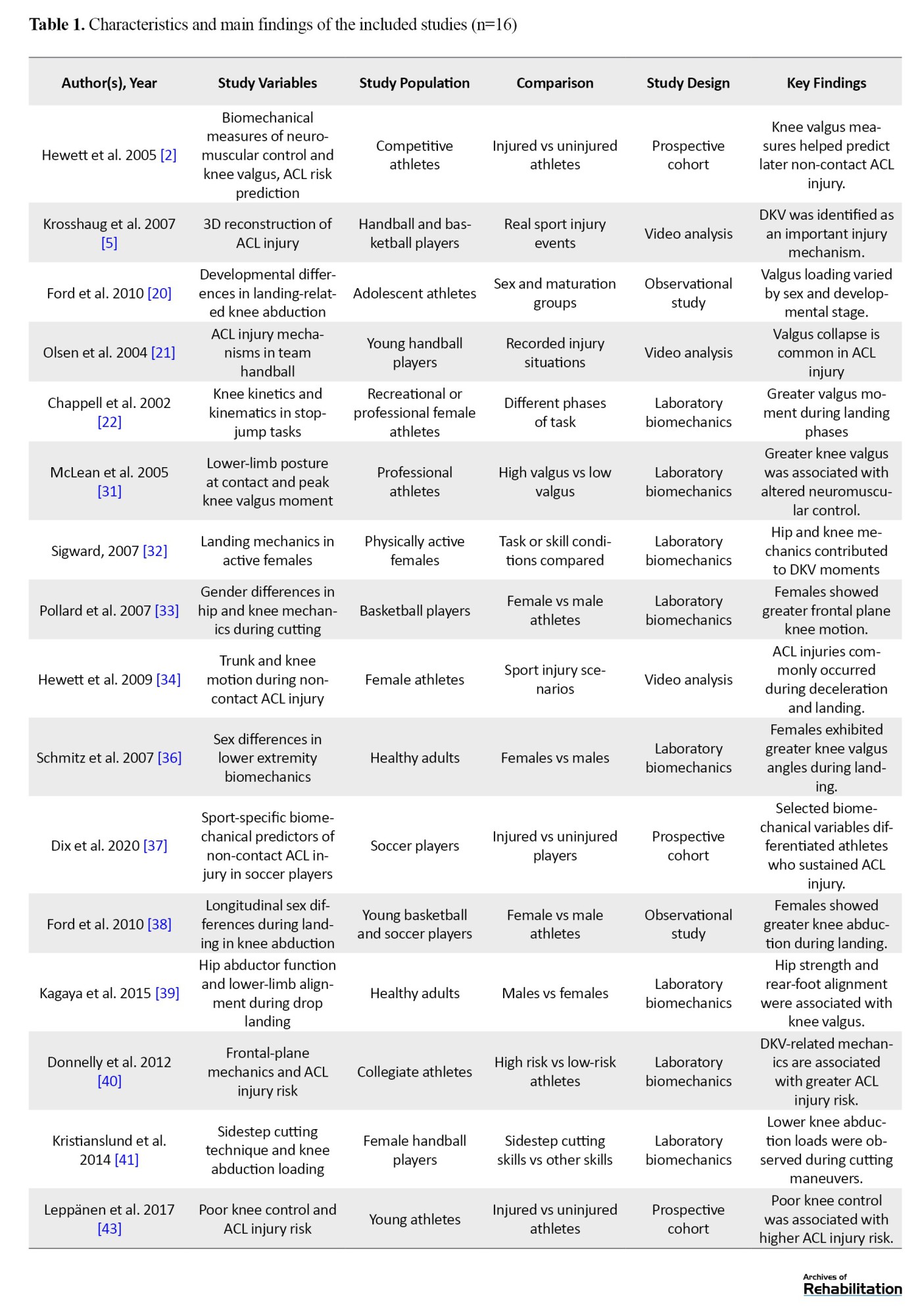
The included studies varied in design. Four were prospective cohort studies with longitudinal follow-up of ACL injury [2, 35, 37, 43], three were based on video analysis of recorded ACL injuries [5, 8, 21], and nine were laboratory-based or cross-sectional studies [22, 31-33, 36, 37-41]. Participants were mainly young competitive or active athletes, approximately 16-25 years old, from sports with frequent jumping and pivoting demands, including basketball, volleyball, soccer, handball, and track and field. Reported sample sizes ranged from 16 to 205. Most studies (85%) measured kinematics and kinetics with 3D motion analysis and force plates. Other studies used 2D video analysis, electromyography, or modeling tools such as OpenSim. The most commonly used landing tasks were drop vertical jump, single-leg landing, jump landing, and stop-jump maneuvers. Approximately 30% of the studies included gender-based comparisons, which generally showed larger DKV in females (Table 1).
Quality assessment using the modified Downs and Black checklist showed scores ranged from 14 to 15 (Table 2), with a mean score of 14.2±0.4.
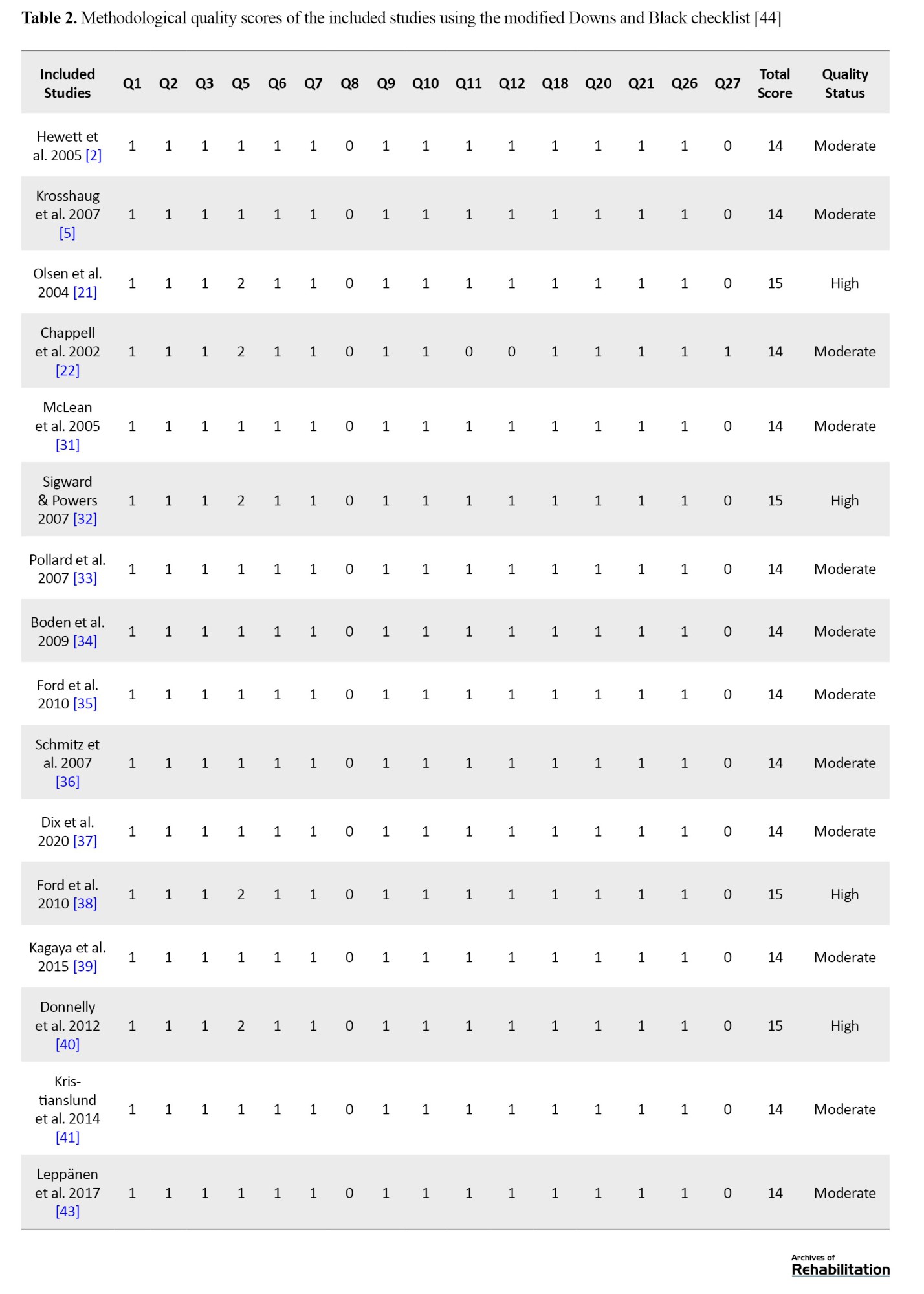
Four studies (25%) were categorized as high quality, and 12(75%) as moderate quality. No study was rated as low quality. Strengths of the included studies included clear reporting of hypotheses, results, and participant characteristics, while their weaknesses were the absence of sample size/power calculations in nearly 95% of studies, and incomplete control of confounders such as age, sex, and competitive level in about 70% of the studies. No article was removed from the review based on quality scores.
Association between dynamic knee valgus and non-contact anterior cruciate ligament injury risk
Across 7 studies that used video analyses or injury simulations, common patterns prior to ACL injury included offensive pressing/tackling (44%) [47], being tackled by an opponent [10, 49], balance recovery after shooting [11, 24, 47], or uncontrolled landing from a jump [24, 47, 48]. Most injuries (88%) were classified as non-contact, although indirect contacts, such as close opponent presence without direct knee contact, were also common [10, 47]. The most frequent mechanical pattern was multi-planar knee valgus loading characterized by frontal-plane knee abduction together with hip adduction/internal rotation and lateral trunk flexion in 81% of cases [10, 24, 49, 50]. Modulating factors such as neuromuscular fatigue, dual-skill cognitive loading, and decreased core muscle stability were shown to significantly exacerbate the severity of DKV (P<0.05) [11, 50, 51].
Gender differences
The reviewed studies showed gender-related differences in DKV biomechanics during landing. Females generally reached higher peak knee abduction angles than males in the landing phase (mean difference=4-10 degrees, P<0.001, Cohen’s d=0.8-1.2, reflecting a large effect size) [2, 22, 32, 33, 35, 36, 38]. This difference was significantly greater during single-leg landings (mean difference=7-10 degrees) than in double-leg landings (mean difference=4-6 degrees) [32, 36, 38]. In addition to kinematics, peak knee abduction moment was also significantly higher in women than in men (mean difference=15-25 Nm, P<0.01, Cohen’s d=0.6-0.9, reflecting a medium to large effect size) [22, 33], multi-plane movement patterns further indicated that females had different lower-extremity and trunk biomechanical patterns. Compared to men, women showed significantly greater hip adduction and internal rotation (mean differences=5-8 degrees, P<0.05, Cohen’s d=0.5-0.7) [2, 33], lower knee flexion at initial contact (mean differences=8-12 degrees, P<0.01) [2, 34], and greater lateral trunk displacement (30-40%, P<0.05) [39]. These gender-specific differences were most pronounced within 40-100 ms after initial ground contact, the interval in which peak vertical GRF and high mechanical loading on the ACL typically occur [5, 21].
Discussion
This systematic review indicated that DKV during landing is a clinically relevant, observable, and modifiable biomechanical risk factor of non-contact ACL injury in athletes. Fourteen of the 16 included studies (88%) reported a positive association between greater DKV and higher ACL injury risk. This biomechanical pattern is particularly prominent during the initial deceleration phase after initial foot contact with the ground (40–100 ms) and is consistent with mechanisms observed in video analyses of real-life injuries [10, 11]. Our findings are consistent with those of Cronström et al. [23], whose systematic review and meta-analysis identified knee abduction moment as a prospective predictor of ACL injury. In a classic prospective cohort, Hewett et al. [2] showed that laboratory-based valgus predicted subsequent ACL injury in female athletes. More recently, Sigurðsson et al. [52] proposed the early peak knee abduction moment as an independent risk factor in young athletes, confirming the importance of the time of valgus loading in addition to its magnitude. Two studies that did not identify a significant relationship [36, 53] generally had smaller sample sizes or shorter follow-up periods, which can reduce statistical power.
Significant gender differences were evident across studies; women consistently demonstrated greater DKV (4–8 degrees) with a medium to large effect size, as well as greater hip internal rotation angles and greater lateral trunk displacement during landing [32, 33, 36, 38]. Men more often showed inter-limb asymmetry rather than bilateral valgus dominance. Plausible mechanisms include relative weakness of the hip abductors and external rotators that impair frontal plane control [39], larger Q-angle in women that increases valgus loading; and hormonal effects on ligament laxity that vary during different phases of the menstrual cycle [54]. These mechanisms may exacerbate ACL strain by combining knee valgus and internal rotation moments under multi-planar forces [49]. These gender-specific patterns likely contribute to the 4–8-fold higher rate of ACL injury in female athletes and justify the need for gender-specific prevention programs [2, 55].
The association between DKV and ACL injury risk was consistently stronger in single-leg landing tasks than in double-leg landing tasks (mean valgus difference 8–12 degrees) [56, 57]. Single-leg landings increase valgus due to the smaller base of support, higher asymmetric load, and greater neuromuscular demand. This finding is consistent with video analyses of real-life injuries, which show that most non-contact ACL injuries occur during single-leg tasks such as landing after a jump, balance recovery after a shot, or sudden deceleration [47, 58]. In these situations, the common biomechanical pattern was multiplane valgus loading with simultaneous knee abduction, hip adduction/internal rotation, and lateral trunk displacement, observed in 81% of analyzed cases [10, 24, 49]. Clinically, this finding supports the inclusion of a single-leg landing task in screening protocols for athletes at higher risk of ACL injury.
Several modifiable intrinsic factors were repeatedly associated with larger DKV, including weakness of the hip abductors and external rotators, restricted ankle dorsiflexion, and inadequate core stability [39, 59-61]. Fatigue and dual cognitive task conditions further increased valgus severity [62]. These factors highlight the importance of trunk control and fatigue resistance for preserving lower-limb alignment during sport-specific demands. From a clinical perspective, our finding regarding the key role of hip abductor weakness in valgus directly supports exercises such as single-leg squats and resistance band training found in prevention programs like FIFA 11+ and PEP [25, 63]. Furthermore, screening protocols using accessible tools—such as 2D video or IMUs—can identify high-risk athletes prior to injury and enable early intervention [12, 15]. Gender-specific strategies also appear essential, particularly given the distinct biomechanical patterns of women, which justify the targeted focus of neuromuscular programs [2, 55].
While the association between DKV and ACL injury risk was strong, methodological heterogeneity complicated the interpretation of findings. The diversity of measurement techniques—ranging from 3D motion capture as the gold standard to 2D video analysis and IMUs—influences the accuracy and comparability of DKV assessments [12, 15]. The definition of the high valgus threshold also varied widely across studies (5-15 degrees), affected by the type of landing task, testing instructions, jump height, and fatigue status [18, 19]. This diversity limits the establishment of global risk thresholds and underscores the urgent need for methodological standardization in future research. Furthermore, limitations such as small sample sizes, the failure to calculate statistical power (in 95% of studies), and inadequate adjustment for confounding variables introduce potential bias [40]. Overall, this heterogeneity precluded a quantitative meta-analysis and highlights the need for future research to incorporate standardized measurement protocols, long-term follow-up with precise injury recording, and more diverse populations—including men, older athletes, and individuals across various competitive levels [23, 42].
This systematic review had some limitations. Excluding non-English studies and retrospective designs may have reduced the available evidence and introduced language or publication bias, although these restrictions were applied to maintain methodological consistency. The search was done in major databases only up to December 2025, and grey literature and newer records may not have been captured. Heterogeneity in valgus assessment methods, including 3D, 2D, and video-based approaches, as well as variation in high valgus definitions and landing protocols, made meta-analysis inappropriate. The included studies also differed in design. Some were prospective cohorts with injury follow-up, whereas others were laboratory cross-sectional studies or video analyses. This design diversity limits direct comparability and should be considered when interpreting the results. In addition, the evidence focused mainly on young female athletes, which limits generalization to male and older athletes, or those with other competitive levels. Moreover, inconsistent reporting of confounders (e.g. fatigue, dual-task conditions, and hormonal effects) and the failure to calculate statistical power in most studies may affect the accuracy of risk estimates. Finally, the exclusive focus on landing mechanics may overlook the contribution of DKV in other high-risk movements such as cutting and pivoting. Future studies should prioritize standardized protocols, longer follow-ups, better control of confounders, and inclusion of more diverse populations to provide stronger evidence. Greater methodological consistency would enable meta-analyses in future studies.
Conclusion
The DKV during landing in female athletes and during single-leg tasks is strongly associated with non-contact ACL injury risk. Although measurement methods, landing protocols, and high-valgus criteria differs across studies, the evidence consistently supports a meaningful clinical relationship between DKV and ACL injury risk. Neuromuscular training programs that target lower-limb alignment, hip strength, trunk stability, core muscles, and fatigue resistance may reduce ACL injury incidence in high-risk athletes. Future research should establish standardized assessment procedures and conduct rigorous prospective studies to define risk mechanisms, valgus thresholds, and optimized preventive strategies more precisely.
Ethical Considerations
Compliance with ethical guidelines
This is a systematic review with no human or animal samples. Therefore, no ethical approval code was needed.
Funding
This research did not receive any specific grant from funding agencies in the public, commercial, or not-for profit sectors.
Authors' contributions
Conceptualization, study design, methodology, systematic search, screening, data extraction, review and editing: Neda Nematzadeh and Ali Fatahi; Data interpretation, supervision, and project administration: Ali Fatahi; Writing the initial draft: Neda Nematzadeh.
Conflict of interest
The authors declared no conflict of interest.
Statement on the use of AI tools
The authors used large language model (LLM) tools only for grammatical and structural editing and improving readability. The authors are responsible for the content, data analysis, and results of the manuscript.
References
Full-Text: (153 Views)
Introduction
Dynamic knee valgus (DKV) is an abnormal lower-limb movement pattern in which the knee joint center moves medially while knee abduction increases, along with hip adduction, hip internal rotation, and subtalar pronation [1, 2]. It is commonly seen during initial foot contact with the ground and when the vertical ground reaction (VGR) force reaches its peak during landing [3]. Because this movement pattern can increase anterior cruciate ligament (ACL) loading, it has been discussed as an important biomechanical marker of potential ACL injury [4]. Several biomechanical studies further suggest that knee valgus collapse, particularly when combined with limited knee flexion, may help explain sex-related differences in ACL injury incidence [2, 5]. Effective landing requires coordinated neuromuscular control to maintain proper lower limb alignment [6, 7]. When this control is inadequate, knee valgus collapse occurs, ACL pressure increases, and ligament strain rises significantly [2, 8]. Prospective studies show that female athletes with higher knee abduction moments during landing are at higher risk of ACL injury during sport competitions [2, 9]. Video analyses of real injury events have also indicated that ACL rupture often occurs approximately 40 milliseconds after initial contact, with rapid knee valgus collapse [10, 11].
Different approaches have been used to assess knee valgus in landing tasks, including three-dimensional (3D) motion capture, two-dimensional (2D) video analysis, force plate methods, and structured video review [12]. However, heterogeneity in measurement techniques, landing tasks (e.g. jump-landing, vertical jump, single-leg landing), and levels used to define “high valgus” has made it challenging to draw consistent conclusions from the existing literature [13, 14]. Although 3D motion analysis is usually considered the reference method, 2D video and inertial measurement units (IMUs) are increasingly used for clinically feasible and field-based screening [12, 15]. Recent markerless motion capture systems and IMU-based methods have offered promising options that enable field assessment with improved reliability [16]. The landing task itself also affect the magnitude of DKV. Single-leg landings, for example, generally impose greater knee valgus than double-leg landings because the base of support is reduced and load asymmetry is greater [16]. Landing instructions, landing height, and fatigue can further modulate knee kinematics [17]. As a result, proposed thresholds for high valgus have varied widely (from about 5 degrees in controlled laboratory settings to more than 15 degrees in game-like conditions), making inter-study comparisons difficult [18]. This methodological diversity has improved measurement accuracy but has produced uncertainty about the actual DKV threshold associated with ACL injury risk, highlighting the need for systematic synthesis and standardization [19].
Several systematic review studies have examined biomechanical predictors of ACL injury and many have identified DKV as a risk factor [7, 20]. However, many of these studies have combined landing with motor skills such as cutting, pivoting, and deceleration tasks, making it difficult to determine the specific role of valgus during landing [21, 22]. While these studies identified DKV as an important risk factor, they were unable to determine whether DKV during landing alone independently predicts the risk of non-contact ACL injury [7, 23]. To date, no systematic review has comprehensively and exclusively focused on assessing the quantitative association between DKV angle during landing and the risk of non-contact ACL injury [7]. Furthermore, landing is a modifiable and trainable skill. Unlike cutting or pivoting, which is an innate skill that cannot be trained, landing mechanics can be targeted through interventions based on power and neuromuscular programs, such as FIFA 11+ or PEP programs, that emphasize valgus control and proper lower limb alignment [24, 25]. A comprehensive review focusing exclusively on the biomechanics of landing-related DKV is necessary to clarify level values, refine screening protocols, and guide preventive exercise strategies. Therefore, this systematic review aimed to synthesize evidence on the association between DKV during landing tasks and non-contact ACL injury risk. By concentrating on landing, the review seeks to define the role of DKV biomechanics more precisely and to support evidence-based screening and prevention strategies.
Materials and Methods
This is a systematic review conducted and reported in accordance with the preferred reporting items for systematic reviews and meta-analyses (PRISMA) 2020, statement [26, 27]. The eligibility criteria was organized according to the PICO model [28]: Population (P) included healthy athletes with no previous ACL injury, exposure (E) included DKV during landing, comparison (C) included athletes with higher DKV versus lower DKV, and outcome (O) included non-contact ACL injury verified by clinical assessment, MRI, or surgery. Therefore, we included studies that measured DKV (defined as peak frontal-plane knee abduction angle or peak knee abduction moment) during a standardized landing task, such as single-leg landing, double-leg jump-landing, drop vertical jump, or stop jump; evaluated the relationship between DKV and either the risk or the mechanism of non-contact ACL injury; examined healthy athletes without a previous ACL injury; and had available full-text articles written in English. Cadaveric studies, systematic reviews, and studies without biomechanical information on DKV during landing were excluded.
Relevant articles published up to December 2025 were identified through searching in Medline/Pubmed, Web of Science, Scopus, ScienceDirect, the Cochrane Library, SpringerLink, and Google Scholar. Reference lists of the included papers were also searched manually. The keywords and terms for search were drawn from standardized terminology and earlier systematic reviews [29, 30], and were used as follows: (“dynamic knee valgus” OR “knee valgus” OR “knee abduction angle” OR “knee abduction moment”) AND (“landing” OR “drop jump” OR “single-leg landing” OR “double-leg landing” OR “stop-jump” OR “vertical jump landing”) AND (“anterior cruciate ligament” OR “ACL”) AND (“prospective” OR “cohort” OR “longitudinal” OR “injury risk” OR “non-contact ACL injury”). A search was also applied in national databases, including the Scientific Information Database (SID), Medlib, IranMedex, IranDoc, and MagIran, using Persian equivalents of the search terms.
After compiling all records, two authors screened titles and abstracts independently. Articles that met the predefined eligibility criteria were moved to the full-text screening stage; otherwise, they were excluded. Disagreements about inclusion between authors were settled through discussion until consensus was reached.
Methodological quality of selected studies was assessed independently using the modified Downs and Black checklist [42]. Differences between authors were resolved by consensus. We selected 16 items suitable for observational studies from the original 27-item instrument. Item 5, concerning the reporting and control of confounding, was scored from 0 to 2, while other items were scored as 0 or 1. The maximum score was 17; high quality was defined as 15 to 17, moderate quality as 12 to 14, and low quality as less than 12.
Results
Study selection
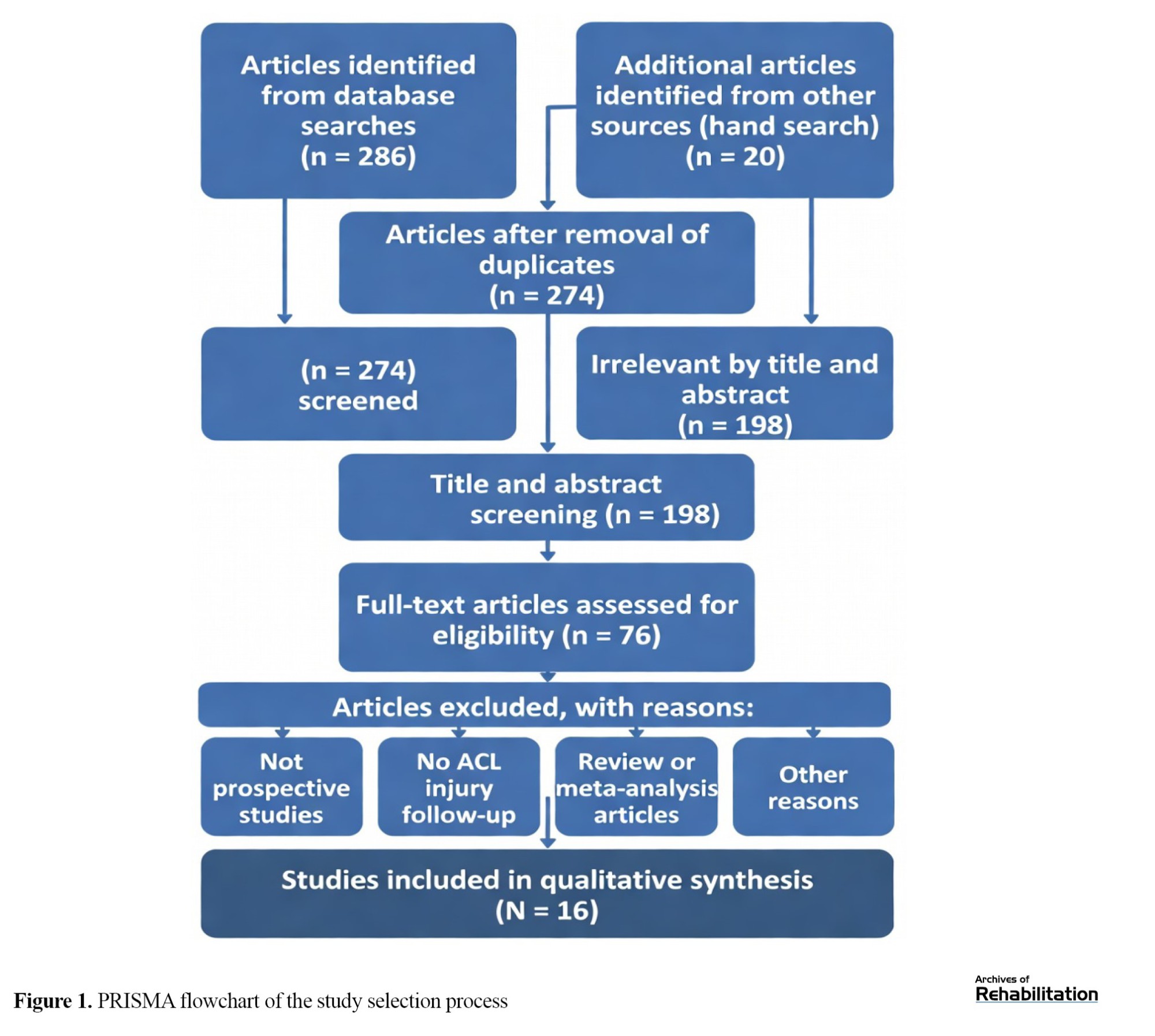
The initial search yielded 456 records. After removing 182 duplicates, titles and abstracts of 274 studies were screened. At this stage, 198 records were excluded because they did not meet the inclusion criteria, most commonly because they used cross-sectional designs without longitudinal follow-up of ACL injury, focused on non-landing tasks. Seventy-six full-text articles were then reviewed, of which 16 met all eligibility criteria (Figure 1).
Study characteristics
The included studies varied in design. Four were prospective cohort studies with longitudinal follow-up of ACL injury [2, 35, 37, 43], three were based on video analysis of recorded ACL injuries [5, 8, 21], and nine were laboratory-based or cross-sectional studies [22, 31-33, 36, 37-41]. Participants were mainly young competitive or active athletes, approximately 16-25 years old, from sports with frequent jumping and pivoting demands, including basketball, volleyball, soccer, handball, and track and field. Reported sample sizes ranged from 16 to 205. Most studies (85%) measured kinematics and kinetics with 3D motion analysis and force plates. Other studies used 2D video analysis, electromyography, or modeling tools such as OpenSim. The most commonly used landing tasks were drop vertical jump, single-leg landing, jump landing, and stop-jump maneuvers. Approximately 30% of the studies included gender-based comparisons, which generally showed larger DKV in females (Table 1).
Quality assessment using the modified Downs and Black checklist showed scores ranged from 14 to 15 (Table 2), with a mean score of 14.2±0.4.
Four studies (25%) were categorized as high quality, and 12(75%) as moderate quality. No study was rated as low quality. Strengths of the included studies included clear reporting of hypotheses, results, and participant characteristics, while their weaknesses were the absence of sample size/power calculations in nearly 95% of studies, and incomplete control of confounders such as age, sex, and competitive level in about 70% of the studies. No article was removed from the review based on quality scores.
Association between dynamic knee valgus and non-contact anterior cruciate ligament injury risk
Across 7 studies that used video analyses or injury simulations, common patterns prior to ACL injury included offensive pressing/tackling (44%) [47], being tackled by an opponent [10, 49], balance recovery after shooting [11, 24, 47], or uncontrolled landing from a jump [24, 47, 48]. Most injuries (88%) were classified as non-contact, although indirect contacts, such as close opponent presence without direct knee contact, were also common [10, 47]. The most frequent mechanical pattern was multi-planar knee valgus loading characterized by frontal-plane knee abduction together with hip adduction/internal rotation and lateral trunk flexion in 81% of cases [10, 24, 49, 50]. Modulating factors such as neuromuscular fatigue, dual-skill cognitive loading, and decreased core muscle stability were shown to significantly exacerbate the severity of DKV (P<0.05) [11, 50, 51].
Gender differences
The reviewed studies showed gender-related differences in DKV biomechanics during landing. Females generally reached higher peak knee abduction angles than males in the landing phase (mean difference=4-10 degrees, P<0.001, Cohen’s d=0.8-1.2, reflecting a large effect size) [2, 22, 32, 33, 35, 36, 38]. This difference was significantly greater during single-leg landings (mean difference=7-10 degrees) than in double-leg landings (mean difference=4-6 degrees) [32, 36, 38]. In addition to kinematics, peak knee abduction moment was also significantly higher in women than in men (mean difference=15-25 Nm, P<0.01, Cohen’s d=0.6-0.9, reflecting a medium to large effect size) [22, 33], multi-plane movement patterns further indicated that females had different lower-extremity and trunk biomechanical patterns. Compared to men, women showed significantly greater hip adduction and internal rotation (mean differences=5-8 degrees, P<0.05, Cohen’s d=0.5-0.7) [2, 33], lower knee flexion at initial contact (mean differences=8-12 degrees, P<0.01) [2, 34], and greater lateral trunk displacement (30-40%, P<0.05) [39]. These gender-specific differences were most pronounced within 40-100 ms after initial ground contact, the interval in which peak vertical GRF and high mechanical loading on the ACL typically occur [5, 21].
Discussion
This systematic review indicated that DKV during landing is a clinically relevant, observable, and modifiable biomechanical risk factor of non-contact ACL injury in athletes. Fourteen of the 16 included studies (88%) reported a positive association between greater DKV and higher ACL injury risk. This biomechanical pattern is particularly prominent during the initial deceleration phase after initial foot contact with the ground (40–100 ms) and is consistent with mechanisms observed in video analyses of real-life injuries [10, 11]. Our findings are consistent with those of Cronström et al. [23], whose systematic review and meta-analysis identified knee abduction moment as a prospective predictor of ACL injury. In a classic prospective cohort, Hewett et al. [2] showed that laboratory-based valgus predicted subsequent ACL injury in female athletes. More recently, Sigurðsson et al. [52] proposed the early peak knee abduction moment as an independent risk factor in young athletes, confirming the importance of the time of valgus loading in addition to its magnitude. Two studies that did not identify a significant relationship [36, 53] generally had smaller sample sizes or shorter follow-up periods, which can reduce statistical power.
Significant gender differences were evident across studies; women consistently demonstrated greater DKV (4–8 degrees) with a medium to large effect size, as well as greater hip internal rotation angles and greater lateral trunk displacement during landing [32, 33, 36, 38]. Men more often showed inter-limb asymmetry rather than bilateral valgus dominance. Plausible mechanisms include relative weakness of the hip abductors and external rotators that impair frontal plane control [39], larger Q-angle in women that increases valgus loading; and hormonal effects on ligament laxity that vary during different phases of the menstrual cycle [54]. These mechanisms may exacerbate ACL strain by combining knee valgus and internal rotation moments under multi-planar forces [49]. These gender-specific patterns likely contribute to the 4–8-fold higher rate of ACL injury in female athletes and justify the need for gender-specific prevention programs [2, 55].
The association between DKV and ACL injury risk was consistently stronger in single-leg landing tasks than in double-leg landing tasks (mean valgus difference 8–12 degrees) [56, 57]. Single-leg landings increase valgus due to the smaller base of support, higher asymmetric load, and greater neuromuscular demand. This finding is consistent with video analyses of real-life injuries, which show that most non-contact ACL injuries occur during single-leg tasks such as landing after a jump, balance recovery after a shot, or sudden deceleration [47, 58]. In these situations, the common biomechanical pattern was multiplane valgus loading with simultaneous knee abduction, hip adduction/internal rotation, and lateral trunk displacement, observed in 81% of analyzed cases [10, 24, 49]. Clinically, this finding supports the inclusion of a single-leg landing task in screening protocols for athletes at higher risk of ACL injury.
Several modifiable intrinsic factors were repeatedly associated with larger DKV, including weakness of the hip abductors and external rotators, restricted ankle dorsiflexion, and inadequate core stability [39, 59-61]. Fatigue and dual cognitive task conditions further increased valgus severity [62]. These factors highlight the importance of trunk control and fatigue resistance for preserving lower-limb alignment during sport-specific demands. From a clinical perspective, our finding regarding the key role of hip abductor weakness in valgus directly supports exercises such as single-leg squats and resistance band training found in prevention programs like FIFA 11+ and PEP [25, 63]. Furthermore, screening protocols using accessible tools—such as 2D video or IMUs—can identify high-risk athletes prior to injury and enable early intervention [12, 15]. Gender-specific strategies also appear essential, particularly given the distinct biomechanical patterns of women, which justify the targeted focus of neuromuscular programs [2, 55].
While the association between DKV and ACL injury risk was strong, methodological heterogeneity complicated the interpretation of findings. The diversity of measurement techniques—ranging from 3D motion capture as the gold standard to 2D video analysis and IMUs—influences the accuracy and comparability of DKV assessments [12, 15]. The definition of the high valgus threshold also varied widely across studies (5-15 degrees), affected by the type of landing task, testing instructions, jump height, and fatigue status [18, 19]. This diversity limits the establishment of global risk thresholds and underscores the urgent need for methodological standardization in future research. Furthermore, limitations such as small sample sizes, the failure to calculate statistical power (in 95% of studies), and inadequate adjustment for confounding variables introduce potential bias [40]. Overall, this heterogeneity precluded a quantitative meta-analysis and highlights the need for future research to incorporate standardized measurement protocols, long-term follow-up with precise injury recording, and more diverse populations—including men, older athletes, and individuals across various competitive levels [23, 42].
This systematic review had some limitations. Excluding non-English studies and retrospective designs may have reduced the available evidence and introduced language or publication bias, although these restrictions were applied to maintain methodological consistency. The search was done in major databases only up to December 2025, and grey literature and newer records may not have been captured. Heterogeneity in valgus assessment methods, including 3D, 2D, and video-based approaches, as well as variation in high valgus definitions and landing protocols, made meta-analysis inappropriate. The included studies also differed in design. Some were prospective cohorts with injury follow-up, whereas others were laboratory cross-sectional studies or video analyses. This design diversity limits direct comparability and should be considered when interpreting the results. In addition, the evidence focused mainly on young female athletes, which limits generalization to male and older athletes, or those with other competitive levels. Moreover, inconsistent reporting of confounders (e.g. fatigue, dual-task conditions, and hormonal effects) and the failure to calculate statistical power in most studies may affect the accuracy of risk estimates. Finally, the exclusive focus on landing mechanics may overlook the contribution of DKV in other high-risk movements such as cutting and pivoting. Future studies should prioritize standardized protocols, longer follow-ups, better control of confounders, and inclusion of more diverse populations to provide stronger evidence. Greater methodological consistency would enable meta-analyses in future studies.
Conclusion
The DKV during landing in female athletes and during single-leg tasks is strongly associated with non-contact ACL injury risk. Although measurement methods, landing protocols, and high-valgus criteria differs across studies, the evidence consistently supports a meaningful clinical relationship between DKV and ACL injury risk. Neuromuscular training programs that target lower-limb alignment, hip strength, trunk stability, core muscles, and fatigue resistance may reduce ACL injury incidence in high-risk athletes. Future research should establish standardized assessment procedures and conduct rigorous prospective studies to define risk mechanisms, valgus thresholds, and optimized preventive strategies more precisely.
Ethical Considerations
Compliance with ethical guidelines
This is a systematic review with no human or animal samples. Therefore, no ethical approval code was needed.
Funding
This research did not receive any specific grant from funding agencies in the public, commercial, or not-for profit sectors.
Authors' contributions
Conceptualization, study design, methodology, systematic search, screening, data extraction, review and editing: Neda Nematzadeh and Ali Fatahi; Data interpretation, supervision, and project administration: Ali Fatahi; Writing the initial draft: Neda Nematzadeh.
Conflict of interest
The authors declared no conflict of interest.
Statement on the use of AI tools
The authors used large language model (LLM) tools only for grammatical and structural editing and improving readability. The authors are responsible for the content, data analysis, and results of the manuscript.
References
- Norasteh AA, Fadaei Dehcheshmeh M, Shamlou Kazemi A. [The Role of Dynamic Knee Valgus in Occurrence of Knee Injuries: A Review Study. (Persian)] Scientific Journal of Rehabilitation Medicine. 2023; 12(2):186-201. [DOI:10.32598/SJRM.12.2.10]
- Hewett TE, Myer GD, Ford KR, Heidt RS Jr, Colosimo AJ, McLean SG, et al. Biomechanical measures of neuromuscular control and valgus loading of the knee predict anterior cruciate ligament injury risk in female athletes: A prospective study. The American Journal of Sports Medicine. 2005; 33(4):492-501. [DOI:10.1177/0363546504269591] [PMID]
- Abbasi S, Rahmatzadeh D, Minoonejad H, Mousavi SH. The effect of fatigue on dynamic knee valgus during landing tasks: A systematic review and meta-analysis. BMC Sports Science, Medicine and Rehabilitation. 2025; 17(1):166. [DOI:10.1186/s13102-025-01205-3] [PMID]
- Teng PSP, Kong PW, Leong KF. Effects of foot rotation positions on knee valgus during single-leg drop landing: Implications for ACL injury risk reduction. The Knee. 2017; 24(3):547-54. [DOI:10.1016/j.knee.2017.01.014] [PMID]
- Krosshaug T, Slauterbeck JR, Engebretsen L, Bahr R. Biomechanical analysis of anterior cruciate ligament injury mechanisms: three-dimensional motion reconstruction from video sequences. Scandinavian Journal of Medicine & Science in Sports. 2007; 17(5):508-19. [DOI:10.1111/j.1600-0838.2006.00558.x] [PMID]
- Padua DA, Marshall SW, Boling MC, Thigpen CA, Garrett WE Jr, Beutler AI. The Landing Error Scoring System (LESS) is a valid and reliable clinical assessment tool of jump-landing biomechanics: The JUMP-ACL study. The American Journal of Sports Medicine. 2009; 37(10):1996-2002. [DOI:10.1177/0363546509343200] [PMID]
- Larwa J, Stoy C, Chafetz RS, Boniello M, Franklin C. Stiff landings, core stability, and dynamic knee valgus: a systematic review on documented anterior cruciate ligament ruptures in male and female athletes. International Journal of Environmental Research and Public Health. 2021; 18(7):3826. [DOI:10.3390/ijerph18073826] [PMID]
- Hewett TE, Torg JS, Boden BP. Video analysis of trunk and knee motion during non-contact anterior cruciate ligament injury in female athletes: Lateral trunk and knee abduction motion are combined components of the injury mechanism. British Journal of Sports Medicine. 2009; 43(6):417-22. [DOI:10.1136/bjsm.2009.059162] [PMID]
- Myer GD, Ford KR, Khoury J, Succop P, Hewett TE. Biomechanics laboratory-based prediction algorithm to identify female athletes with high knee loads that increase risk of ACL injury. British Journal of Sports Medicine. 2011; 45(4):245-52. [DOI:10.1136/bjsm.2009.069351] [PMID]
- Koga H, Nakamae A, Shima Y, Iwasa J, Myklebust G, Engebretsen L, et al. Mechanisms for noncontact anterior cruciate ligament injuries: knee joint kinematics in 10 injury situations from female team handball and basketball. The American Journal of Sports Medicine. 2010; 38(11):2218-25. [DOI:10.1177/0363546510373570] [PMID]
- Sundberg A, Högberg J, Tosarelli F, Buckthorpe M, Della Villa F, Hägglund M, et al. Sport-Specific Injury Mechanisms and Situational Patterns of ACL Injuries: A Comprehensive Systematic Review: A. Sports Medicine. 2025; 55(10):2489-527. [DOI:10.1007/s40279-025-02271-w] [PMID]
- Erdman A, Loewen A, Dressing M, Wyatt C, Oliver G, Butler L, et al. A 2D video-based assessment is associated with 3D biomechanical contributors to dynamic knee valgus in the coronal plane. Frontiers in Sports and Active Living. 2024; 6:1352286. [DOI:10.3389/fspor.2024.1352286] [PMID]
- Alanazi SA, Alamrani SA, Bajuaifer SS, Alhammad L, Alotaibi N, Alrashdi NZ, et al. “Returning to Sport Is Not Just About the Knee”: Physiotherapists’ Experiences of the Management of Anterior Cruciate Ligament Injury: A Qualitative Study. Journal of Clinical Medicine. 2025; 14(20):7301. [DOI:10.3390/jcm14207301] [PMID]
- D’Onofrio R, Alashram AR, Annino G, Masucci M, Romagnoli C, Padua E, et al. Prevention of secondary injury after anterior cruciate ligament reconstruction: Relationship between pelvic-drop and dynamic knee valgus. International Journal of Environmental Research and Public Health. 2023; 20(4):3063. [DOI:10.3390/ijerph20043063] [PMID]
- Schurr SA, Marshall AN, Resch JE, Saliba SA. Two-dimensional video analysis is comparable to 3D motion capture in lower extremity movement assessment. International Journal of Sports Physical Therapy. 2017; 12(2):163-72. [PMID]
- Fan B, Xia H, Xu J, Li Q, Shull PB. IMU-based knee flexion, abduction and internal rotation estimation during drop landing and cutting tasks. Journal of Biomechanics. 2021; 124:110549. [DOI:10.1016/j.jbiomech.2021.110549] [PMID]
- Hasani Chenari R, Mohammad Ali Nasab Firouzjah E, Roshani S. The effect of Stop X exercises on balance, strength and range of motion of male adolescent football players with dynamic knee valgus. Scientific Reports. 2025; 15(1):18213. [DOI:10.1038/s41598-025-00840-7] [PMID]
- Belkhelladi M, Cierson T, Martineau PA. Biomechanical Risk Factors for Increased Anterior Cruciate Ligament Loading and Injury: A Systematic Review. Orthopaedic Journal of Sports Medicine. 2025; 13(2):23259671241312681. [DOI:10.1177/23259671241312681] [PMID]
- Wilczyński B, Wąż P, Zorena K, editors. Impact of three strengthening exercises on dynamic knee valgus and balance with poor knee control among young football players: A randomized controlled trial. Healthcare. 2021; 9(5):558. [DOI:10.3390/healthcare9050558] [PMID]
- Ford KR, Myer GD, Hewett TE. Valgus knee motion during landing in high school female and male basketball players. Medicine and Science in Sports and Exercise. 2003; 35(10):1745-50.[DOI:10.1249/01.MSS.0000089346.85744.D9] [PMID]
- Olsen OE, Myklebust G, Engebretsen L, Bahr R. Injury mechanisms for anterior cruciate ligament injuries in team handball: A systematic video analysis. The American Journal of Sports Medicine. 2004; 32(4):1002-12. [DOI:10.1177/0363546503261724] [PMID]
- Chappell JD, Yu B, Kirkendall DT, Garrett WE. A comparison of knee kinetics between male and female recreational athletes in stop-jump tasks. The American Journal of Sports Medicine. 2002; 30(2):261-7. [DOI:10.1177/03635465020300021901] [PMID]
- Cronström A, Creaby MW, Ageberg E. Do knee abduction kinematics and kinetics predict future anterior cruciate ligament injury risk? A systematic review and meta-analysis of prospective studies. BMC musculoskeletal disorders. 2020; 21(1):563. [DOI:10.1186/s12891-020-03552-3] [PMID]
- Kiapour AM, Quatman CE, Goel VK, Wordeman SC, Hewett TE, Demetropoulos CK. Timing sequence of multi-planar knee kinematics revealed by physiologic cadaveric simulation of landing: implications for ACL injury mechanism. Clinical Biomechanics. 2014; 29(1):75-82. [DOI:10.1016/j.clinbiomech.2013.10.017] [PMID]
- Bates NA, Nesbitt RJ, Shearn JT, Myer GD, Hewett TE. Relative strain in the anterior cruciate ligament and medial collateral ligament during simulated jump landing and sidestep cutting tasks: Implications for injury risk. The American Journal of Sports Medicine. 2015; 43(9):2259-69. [DOI:10.1177/0363546515589165] [PMID]
- Sohrabi C, Franchi T, Mathew G, Kerwan A, Nicola M, Griffin M, et al. PRISMA 2020 statement: What’s new and the importance of reporting guidelines. International Journal of Surgery (London, England). 2021; 88:105918. [DOI:10.1016/j.ijsu.2021.105918] [PMID]
- Torabi A, Eidiyan-Kakhki MM, Amani-Shalamzari S, Jafari M. The effect of vitamin D supplementation on physical performance of male soccer players: A Systematic review. Journal of Exercise and Health Science. 2022; 2(2):59-74. [DOI:10.22089/jehs.2024.14483.1067]
- Schiavenato M, Chu F. PICO: What it is and what it is not. Nurse Education in Practice. 2021; 56:103194. [DOI:10.1016/j.nepr.2021.103194] [PMID]
- Rinaldi VG, Prill R, Jahnke S, Zaffagnini S, Becker R. The influence of gluteal muscle strength deficits on dynamic knee valgus: A scoping review. Journal of Experimental Orthopaedics. 2022; 9(1):81. [DOI:10.1186/s40634-022-00513-8] [PMID]]
- Yalfani A, Ahmadi M, Asgarpoor A. The effect of kinetic factors of dynamic knee valgus on patellofemoral pain: A systematic review and meta-analysis. Journal of Bodywork and Movement Therapies. 2024; 37:246-53. [DOI:10.1016/j.jbmt.2023.11.001] [PMID]
- McLean SG, Huang X, Van Den Bogert AJ. Association between lower extremity posture at contact and peak knee valgus moment during sidestepping: Implications for ACL injury. Clinical Biomechanics. 2005; 20(8):863-70. [DOI:10.1016/j.clinbiomech.2005.05.007] [PMID]
- Sigward SM, Powers CM. Loading characteristics of females exhibiting excessive valgus moments during cutting. Clinical Biomechanics. 2007; 22(7):827-33. [DOI:10.1016/j.clinbiomech.2007.04.003] [PMID]
- Pollard CD, Sigward SM, Powers CM. Gender differences in hip joint kinematics and kinetics during side-step cutting maneuver. Clinical Journal of Sport Medicine. 2007; 17(1):38-42. [DOI:10.1097/JSM.0b013e3180305de8] [PMID]
- Boden BP, Torg JS, Knowles SB, Hewett TE. Video analysis of anterior cruciate ligament injury: abnormalities in hip and ankle kinematics. The American Journal of Sports Medicine. 2009; 37(2):252-9. [DOI:10.1177/0363546508328107]
- Paterno MV, Schmitt LC, Ford KR, Rauh MJ, Myer GD, Huang B, et al. Biomechanical measures during landing and postural stability predict second anterior cruciate ligament injury after anterior cruciate ligament reconstruction and return to sport. The American Journal of Sports Medicine. 2010; 38(10):1968-78. [DOI:10.1177/0363546510376053] [PMID]
- Schmitz RJ, Kulas AS, Perrin DH, Riemann BL, Shultz SJ. Sex differences in lower extremity biomechanics during single leg landings. Clinical Biomechanics. 2007; 22(6):681-8. [DOI:10.1016/j.clinbiomech.2007.03.001] [PMID]
- Dix C, Arundale A, Silvers-Granelli H, Marmon A, Zarzycki R, Snyder-Mackler L. Biomechanical measures during two sport-specific tasks differentiate between soccer players who go on to anterior cruciate ligament injury and those who do not: A prospective cohort analysis. International Journal of Sports Physical Therapy. 2020; 15(6):928-35. [DOI:10.26603/ijspt20200928] [PMID]
- Ford KR, Shapiro R, Myer GD, Van Den Bogert AJ, Hewett TE. Longitudinal sex differences during landing in knee abduction in young athletes. Medicine and Science in Sports and Exercise. 2010; 42(10):1923-31. [DOI:10.1249/MSS.0b013e3181dc99b1] [PMID]
- Kagaya Y, Fujii Y, Nishizono H. Association between hip abductor function, rear-foot dynamic alignment, and dynamic knee valgus during single-leg squats and drop landings. Journal of Sport and Health Science. 2015; 4(2):182-7. [DOI:10.1016/j.jshs.2013.08.002]
- Donnelly CJ, Lloyd DG, Elliott BC, Reinbolt JA. Optimizing whole-body kinematics to minimize valgus knee loading during sidestepping: Implications for ACL injury risk. Journal of Biomechanics. 2012; 45(8):1491-7. [DOI:10.1016/j.jbiomech.2012.02.010] [PMID]
- Kristianslund E, Faul O, Bahr R, Myklebust G, Krosshaug T. Sidestep cutting technique and knee abduction loading: Implications for ACL prevention exercises. British Journal of Sports Medicine. 2014; 48(9):779-83. [DOI:10.1136/bjsports-2012-091370] [PMID]
- Downs SH, Black N. The feasibility of creating a checklist for the assessment of the methodological quality both of randomised and non-randomised studies of health care interventions. Journal of Epidemiology & Community Health. 1998; 52(6):377-84. [DOI:10.1136/jech.52.6.377] [PMID]
- Leppänen M, Pasanen K, Kujala UM, Vasankari T, Kannus P, Äyrämö S, et al. Stiff landings are associated with increased ACL injury risk in young female basketball and floorball players. The American Journal of Sports Medicine. 2017; 45(2):386-93. [DOI:10.1177/0363546516665810] [PMID]
- Drikos S, Fatahi A, Ahmed SA, Molavian R, Giatsis G, Shakeri A. A comparative analysis of volleyball skills in balanced sets for men and women in Asian competitions. Journal of Human Sport and Exercise. 2025; 20(1):180-92. [DOI:10.55860/j7d91004]
- Mohammad Zaheri R, Majlesi M, Fatahi A. [Assessing the Effects of Fatigue on Ground Reaction Force Variations during Landing after a Spike in Professional Volleyball Players (Persian)]. Journal of Sport Biomechanics. 2024; 10(1):54-68. [DOI:10.61186/JSportBiomech.10.1.54]
- Molla RY, Fatahi A, Khezri D, Ceylan HI, Nobari H. Relationship between impulse and kinetic variables during jumping and landing in volleyball players. BMC Musculoskeletal Disorders. 2023; 24(1):619. [DOI:10.1186/s12891-023-06757-4] [PMID]
- Della Villa F, Buckthorpe M, Grassi A, Nabiuzzi A, Tosarelli F, Zaffagnini S, et al. Systematic video analysis of ACL injuries in professional male football (soccer): Injury mechanisms, situational patterns and biomechanics study on 134 consecutive cases. British Journal of Sports Medicine. 2020; 54(23):1423-32. [DOI:10.1136/bjsports-2019-101247] [PMID]
- Bates NA, Ford KR, Myer GD, Hewett TE. Kinetic and kinematic differences between first and second landings of a drop vertical jump task: Implications for injury risk assessments. Clinical Biomechanics. 2013; 28(4):459-66. [DOI:10.1016/j.clinbiomech.2013.02.013] [PMID]
- Quatman CE, Kiapour AM, Demetropoulos CK, Kiapour A, Wordeman SC, Levine JW, et al. Preferential loading of the ACL compared with the MCL during landing: a novel in sim approach yields the multiplanar mechanism of dynamic valgus during ACL injuries. The American Journal of Sports Medicine. 2014; 42(1):177-86. [DOI:10.1177/0363546513506558] [PMID]
- Hu Z, Kim Y, Zhang Y, Zhang Y, Li J, Tang X, et al. Correlation of lower limb muscle activity with knee joint kinematics and kinetics during badminton landing tasks. International Journal of Environmental Research and Public Health. 2022; 19(24):16587. [DOI:10.3390/ijerph192416587] [PMID]
- Asaeda M, Nakamae A, Hirata K, Kono Y, Uenishi H, Adachi N. Factors associated with dynamic knee valgus angle during single-leg forward landing in patients after anterior cruciate ligament reconstruction. Asia-Pacific Journal of Sports Medicine, Arthroscopy, Rehabilitation and Technology. 2020; 22:56-61. [DOI:10.1016/j.asmart.2020.07.002] [PMID]
- Sigurðsson HB, Fl Pétursdóttir MK, Briem K. The early peak knee abduction moment waveform is a novel risk factor predicting anterior cruciate ligament injury in young athletes: A prospective study. Knee Surgery, Sports Traumatology, Arthroscopy. 2025; 33(5):1677-85. [DOI:10.1002/ksa.12471] [PMID]
- Smith HC, Vacek P, Johnson RJ, Slauterbeck JR, Hashemi J, Shultz S, et al. Risk factors for anterior cruciate ligament injury: A review of the literature-part 1: Neuromuscular and anatomic risk. Sports Health. 2012; 4(1):69-78. [DOI:10.1177/1941738111428281] [PMID]
- Mozayani H., Zarei M., Movahedinia F. [Comparison of Biomechanical and Neuromuscular Risk Factors of Anterior Cruciate Ligament Injury in Different Phases of the Menstrual Cycle of Elite Female Athletes: A Systematic Review (Persian)]. Studies in Sport Medicine. 2025; 17(45):17–40. [DOI:10.22089/smj.2025.17288.1776]
- Myer GD, Sugimoto D, Thomas S, Hewett TE. The influence of age on the effectiveness of neuromuscular training to reduce anterior cruciate ligament injury in female athletes: A meta-analysis. The American Journal of Sports Medicine. 2013; 41(1):203-15. [DOI:10.1177/0363546512460637] [PMID]
- Bates NA, Ford KR, Myer GD, Hewett TE. Timing differences in the generation of ground reaction forces between the initial and secondary landing phases of the drop vertical jump. Clinical Biomechanics. 2013; 28(7):796-9. [DOI:10.1016/j.clinbiomech.2013.07.004] [PMID]
- Tamura A, Akasaka K, Otsudo T, Shiozawa J, Toda Y, Yamada K. Dynamic knee valgus alignment influences impact attenuation in the lower extremity during the deceleration phase of a single-leg landing. Plos One. 2017; 12(6):e0179810. [DOI:10.1371/journal.pone.0179810] [PMID]
- Sundberg A, Senorski RH, Högberg J, Piussi R, Samuelsson K, Thomeé R, et al. Persistent isokinetic knee flexion strength deficits at the time of return to sport are not associated with a second ACL injury. Knee Surgery, Sports Traumatology, Arthroscopy. 2025; 33(8):2971-83. [DOI:10.1002/ksa.12718] [PMID]
- Straub RK, Powers CM. Prediction of secondary ACL injury in female athletes using 2D video-based measurements obtained during dynamic tasks: A retrospective case-control study. British Journal of Sports Medicine. 2025; 59(20):1418-25. [DOI:10.1136/bjsports-2025-109886] [PMID]
- Willson JD, Dougherty CP, Ireland ML, Davis IM. Core stability and its relationship to lower extremity function and injury. JAAOS-Journal of the American Academy of Orthopaedic Surgeons. 2005; 13(5):316-25. [DOI:10.5435/00124635-200509000-00005] [PMID]
- Zazulak BT, Hewett TE, Reeves NP, Goldberg B, Cholewicki J. Deficits in neuromuscular control of the trunk predict knee injury risk: A prospective biomechanical-epidemiologic study. The American Journal of Sports Medicine. 2007; 35(7):1123-30. [DOI:10.1177/0363546507301585] [PMID]
- Hu M, Xu X, Mei J. Ankle joint pressure change before and after subtalar joint arthrodesis in varus and valgus malalignment of the tibia. Journal of Orthopaedic Surgery. 2022; 30(1):10225536221098478. [DOI:10.1177/10225536221098478] [PMID]
- Soligard T, Myklebust G, Steffen K, Holme I, Silvers H, Bizzini M, et al. Comprehensive warm-up programme to prevent injuries in young female footballers: Cluster randomised controlled trial. BMJ. 2008; 337:a2469. [DOI:10.1136/bmj.a2469] [PMID]
Type of Study: Systematic Review |
Subject:
Sport Pathology and Corrective Movements
Send email to the article author
| Rights and permissions | |
 |
This work is licensed under a Creative Commons Attribution-NonCommercial 4.0 International License. |

Copyright © The Author(s);
This is an open access article distributed under the terms of the Creative Commons Attribution-NonCommercial 4.0 (CC-By-NC 4.0), which permits use, distribution, and reproduction in any medium, provided the original work is properly cited and is not used for commercial purposes.
Contact Information
This is an open access article distributed under the terms of the Creative Commons Attribution-NonCommercial 4.0 (CC-By-NC 4.0), which permits use, distribution, and reproduction in any medium, provided the original work is properly cited and is not used for commercial purposes.
Contact Information