
Volume 27, Issue 2 (7-2026)
Arch Rehabil 2026, 27(2): 218-235 |
Back to browse issues page



Ethics code: IR.USWR.REC.1403.204


Download citation:
BibTeX | RIS | EndNote | Medlars | ProCite | Reference Manager | RefWorks
Send citation to:


BibTeX | RIS | EndNote | Medlars | ProCite | Reference Manager | RefWorks
Send citation to:
Rostaei M, Shahshahani S, Hedayati M, Vahedi M. Determining the Validity and Reliability of the Persian Version of the University of Washington Self-efficacy Scale (UW-SES) in Iranian Adults With Physical Disabilities. Arch Rehabil 2026; 27 (2) :218-235
URL: http://rehabilitationj.uswr.ac.ir/article-1-3734-en.html
URL: http://rehabilitationj.uswr.ac.ir/article-1-3734-en.html

1- Department of Rehabilitation Management, Faculty of Rehabilitation Sciences, University of Social Welfare and Rehabilitation Sciences, Tehran, Iran
2- Department of Rehabilitation Management, Pediatric Neurorehabilitation Research Centerfacultr, Faculty of Rehabilitation Sciences, University of Social Welfare and Rehabilitation Sciences, Tehran, Iran. ,sol_shah@yahoo.com
3- Department of Biostatistics and Epidemiology, Iranian Research Center on Aging, University of Social Welfare and Rehabilitation Sciences, Tehran, Iran.
2- Department of Rehabilitation Management, Pediatric Neurorehabilitation Research Centerfacultr, Faculty of Rehabilitation Sciences, University of Social Welfare and Rehabilitation Sciences, Tehran, Iran. ,
3- Department of Biostatistics and Epidemiology, Iranian Research Center on Aging, University of Social Welfare and Rehabilitation Sciences, Tehran, Iran.
Full-Text [PDF 2369 kb]
(221 Downloads)
| Abstract (HTML) (1620 Views)
Full-Text: (207 Views)
Introduction
Disability is a complex phenomenon that limits activities and restricts participation, arising from interactions between an individual’s physical or mental limitations and societal barriers [1]. According to the United Nations convention on the rights of persons with disabilities (2007), persons with disabilities include those with long-term physical, mental, intellectual, or sensory impairments that, in interaction with various barriers, may hinder their full and effective participation in society on an equal basis with others [1]. Globally, over one billion people live with some form of disability, representing about 15% of the world’s population [1]. In Iran, more than 1.6 million individuals are registered with disabilities, many facing physical-motor impairments requiring rehabilitation support [2].
Self-efficacy, defined as an individual’s belief in their ability to organize and execute actions required to achieve desired outcomes [3], plays a pivotal role in rehabilitation. It influences goal selection, effort, persistence, and resilience in the face of challenges [4-6]. For individuals with physical disabilities, such as multiple sclerosis (MS) and spinal cord injury (SCI), higher levels of self-efficacy are associated with positive outcomes such as decreasing levels of depression and anxiety, increased social participation and quality of life, and higher adherence to rehabilitation programs [7-11]. General self-efficacy tools, including the general self-efficacy scale (GSE), are available in a Persian version, but lack specificity for disabled people [4]. Specialized tools are needed to assess aspects such as managing secondary symptoms, maintaining independence, and adapting to environmental barriers. The University of Washington self-efficacy scale (UW-SES) is a 17-item tool developed specifically for adults with disabilities, focusing on confidence in managing disability-related challenges [12, 13]. It has demonstrated strong psychometric properties in English [12], Korean [14], and Dutch [15] versions. However, no Persian version of this scale exists. Therefore, this study aimed to translate the UW-SES into Persian and evaluate its validity and reliability among Iranian adults with physical disabilities.
Materials & Methods
Study design and participants
This methodological, cross-sectional study was conducted from December 2023 to November 2024 in Tehran, Iran. Participants included adults (≥18 years) with MS or SCI, diagnosed for at least one year, and classified under the international classification of functioning, disability and health (ICF) by the Iranian Welfare Organization. Exclusion criteria were cognitive impairments, acute exacerbations, or unwillingness to participate. A stratified sampling method was used to ensure a balanced distribution of age, gender, and type of disability. Based on the prevalence of MS or SCI in Tehran, approximately 32% of the sample was selected from SCI patients and 68% from MS patients. The sample size was calculated to be 230, considering 10 participants per questionnaire item (n=19) and a 20% possible sample dropout. Ethical approval was obtained from the University of Social Welfare and Rehabilitation Sciences. Informed consent was secured, ensuring confidentiality and voluntary participation.
Measures
The UW-SES, developed by Amtmann et al. [12], has 19 items rated on a 5-point Likert scale from 1 (not at all) to 5 (completely). The first 17 items are used to assess self-efficacy in managing the effects of disability on daily life, relationships, and health. Two optional items address intimate relationships and are not included in scoring. Total score ranges from 17 to 85, with higher scores indicating greater self-efficacy. The UW-SES score has very high convergent validity (r=0.832) with the chronic disease self-efficacy scale (CDSES) and high reliability (α=0.90) [12, 13].
Translation process
After obtaining permission from the authors of the main version, the UW-SES was translated to Persian according to the World Health Organization (WHO)’s guidelines by two bilingual experts and back translated to English by one independent translator. Then, two rehabilitation specialists compared the translated version with the original version and revised it in terms of clarity, conceptual equivalence, and pragmatic usage. A pilot study was done with 10 participants with disabilities to assess the comprehensibility of the questions.
Validity assessment
The content validity was evaluated by 11 experts in terms of clarity, transparency, simplicity, and relevance, followed by calculating the content validity ratio (CVR) and content validity index (CVI). Based on the Lawshe table for 11 experts, CVR ≥0.59 and CVI ≥0.79 were considered acceptable. Face validity was also assessed qualitatively by 10 participants for clarity and relevance. For construct validity assessment, confirmatory factor analysis (CFA) was conducted in AMOS. The initial assessment model with one latent variable (self-efficacy) and 17 observed items had poor fit to the data. After examining modification indices and compliance with theoretical foundations, the measurement errors of items that had high conceptual overlap (e.g. items managing physical symptoms, controlling chronic pain, coping with fatigue, and managing sleep) were correlated with one another. These amendments were made solely based on content similarity and the lived experiences of people with chronic disabilities. Chung et al., in evaluating 292 people with MS in South Korea, also reported that the initial model required minor modifications and subsequently showed suitable fit indices [14].
Reliability assessment
Internal consistency was evaluated with Cronbach’s α in SPSS software. To evaluate the test re-test reliability of the tool, 28 participants were asked to re-complete the questionnaire at a 2-week interval. Then, the correlation between the two measurements was calculated using the intraclass correlation coefficient (ICC).
Data collection
After obtaining informed consent from the participants, the questionnaires were distributed online via Telegram groups or at clinics. From 500 questionnaires, 230 were completed.
Statistical analysis
Data were analyzed in SPSS and AMOS software, version 26 and 24 irrespectively. CVR and CVI for content validity, CFA for construct validity, and Cronbach’s α and ICC for reliability were calculated.
Results
Participant characteristics
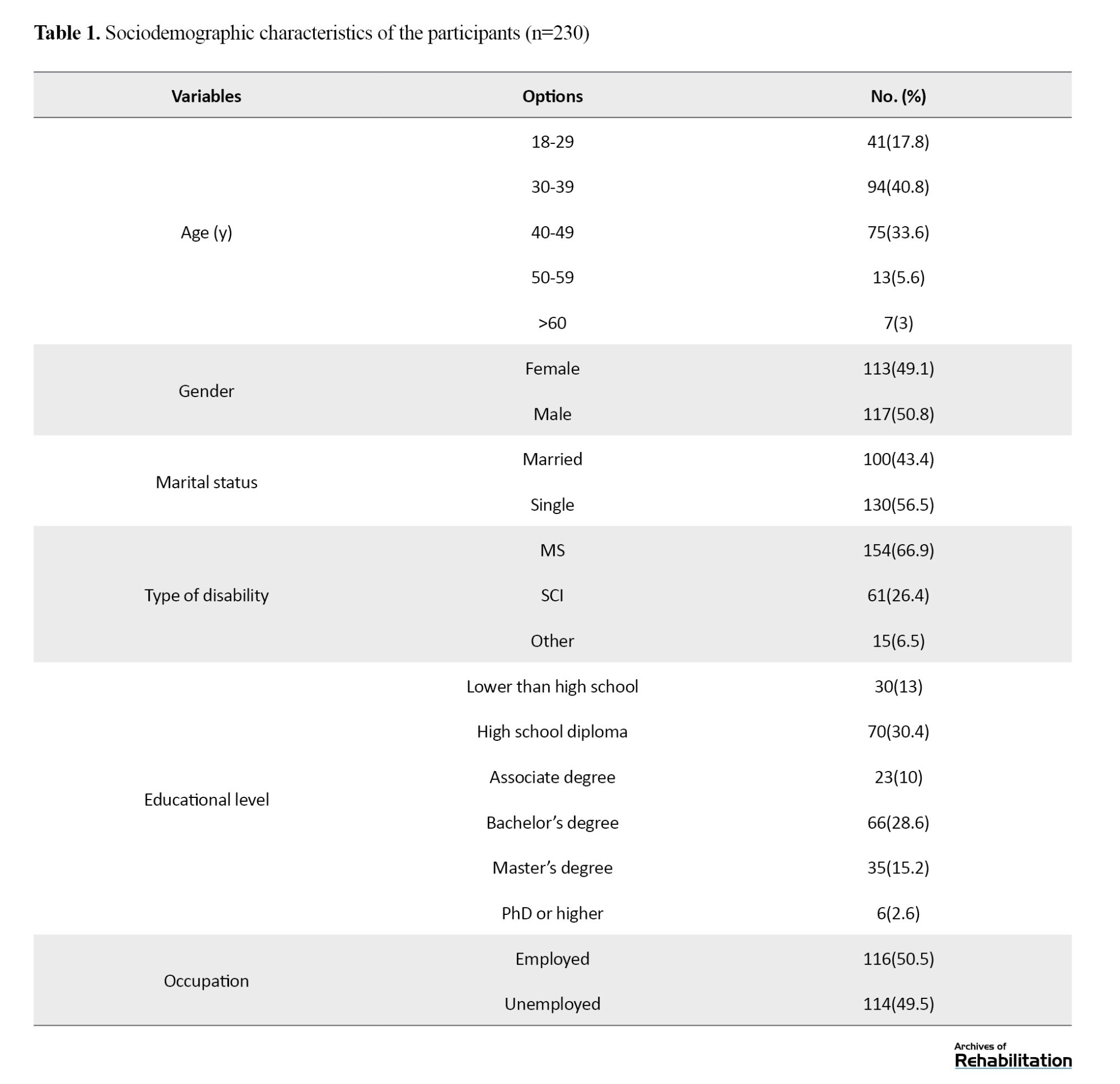
A total of 230 adults with physical disabilities participated in the study (Table 1). Their mean age was 42.11±5.2 years (ranging from 22–68 years), and 110 (55%) were male. Most of them had academic education (n=130, 56.6%), and half of the participants were employed (50.4%). To maintain sample diversity, 15 individuals with other types of physical-motor disabilities (excluding MS and SCI) also participated in the study.
Analysis of self-efficacy scores based on sociodemographic variables
Independent t-test (for gender and type of disability) and ANOVA (for age and education level) were used to evaluate the differences in self-efficacy scores based on sociodemographic variables. No significant differences were observed in the scores by gender (t=1.45, P=0.15), disability type (t=1.78, P=0.08), age group (<40 vs >40) (F=2.12, P=0.12), or education level (F=1.89, P=0.13). This finding indicates the stability of the scale construct across participant subgroups and its generalizability to diverse populations of people with disabilities.
Face validity
Face validity was assessed qualitatively through individual interviews with 10 participants with disabilities (5 with MS and 5 with SCI). All items were reported as clear, understandable, and relevant to daily experiences of living with disability. Minor linguistic adjustments were made to two items for improving readability (e.g. simplifying phrasing related to “emotional distress”), but no items were removed or changed.
Content validity
Content validity was evaluated by 11 experts. The CVR was 0.99, and the CVI for the entire scale was 0.95, indicating excellent relevance, simplicity, and clarity. All 17 items were retained.
Construct validity
The initial CFA model had one latent variable (self-efficacy), 17 observed items, and showed inadequate fit. (χ²/df=5.88, RMSEA=0.146, CFI<0.9, TLI<0.9, Hoelter’s statistic <50). Modification indices suggested correlating the error terms of theoretically related items and omitting or modifying those items with factor loadings <0.4. After modifications, the model demonstrated acceptable fit (Table 2, and Figure 1).
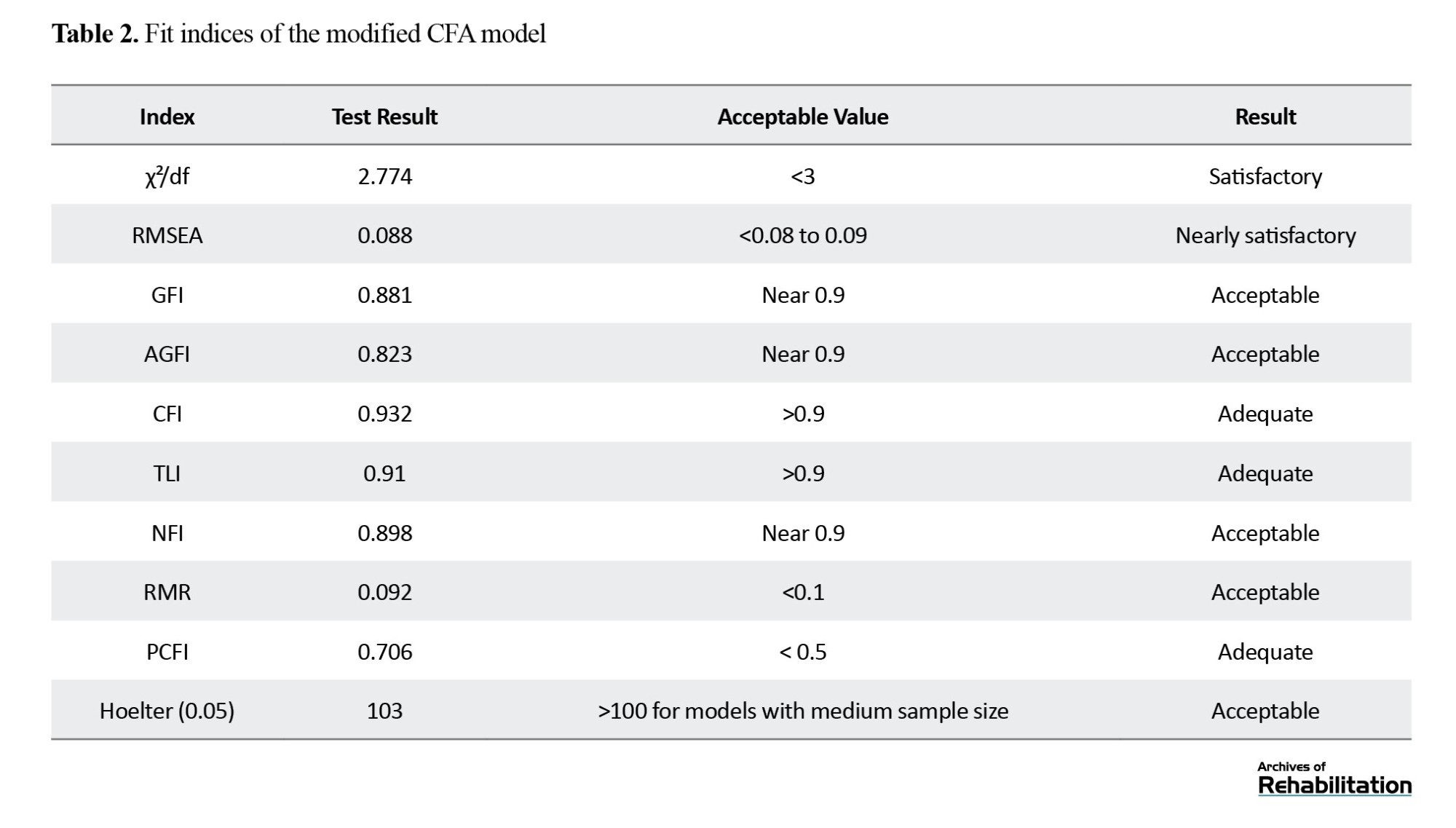
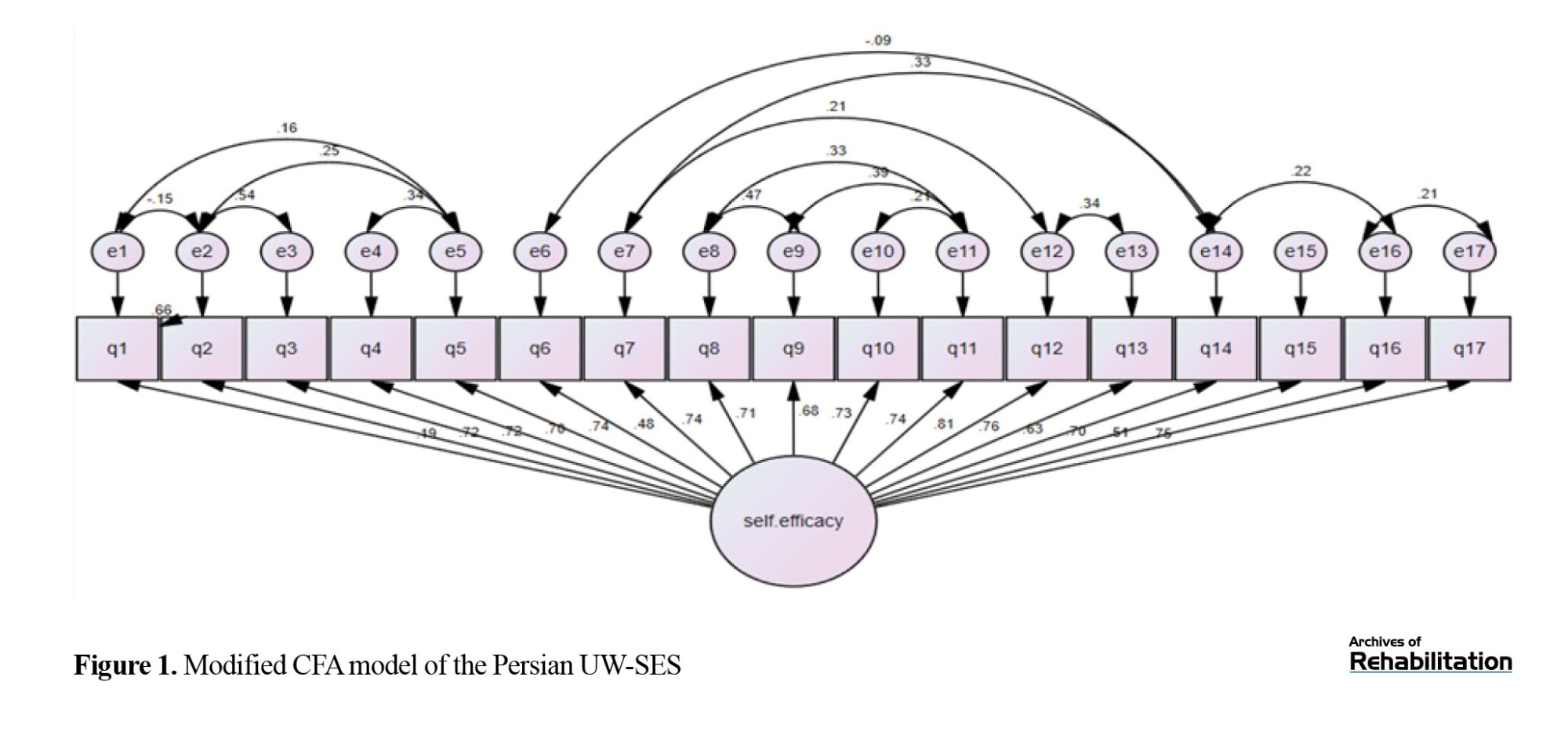
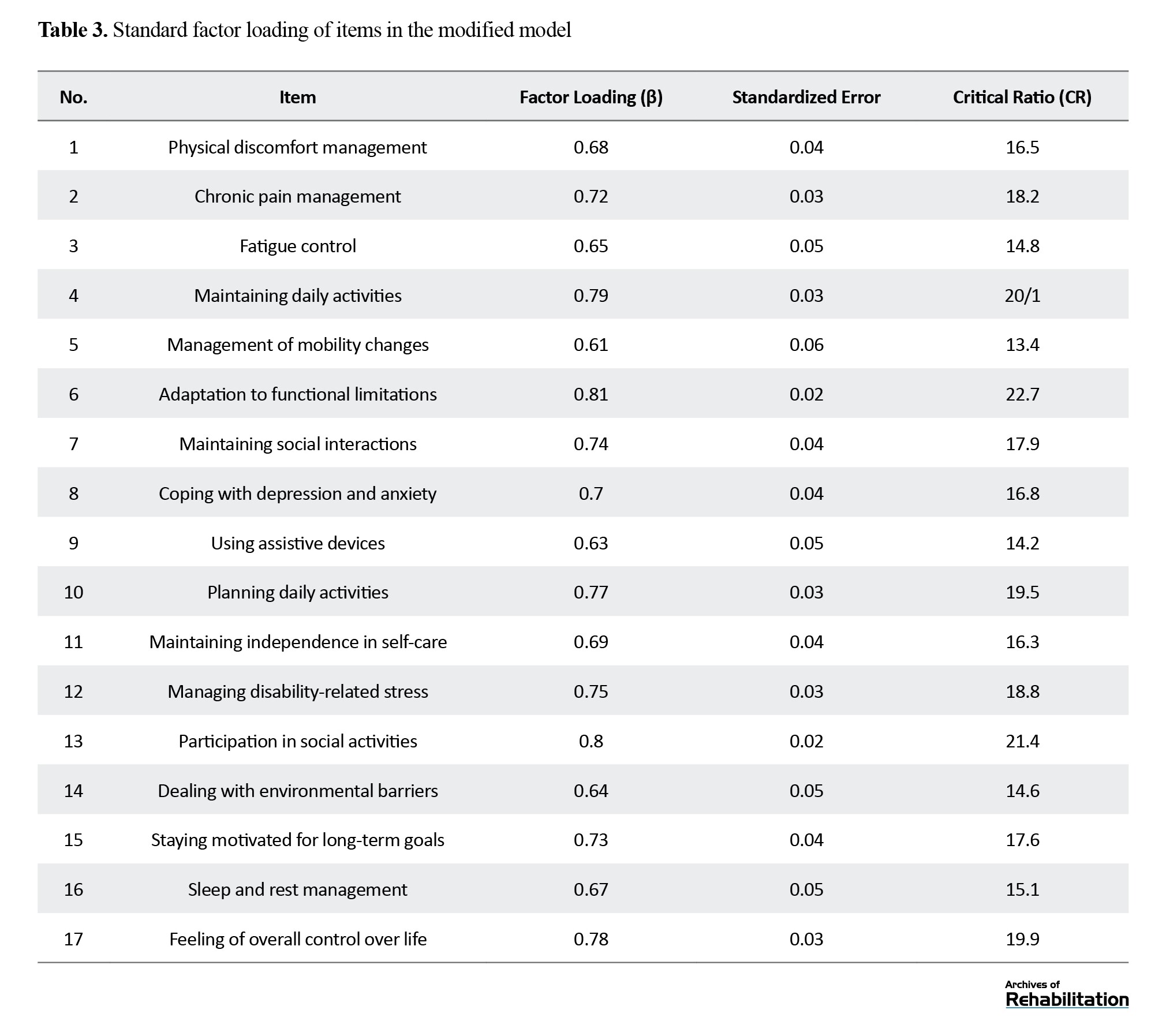
The results showed that the factor structure of the Persian UW-SES was compatible with Iranian samples and confirmed the construct validity of the tool. Although some indices were at the boundary level, the overall fitness of the modified model was confirmed, demonstrating the construct validity of the questionnaire. Although the RMSEA (0.088) was slightly higher than the acceptable limit (0.08), it remained within the acceptable range (<0.10). This value still indicates a good fit, given the moderate sample size and the model’s complexity, and is consistent with Post et al.’s study [15]. Also, the PCFI value (0.706) was desirable. The standard factor loadings of items in the modified model were statistically significant. All factor loadings were >0.60 and critical ratios >1.96 (P<0.001) (Table 3).
Reliability
The internal consistency of the 17-item Persian UW-SES was excellent (Cronbach’s α=0.943). Modified correlation coefficients of each item ranged from 0.486 to 0.784, all above the acceptable threshold of 0.30. The alpha if item deleted value (ranging from 0.937 to 0.944) showed that deleting any item did not improve the overall alpha. Therefore, all items were retained in the final model. For test re-test reliability, assessed in 28 participants at a 2-week interval, yielded an ICC of 0.97 (95% CI, 0.94%, 0.98%), indicating very high temporal stability.
Discussion
The present study translated and validated the Persian version of the UW-SES for Iranian adults with physical disabilities, specifically those with MS and SCI. The results demonstrate that the Persian UW-SES exhibited high content validity, construct validity after modifications, and reliability. This tool can help fill a critical gap in Iran, where existing self-efficacy tools, such as the GSE or CDSES, assess the overall or disease-specific self-efficacy and fail to capture the nuanced aspects of disability management, including handling secondary symptoms, maintaining social participation, and adapting to environmental barriers [13, 16].
Content validity was high (CVR=0.99, CVI=0.95), aligning with the results for the original English version developed by Amtmann et al. [12]. Similarly, the versions in Korean [14] and Dutch [15] achieved CVI values of 0.94 and 0.92, respectively, indicating that the UW-SES’s core concepts—such as managing fatigue, pain, emotional distress, and interpersonal impacts—translate well across cultures. The high CVR and CVI in this study may be attributed to the expert panel’s composition, which included rehabilitation specialists familiar with Iranian culture, where family support and societal attitudes toward disability play prominent roles. For instance, items related to “keeping disability from interfering with family relationships” strongly adhered to family values in Iranian culture that emphasize the role of family in managing disability, potentially enhancing the tool’s cultural relevance [17].
Construct validity was confirmed by CFA, with the modified model yielding acceptable fit indices (χ²/df=2.77, RMSEA=0.088, CFI=0.932). The modifications, such as correlating error terms for theoretically linked items (e.g. those with content similarity in terms of clinical symptoms), have also been used in other studies by Chung et al. [14] and Post et al. [15]. Chung et al. reported similar adjustments in the Korean version, attributing them to the complex, multifaceted nature of self-efficacy in disability contexts [14]. Post et al. [15] also noted boundary RMSEA values in their Dutch short-form version, suggesting sensitivity to sample size and cultural interpretations of “control” and “independence” . In the Persian version, the slightly elevated RMSEA may also be related to cultural factors. In a collectivist context such as Iran, self-efficacy perceptions are often intertwined with family or social supports, leading to higher correlated responses for some items [6, 17]. Factor loadings (>0.60) and critical ratios (>1.96) further support the single-dimensional structure, corroborating the original model’s emphasis on a cohesive self-efficacy construct for disability management [12]. The Hoelter’s index value (103) indicated sample adequacy, though larger multi-center samples could further stabilize the model.
Reliability analyses revealed high internal consistency (Cronbach’s α=0.943) and test re-test reliability (ICC=0.97), outperforming the values for other versions (e.g. alpha=0.90 in Amtmann et al.’s study [12] and ICC=0.90 in Chung et al.’s study [14]. Item-total correlation (0.486–0.784) indicated strong item coherence, with no deletions needed, consistent with findings in Post et al.’s study [15]. The higher alpha value in our study may be due to the homogeneity of samples with long durations of disability (>1 year), which likely share similar lived experiences in managing physical limitations. Additionally, cultural factors such as strong familial networks in Iran could foster more consistent perceptions of self-efficacy, as individuals may have more collective resilience, leading to maintaining independence and adapting to disability [6, 17]. Subgroup analyses showed no significant effects of sociodemographic factors on the self-efficacy scores, suggesting the tool’s robustness across gender, age, educational level, and disability type, enhancing its applicability in diverse clinical settings.
The Persian UW-SES enables precise evaluation of self-efficacy domains critical for rehabilitation outcomes in Iranian samples. Self-efficacy is a key predictor of health behaviors, treatment adherence, and quality of life in individuals with disabilities [3, 18, 19]. Studies by Cijsouw et al. and Bhattarai et al. have underscored the mediating role of self-efficacy in the relationship between pain/disability and life satisfaction/social participation, with higher self-efficacy buffering emotional distress and promoting independence [7, 9]. In Iran, there are more than 1.6 million people with disabilities, who face numerous limitations such as lack of access to municipal services and social inequalities [2, 20]. This tool can be used in targeted interventions, such as cognitive-behavioral therapy or family-oriented rehabilitation, for boosting self-efficacy, which can prevent secondary complications [21, 22]. Its brevity (a 17-item tool) and focus on areas that can be assessed make it suitable for clinical monitoring, research, and possibly improving decision-making in economically constrained situations [19, 23].
Conclusion
The Persian version of the UW-SES is a valid, reliable, and culturally adapted instrument for measuring self-efficacy in Iranian adults with physical disabilities. This questionnaire can help clinicians and researchers more accurately assess and strengthen patients’ self-efficacy, ultimately increasing their adaptation, social participation, and quality of life. Its use in rehabilitation programs can improve evidence-based interventions and assist in policymaking towards disability inclusion and equity. Further studies can use it in different contexts and help global efforts in disability rehabilitation.
A limitation of this study was that the participants were limited to Tehran, reducing the generalizability of the results to regions or ethnicities in Iran, where access to services or cultural attitudes may differ [21, 24], potentially leading to different self-efficacy levels. Therefore, multicenter studies across Iran with higher sample size are recommended. The use of a self-report tool can introduce response bias, and a cross-sectional design cannot establish causality or assess sensitivity to change. Convergent/divergent validity of the tool was not assessed. Thus, it is recommended to be assessed using tools such as WHOQOL-BREF or GSE in future studies. Moreover, the focus of this study was on people with MS and SCI, which limits the generalizability of the results to people with other disabilities (e.g. amputations or cerebral palsy). Future research should evaluate the Persian UW-SES across a broader range of disabilities. The tool can be used in longitudinal studies in Iran to assess the effectiveness of interventions, and as a criterion to measure the validity of other instruments. Also, integrating it into digital platforms may facilitate its wider use in tele-rehabilitation.
Ethical Considerations
Compliance with ethical guidelines
This study was approved by the Research Ethics Committee of the University of Social Welfare and Rehabilitation Sciences (Code: IR.USWR.REC.1403.204). All participants were fully informed about the study objectives and were assured that the information would remain confidential. They had the right to withdraw from the study and signed a written informed consent form.
Funding
This article was extracted from a master’s thesis of Mahnaz Rostaei at the Department of Rehabilitation Management, University of Social Welfare and Rehabilitation Sciences. This research did not receive any specific grant from funding agencies in the public, commercial, or not-for profit sectors.
Authors' contributions
Conceptualization, study design, investigation, and final approval: All authors; writing the original draft: Mahnaz Rostaei; Review and editing: Soheila Shahshahani and Maryam Hedayati.
Conflict of interest
The authors declared no conflict of interest.
AI tools disclosure statement
The authors acknowledge that no artificial intelligence was used in the preparation of the article.
Acknowledgments
The authors would like to thank all participants for their cooperation in this research.
Disability is a complex phenomenon that limits activities and restricts participation, arising from interactions between an individual’s physical or mental limitations and societal barriers [1]. According to the United Nations convention on the rights of persons with disabilities (2007), persons with disabilities include those with long-term physical, mental, intellectual, or sensory impairments that, in interaction with various barriers, may hinder their full and effective participation in society on an equal basis with others [1]. Globally, over one billion people live with some form of disability, representing about 15% of the world’s population [1]. In Iran, more than 1.6 million individuals are registered with disabilities, many facing physical-motor impairments requiring rehabilitation support [2].
Self-efficacy, defined as an individual’s belief in their ability to organize and execute actions required to achieve desired outcomes [3], plays a pivotal role in rehabilitation. It influences goal selection, effort, persistence, and resilience in the face of challenges [4-6]. For individuals with physical disabilities, such as multiple sclerosis (MS) and spinal cord injury (SCI), higher levels of self-efficacy are associated with positive outcomes such as decreasing levels of depression and anxiety, increased social participation and quality of life, and higher adherence to rehabilitation programs [7-11]. General self-efficacy tools, including the general self-efficacy scale (GSE), are available in a Persian version, but lack specificity for disabled people [4]. Specialized tools are needed to assess aspects such as managing secondary symptoms, maintaining independence, and adapting to environmental barriers. The University of Washington self-efficacy scale (UW-SES) is a 17-item tool developed specifically for adults with disabilities, focusing on confidence in managing disability-related challenges [12, 13]. It has demonstrated strong psychometric properties in English [12], Korean [14], and Dutch [15] versions. However, no Persian version of this scale exists. Therefore, this study aimed to translate the UW-SES into Persian and evaluate its validity and reliability among Iranian adults with physical disabilities.
Materials & Methods
Study design and participants
This methodological, cross-sectional study was conducted from December 2023 to November 2024 in Tehran, Iran. Participants included adults (≥18 years) with MS or SCI, diagnosed for at least one year, and classified under the international classification of functioning, disability and health (ICF) by the Iranian Welfare Organization. Exclusion criteria were cognitive impairments, acute exacerbations, or unwillingness to participate. A stratified sampling method was used to ensure a balanced distribution of age, gender, and type of disability. Based on the prevalence of MS or SCI in Tehran, approximately 32% of the sample was selected from SCI patients and 68% from MS patients. The sample size was calculated to be 230, considering 10 participants per questionnaire item (n=19) and a 20% possible sample dropout. Ethical approval was obtained from the University of Social Welfare and Rehabilitation Sciences. Informed consent was secured, ensuring confidentiality and voluntary participation.
Measures
The UW-SES, developed by Amtmann et al. [12], has 19 items rated on a 5-point Likert scale from 1 (not at all) to 5 (completely). The first 17 items are used to assess self-efficacy in managing the effects of disability on daily life, relationships, and health. Two optional items address intimate relationships and are not included in scoring. Total score ranges from 17 to 85, with higher scores indicating greater self-efficacy. The UW-SES score has very high convergent validity (r=0.832) with the chronic disease self-efficacy scale (CDSES) and high reliability (α=0.90) [12, 13].
Translation process
After obtaining permission from the authors of the main version, the UW-SES was translated to Persian according to the World Health Organization (WHO)’s guidelines by two bilingual experts and back translated to English by one independent translator. Then, two rehabilitation specialists compared the translated version with the original version and revised it in terms of clarity, conceptual equivalence, and pragmatic usage. A pilot study was done with 10 participants with disabilities to assess the comprehensibility of the questions.
Validity assessment
The content validity was evaluated by 11 experts in terms of clarity, transparency, simplicity, and relevance, followed by calculating the content validity ratio (CVR) and content validity index (CVI). Based on the Lawshe table for 11 experts, CVR ≥0.59 and CVI ≥0.79 were considered acceptable. Face validity was also assessed qualitatively by 10 participants for clarity and relevance. For construct validity assessment, confirmatory factor analysis (CFA) was conducted in AMOS. The initial assessment model with one latent variable (self-efficacy) and 17 observed items had poor fit to the data. After examining modification indices and compliance with theoretical foundations, the measurement errors of items that had high conceptual overlap (e.g. items managing physical symptoms, controlling chronic pain, coping with fatigue, and managing sleep) were correlated with one another. These amendments were made solely based on content similarity and the lived experiences of people with chronic disabilities. Chung et al., in evaluating 292 people with MS in South Korea, also reported that the initial model required minor modifications and subsequently showed suitable fit indices [14].
Reliability assessment
Internal consistency was evaluated with Cronbach’s α in SPSS software. To evaluate the test re-test reliability of the tool, 28 participants were asked to re-complete the questionnaire at a 2-week interval. Then, the correlation between the two measurements was calculated using the intraclass correlation coefficient (ICC).
Data collection
After obtaining informed consent from the participants, the questionnaires were distributed online via Telegram groups or at clinics. From 500 questionnaires, 230 were completed.
Statistical analysis
Data were analyzed in SPSS and AMOS software, version 26 and 24 irrespectively. CVR and CVI for content validity, CFA for construct validity, and Cronbach’s α and ICC for reliability were calculated.
Results
Participant characteristics
A total of 230 adults with physical disabilities participated in the study (Table 1). Their mean age was 42.11±5.2 years (ranging from 22–68 years), and 110 (55%) were male. Most of them had academic education (n=130, 56.6%), and half of the participants were employed (50.4%). To maintain sample diversity, 15 individuals with other types of physical-motor disabilities (excluding MS and SCI) also participated in the study.
Analysis of self-efficacy scores based on sociodemographic variables
Independent t-test (for gender and type of disability) and ANOVA (for age and education level) were used to evaluate the differences in self-efficacy scores based on sociodemographic variables. No significant differences were observed in the scores by gender (t=1.45, P=0.15), disability type (t=1.78, P=0.08), age group (<40 vs >40) (F=2.12, P=0.12), or education level (F=1.89, P=0.13). This finding indicates the stability of the scale construct across participant subgroups and its generalizability to diverse populations of people with disabilities.
Face validity
Face validity was assessed qualitatively through individual interviews with 10 participants with disabilities (5 with MS and 5 with SCI). All items were reported as clear, understandable, and relevant to daily experiences of living with disability. Minor linguistic adjustments were made to two items for improving readability (e.g. simplifying phrasing related to “emotional distress”), but no items were removed or changed.
Content validity
Content validity was evaluated by 11 experts. The CVR was 0.99, and the CVI for the entire scale was 0.95, indicating excellent relevance, simplicity, and clarity. All 17 items were retained.
Construct validity
The initial CFA model had one latent variable (self-efficacy), 17 observed items, and showed inadequate fit. (χ²/df=5.88, RMSEA=0.146, CFI<0.9, TLI<0.9, Hoelter’s statistic <50). Modification indices suggested correlating the error terms of theoretically related items and omitting or modifying those items with factor loadings <0.4. After modifications, the model demonstrated acceptable fit (Table 2, and Figure 1).
The results showed that the factor structure of the Persian UW-SES was compatible with Iranian samples and confirmed the construct validity of the tool. Although some indices were at the boundary level, the overall fitness of the modified model was confirmed, demonstrating the construct validity of the questionnaire. Although the RMSEA (0.088) was slightly higher than the acceptable limit (0.08), it remained within the acceptable range (<0.10). This value still indicates a good fit, given the moderate sample size and the model’s complexity, and is consistent with Post et al.’s study [15]. Also, the PCFI value (0.706) was desirable. The standard factor loadings of items in the modified model were statistically significant. All factor loadings were >0.60 and critical ratios >1.96 (P<0.001) (Table 3).
Reliability
The internal consistency of the 17-item Persian UW-SES was excellent (Cronbach’s α=0.943). Modified correlation coefficients of each item ranged from 0.486 to 0.784, all above the acceptable threshold of 0.30. The alpha if item deleted value (ranging from 0.937 to 0.944) showed that deleting any item did not improve the overall alpha. Therefore, all items were retained in the final model. For test re-test reliability, assessed in 28 participants at a 2-week interval, yielded an ICC of 0.97 (95% CI, 0.94%, 0.98%), indicating very high temporal stability.
Discussion
The present study translated and validated the Persian version of the UW-SES for Iranian adults with physical disabilities, specifically those with MS and SCI. The results demonstrate that the Persian UW-SES exhibited high content validity, construct validity after modifications, and reliability. This tool can help fill a critical gap in Iran, where existing self-efficacy tools, such as the GSE or CDSES, assess the overall or disease-specific self-efficacy and fail to capture the nuanced aspects of disability management, including handling secondary symptoms, maintaining social participation, and adapting to environmental barriers [13, 16].
Content validity was high (CVR=0.99, CVI=0.95), aligning with the results for the original English version developed by Amtmann et al. [12]. Similarly, the versions in Korean [14] and Dutch [15] achieved CVI values of 0.94 and 0.92, respectively, indicating that the UW-SES’s core concepts—such as managing fatigue, pain, emotional distress, and interpersonal impacts—translate well across cultures. The high CVR and CVI in this study may be attributed to the expert panel’s composition, which included rehabilitation specialists familiar with Iranian culture, where family support and societal attitudes toward disability play prominent roles. For instance, items related to “keeping disability from interfering with family relationships” strongly adhered to family values in Iranian culture that emphasize the role of family in managing disability, potentially enhancing the tool’s cultural relevance [17].
Construct validity was confirmed by CFA, with the modified model yielding acceptable fit indices (χ²/df=2.77, RMSEA=0.088, CFI=0.932). The modifications, such as correlating error terms for theoretically linked items (e.g. those with content similarity in terms of clinical symptoms), have also been used in other studies by Chung et al. [14] and Post et al. [15]. Chung et al. reported similar adjustments in the Korean version, attributing them to the complex, multifaceted nature of self-efficacy in disability contexts [14]. Post et al. [15] also noted boundary RMSEA values in their Dutch short-form version, suggesting sensitivity to sample size and cultural interpretations of “control” and “independence” . In the Persian version, the slightly elevated RMSEA may also be related to cultural factors. In a collectivist context such as Iran, self-efficacy perceptions are often intertwined with family or social supports, leading to higher correlated responses for some items [6, 17]. Factor loadings (>0.60) and critical ratios (>1.96) further support the single-dimensional structure, corroborating the original model’s emphasis on a cohesive self-efficacy construct for disability management [12]. The Hoelter’s index value (103) indicated sample adequacy, though larger multi-center samples could further stabilize the model.
Reliability analyses revealed high internal consistency (Cronbach’s α=0.943) and test re-test reliability (ICC=0.97), outperforming the values for other versions (e.g. alpha=0.90 in Amtmann et al.’s study [12] and ICC=0.90 in Chung et al.’s study [14]. Item-total correlation (0.486–0.784) indicated strong item coherence, with no deletions needed, consistent with findings in Post et al.’s study [15]. The higher alpha value in our study may be due to the homogeneity of samples with long durations of disability (>1 year), which likely share similar lived experiences in managing physical limitations. Additionally, cultural factors such as strong familial networks in Iran could foster more consistent perceptions of self-efficacy, as individuals may have more collective resilience, leading to maintaining independence and adapting to disability [6, 17]. Subgroup analyses showed no significant effects of sociodemographic factors on the self-efficacy scores, suggesting the tool’s robustness across gender, age, educational level, and disability type, enhancing its applicability in diverse clinical settings.
The Persian UW-SES enables precise evaluation of self-efficacy domains critical for rehabilitation outcomes in Iranian samples. Self-efficacy is a key predictor of health behaviors, treatment adherence, and quality of life in individuals with disabilities [3, 18, 19]. Studies by Cijsouw et al. and Bhattarai et al. have underscored the mediating role of self-efficacy in the relationship between pain/disability and life satisfaction/social participation, with higher self-efficacy buffering emotional distress and promoting independence [7, 9]. In Iran, there are more than 1.6 million people with disabilities, who face numerous limitations such as lack of access to municipal services and social inequalities [2, 20]. This tool can be used in targeted interventions, such as cognitive-behavioral therapy or family-oriented rehabilitation, for boosting self-efficacy, which can prevent secondary complications [21, 22]. Its brevity (a 17-item tool) and focus on areas that can be assessed make it suitable for clinical monitoring, research, and possibly improving decision-making in economically constrained situations [19, 23].
Conclusion
The Persian version of the UW-SES is a valid, reliable, and culturally adapted instrument for measuring self-efficacy in Iranian adults with physical disabilities. This questionnaire can help clinicians and researchers more accurately assess and strengthen patients’ self-efficacy, ultimately increasing their adaptation, social participation, and quality of life. Its use in rehabilitation programs can improve evidence-based interventions and assist in policymaking towards disability inclusion and equity. Further studies can use it in different contexts and help global efforts in disability rehabilitation.
A limitation of this study was that the participants were limited to Tehran, reducing the generalizability of the results to regions or ethnicities in Iran, where access to services or cultural attitudes may differ [21, 24], potentially leading to different self-efficacy levels. Therefore, multicenter studies across Iran with higher sample size are recommended. The use of a self-report tool can introduce response bias, and a cross-sectional design cannot establish causality or assess sensitivity to change. Convergent/divergent validity of the tool was not assessed. Thus, it is recommended to be assessed using tools such as WHOQOL-BREF or GSE in future studies. Moreover, the focus of this study was on people with MS and SCI, which limits the generalizability of the results to people with other disabilities (e.g. amputations or cerebral palsy). Future research should evaluate the Persian UW-SES across a broader range of disabilities. The tool can be used in longitudinal studies in Iran to assess the effectiveness of interventions, and as a criterion to measure the validity of other instruments. Also, integrating it into digital platforms may facilitate its wider use in tele-rehabilitation.
Ethical Considerations
Compliance with ethical guidelines
This study was approved by the Research Ethics Committee of the University of Social Welfare and Rehabilitation Sciences (Code: IR.USWR.REC.1403.204). All participants were fully informed about the study objectives and were assured that the information would remain confidential. They had the right to withdraw from the study and signed a written informed consent form.
Funding
This article was extracted from a master’s thesis of Mahnaz Rostaei at the Department of Rehabilitation Management, University of Social Welfare and Rehabilitation Sciences. This research did not receive any specific grant from funding agencies in the public, commercial, or not-for profit sectors.
Authors' contributions
Conceptualization, study design, investigation, and final approval: All authors; writing the original draft: Mahnaz Rostaei; Review and editing: Soheila Shahshahani and Maryam Hedayati.
Conflict of interest
The authors declared no conflict of interest.
AI tools disclosure statement
The authors acknowledge that no artificial intelligence was used in the preparation of the article.
Acknowledgments
The authors would like to thank all participants for their cooperation in this research.
References
- Assembly UG. Convention on the Rights of Persons with Disabilities. The General Assembly. 2006; 61:106. [Link]
- State Welfare Organization. [Prevalance of disability (Persian)].Tehran: State Welfare Organization; 2025. [Link]
- Bandura A. Self-efficacy: Toward a Unifying Theory of Behavioral Change. Psychological Review. 1977; 84(2):191-215. [DOI:10.1037/0033-295X.84.2.191] [PMID]
- Kariminezhad. K, Mansouri L, Movahedi M, Hoseini H. [The effectiveness of self-efficacy training on self-esteem and motivation to improve the welfare of women with disabilities in Khorram Abad city (Persian)]. Quarterly Journal of Social Work. 2018; 6(4):43-50. [Link]
- Raman S, Sharma P. Self-efficacy as a mediator of the relationship between pain and disability in chronic pain patients: A narrative review. Bulletin of Faculty of Physical Therapy. 2022; 27(42). [DOI:10.1186/s43161-022-00101-y]
- Emamgholizadeh-Baboli E, Pashaei-Sabet F, Haghani H, Fotokian Z. Predicting the relationship of general self-efficacy and quality of life of the older adults with physical/mobility disabilities: A cross-sectional study in Northern Iran. BMC Geriatrics. 2025; 25(1):723. [DOI:10.1186/s12877-025-06348-z] [PMID]
- Cijsouw A, Adriaansen JJ, Tepper M, Dijksta C, Van Linden S, De Groot S, et al. Associations between disability-management self-efficacy, participation and life satisfaction in people with long-standing spinal cord injury. Spinal Cord. 2017; 55(1):47-51. [DOI:10.1038/sc.2016.80] [PMID]
- Taheri S, Moradi A, Pazouhesh S. [Share of Self-Efficacy, Self-Esteem and Achievement Motivation in Predicting Quality of Life of Physically Disabled Youth in Shahrekord (Persian)]. Psychology of Exceptional Individuals. 2013; 3(9):145-70. [Link]
- Bhattarai M, McDaniels B, Jin Y, Smedema SM. Pain and quality of life in persons with spinal cord injury: Mediating effects of mindfulness, self-efficacy, social support, and functional independence. Journal of Clinical Psychology. 2024; 80(2):406-20. [DOI:10.1002/jclp.23616] [PMID]
- Kim HM. Effects of self-efficacy, self-esteem, and disability acceptance on the social participation of people with physical disabilities: Focusing on COVID-19 pandemic. Brain and Behavior. 2023; 13(1):e2824. [DOI:10.1002/brb3.2824] [PMID]
- Shabbir A, Hassan B, Ahmad I, Iqbal N. Resilience, Self-Efficacy and Quality Of Life among Assistive and Non-Assistive Technology Users: A Mixed Method Study. Annals of Allied Health Sciences. 2023; 9(2):33-40. [Link]
- Amtmann D, Bamer AM, Cook KF, Askew RL, Noonan VK, Brockway JA. University of Washington self-efficacy scale: A new self-efficacy scale for people with disabilities. Archives of Physical Medicine and Rehabilitation. 2012; 93(10):1757-65. [DOI:10.1016/j.apmr.2012.05.001] [PMID]
- University of Washington. University of Washington Self-Efficacy Scale (UW-SES) Generic Version Users Guide. Washington : University of Washington; 2018. [Link]
- Chung H, Kim J, Park R, Bamer AM, Bocell FD, Amtmann D. Testing the measurement invariance of the University of Washington Self-Efficacy Scale short form across four diagnostic subgroups. Quality of Life Research. 2016; 25(10):2559-64. [DOI:10.1007/s11136-016-1300-z] [PMID]
- Post MWM, Adriaansen JJE, Peter C. Rasch analysis of the University of Washington Self-Efficacy Scale short-form (UW-SES-6) in people with long-standing spinal cord injury. Spinal Cord. 2018; 56(11):1095-101. [DOI:10.1038/s41393-018-0166-z] [PMID]
- Self-Management Resource Center. Self-efficacy for managing chronic disease 6-item scale [Internet]. 2026 [Updated 2026 Aug 1]. Available from: [Link]
- Oliver M. The politics of disablement: A sociological approach. New York: Martin's Press; 1990. [Link]
- Amer FA, Mohamed MS, Elbur AI, Abdelaziz SI, Elrayah ZA. Influence of self-efficacy management on adherence to self-care activities and treatment outcome among diabetes mellitus type 2. J Pharmacy Practice. 2018; 16(4):1274. [DOI:10.18549/PharmPract.2018.04.1274] [PMID]
- Emamgholizadeh baboli E, Pashaii Sabet F, Fotokian Z. [Investigating Factors Affecting General Self-efficacy in the Elderly with Physical-motor Disabilities (Persian)]. Iranian Journal Of Nursing Research. 2023; 18(1):21-33. [Link]
- Sajjadi H, Zanjari N. [Disability in Iran: Prevalence, Characteristics, and Socio-Economic Correlates (Persian)]. Archives of Rehabilitation. 2015; 16(1):36-47. [Link]
- Sidiq M, Muzaffar T, Janakiraman B, Masoodi S, Vasanthi RK, Ramachandran A, et al. Effects of pain education on disability, pain, quality of life, and self-efficacy in chronic low back pain: A randomized controlled trial. PLoS One. 2024; 19(5):e0294302. [DOI:10.1371/journal.pone.0294302] [PMID]
- Sarcami Z, Naviporh H, Amadi F. [Effect of Continuous Care Model-based Intervention on the Care Burden of the Caregivers of Patients With Spinal Cord Injury (Persian)]. Iran Journal of Nursing. 2024; 37(147):50-63. [DOI: 10.32598/ijn.37.147.3276.1]
- Shrout PE, Fleiss JL. Intraclass correlations: Uses in assessing rater reliability. Psychological Bulletin. 1979; 86(2):420-8. [DOI:10.1037//0033-2909.86.2.420] [PMID]
- Human Rights Watch, Center for Human Rights in Iran. “I am equally human”: discrimination and lack of accessibility for people with disabilities in Iran [Internet]. New York: Human Rights Watch; 2018. [Link]
Type of Study: Original |
Subject:
Rehabilitation Management
Send email to the article author
| Rights and permissions | |
 |
This work is licensed under a Creative Commons Attribution-NonCommercial 4.0 International License. |

Copyright © The Author(s);
This is an open access article distributed under the terms of the Creative Commons Attribution-NonCommercial 4.0 (CC-By-NC 4.0), which permits use, distribution, and reproduction in any medium, provided the original work is properly cited and is not used for commercial purposes.
Contact Information
This is an open access article distributed under the terms of the Creative Commons Attribution-NonCommercial 4.0 (CC-By-NC 4.0), which permits use, distribution, and reproduction in any medium, provided the original work is properly cited and is not used for commercial purposes.
Contact Information