

Volume 27, Issue 2 (7-2026)
Arch Rehabil 2026, 27(2): 286-305 |
Back to browse issues page




Download citation:
BibTeX | RIS | EndNote | Medlars | ProCite | Reference Manager | RefWorks
Send citation to:


BibTeX | RIS | EndNote | Medlars | ProCite | Reference Manager | RefWorks
Send citation to:
orakifar N, Barati F, Mehravar M, Mofateh R, Saki R, Seyedtabib M et al . Relationship Between Postural Adjustments and Dynamic Balance Control in Individuals With Chronic Nonspecific Low Back Pain. Arch Rehabil 2026; 27 (2) :286-305
URL: http://rehabilitationj.uswr.ac.ir/article-1-3709-en.html
URL: http://rehabilitationj.uswr.ac.ir/article-1-3709-en.html
Neda Orakifar1  , Fatemeh Barati2 , Mohammad Mehravar1 , Razieh Mofateh *3 , Ramin Saki4 , Maryam Seyedtabib5 , Amin Behdarvandan1
, Fatemeh Barati2 , Mohammad Mehravar1 , Razieh Mofateh *3 , Ramin Saki4 , Maryam Seyedtabib5 , Amin Behdarvandan1
1- Department of Physiotherapy, School of Rehabilitation Sciences, Ahvaz Jundishapur University of Medical Sciences, Ahvaz, Iran. & Rehabilitation Research Center, Ahvaz Jundishapur University of Medical Sciences, Ahvaz, Iran.
2- Rehabilitation Research Center, Ahvaz Jundishapur University of Medical Sciences, Ahvaz, Iran.
3- Department of Physiotherapy, School of Rehabilitation Sciences, Ahvaz Jundishapur University of Medical Sciences, Ahvaz, Iran. & Rehabilitation Research Center, Ahvaz Jundishapur University of Medical Sciences, Ahvaz, Iran. ,mofatehr@yahoo.com
4- Department of Mechanics, Faculty of Civil Engineering and Architecture, Shahid Chamran University of Ahvaz, Ahvaz, Iran.
5- Department of Biostatistics and Epidemiology, School of Public Health, Ahvaz Jundishapur University of Medical Sciences, Ahvaz, Iran.
2- Rehabilitation Research Center, Ahvaz Jundishapur University of Medical Sciences, Ahvaz, Iran.
3- Department of Physiotherapy, School of Rehabilitation Sciences, Ahvaz Jundishapur University of Medical Sciences, Ahvaz, Iran. & Rehabilitation Research Center, Ahvaz Jundishapur University of Medical Sciences, Ahvaz, Iran. ,
4- Department of Mechanics, Faculty of Civil Engineering and Architecture, Shahid Chamran University of Ahvaz, Ahvaz, Iran.
5- Department of Biostatistics and Epidemiology, School of Public Health, Ahvaz Jundishapur University of Medical Sciences, Ahvaz, Iran.
Keywords: Surface electromyography, Motor control, Non-specific low back pain (NSLBP), Postural control
Full-Text [PDF 2822 kb]
(209 Downloads)
| Abstract (HTML) (1436 Views)
Full-Text: (183 Views)
Introduction
Low back pain is a common experience among people all over the world [1].About 85% of individuals report low back pain at least once in their lives [1, 2]. In 85% of people with low back pain, paraclinical findings are negative and no specific pathology is found [2]. This type of back pain is called non-specific low back pain (NSLBP) [3]. In 80% of people with NSLBP, chronic symptoms persist for up to one year after the onset of pain [4]. Chronic NSLBP has an adverse effect on the independence and quality of life and it is considered as the most important reason for activity restriction among people aged <45 years [5, 6]. Although, available evidences confirm the multifactorial nature of chronic NSLBP, it seems that among numerous physical and psychosocial causes known [7, 8], changes in motor control represent one of the key factors involved in the development and chronicity of low back pain [7-9]. Thus, motor control deficits are strongly associated with chronicity and recurrence of low back pain [10]. In addition, motor control deficits have been identified as factors contributing to the occurrence of balance disorders in people with chronic NSLBP [11]. The ability to maintain dynamic balance control during daily activities is essential and balance dysfunctions can increase risk of falls [12].
Motor control is often studied using the concept of postural adjustments (PAs). Accordingly, to maintain dynamic balance, the central nervous system (CNS) controls the initiation of voluntary movements using overlapping and related PAs, such as anticipatory (APAs) and compensatory (CPAs) [11]. APAs are generated through a feedforward control strategy before the commencement of voluntary movement. APAs are typically generated 100–150 ms before voluntary movement [12–14]. They reflect neural control strategies employed by the CNS to preserve postural stability by regulating the position of the body’s center of mass within the base of support and compensation for perturbing forces generated by voluntary movements and by pre-activating specific muscle groups, thereby reducing the postural perturbations imposed by the initiation of voluntary movement [15]. After a postural perturbation is induced by a voluntary movement, body posture is controlled by the CNS using a feedback-based strategy [16], and these responses are identified as CPAs [17]. Therefore, the goal of CPAs is to restore the location of the center of mass following a perturbation [18]. These adjustments are typically made 50–300 ms after the perturbation [19–21] and utilize the flow of sensory information entering the system [19]. Importantly, effective control of the APA system can reduce the need for CPAs [22]. Therefore, motor control system employes different strategies, such as APAs and CPAs, to control body posture during dynamic activities.
A review study found a delayed activation of the trunk muscles in response to expected perturbations (e.g. voluntary limb movements) and unexpected perturbations in individuals with low back pain, indicating the impairment of APAs and CPAs in these individuals [23], although a research gap in this area still remains. Previous studies have mostly examined the maintenance of a neutral trunk position during upper limb lifting [24-26]and have not assessed PAs during large trunk movements. This is despite the association between the risk of low back pain and large trunk movements [27, 28]. Therefore, it is essential to examine motor control during activities involving trunk movement and displacement. Although PAs have often been studied in standing positions, the role of lower limb postural muscles has received less attention. According to Allery et al., low back pain is not necessarily linked with defect in motor control system in a specific muscle or muscle group, and this disorder can be caused by broad alterations in neural control of the complex lumbopelvic-lower limb segment that manifests itself based on postural demands or specific functional activities [25]. Motor control deficits in the gastrocnemius, hamstring, and gluteus maximus muscles have been indicated in individuals with low back pain [24]. On the other hand, the association between PA deficits and balance has not been examined in individuals with low back pain during functional reach test (FRT), a common, simple, and reproducible clinical tool for assessing dynamic balance control, which is performed in a standing position and is accompanied by trunk movement. Maintaining balance during this test requires the ability to control optimal movement in the trunk and lower limb muscles [29]. Therefore, considering the existing research gap, this study aimed to examine the relationship between PAs and dynamic balance control during a FRT in individuals with chronic NSLBP.
Materials & Methods
This cross-sectional study was performed at the Rehabilitation Research Center, Ahvaz Jundishapur University of Medical Sciences, Ahvaz, Iran. Participants included men and women aged 18-45 years with chronic NSLBP referred to physiotherapy clinics. The sample size was calculated as 25 based on previous studies [23, 24] and considering a test power of 80%, a significance level of 0.05, and an effect size of 0.25. Sampling was performed using a convenience sampling method. Pain in the right lumbar region (between the first lumbar vertebra and the gluteal fold) with or without pain referred to the right lower limb, which was present for at least 3 months and a visual analogue scale (VAS) <3 were considered as inclusion criteria. Considering the impact of chronic pain on muscle function, only people with low back pain on the right side were included in the study. Dizziness, epilepsy, inner ear problems, low back pain due to infection, fracture or pathology, low back pain with neurological symptoms, history of surgery in the back or lower limbs, having other musculoskeletal problems such as previous fractures of the lower limbs, neck pain, knee pain, severe brain injury and inability to follow instructions, history of cardiovascular problems, and use of opioid drugs were considered as exclusion criteria.
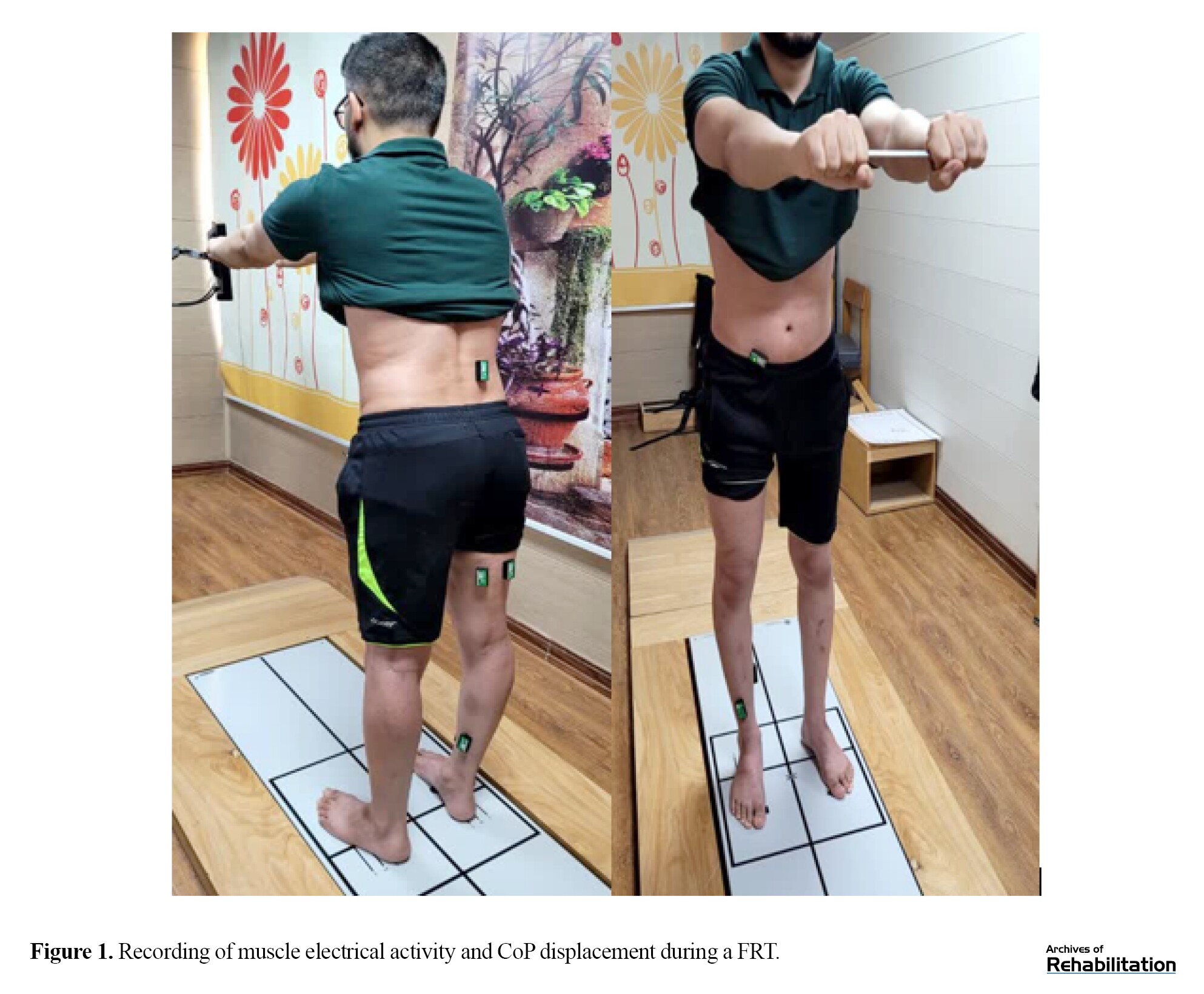
Initially, the levels of disability and physical activity were assessed using the Oswestry disability index (ODI) and the Baecke physical activity questionnaire (BPAQ), respectively. Next, a FRT in standing position was performed for dynamic balance assessment. During this test, electrical muscle activity using an electromyography (EMG) device and the center of pressure (CoP) using a force plate were recorded simultaneously. For this purpose, an accelerometer was attached to the participants’ right elbow. After connecting the EMG surface electrodes to the individual’s body, the individual stood on the force plate with their right side facing the wall and both feet shoulder-width apart. A tape measure was attached to the wall at the individual’s shoulder level. Then, the individual raised both arms 90 degrees with the elbows fully extended and the wrists pronated, holding a small bar in the hand and standing in a relaxed and alert position. Next, after hearing the command “move”, the individual was asked to count to 3 and then reach forward as far as possible without stepping or losing the balance, while standing in a fixed position. The distance between the initial and final positions was measured in centimeters (Figure 1). This FRT was performed three times, with a one-minute rest interval between repetitions. The mean distance traveled was recorded. Noteworthy, due to the effect of height on distance traveled in the FRT, the average distance traveled was divided by height, and the resulting number indicated the individual’s functional balance score, used for subsequent analyses.
Recording the muscle electrical activity
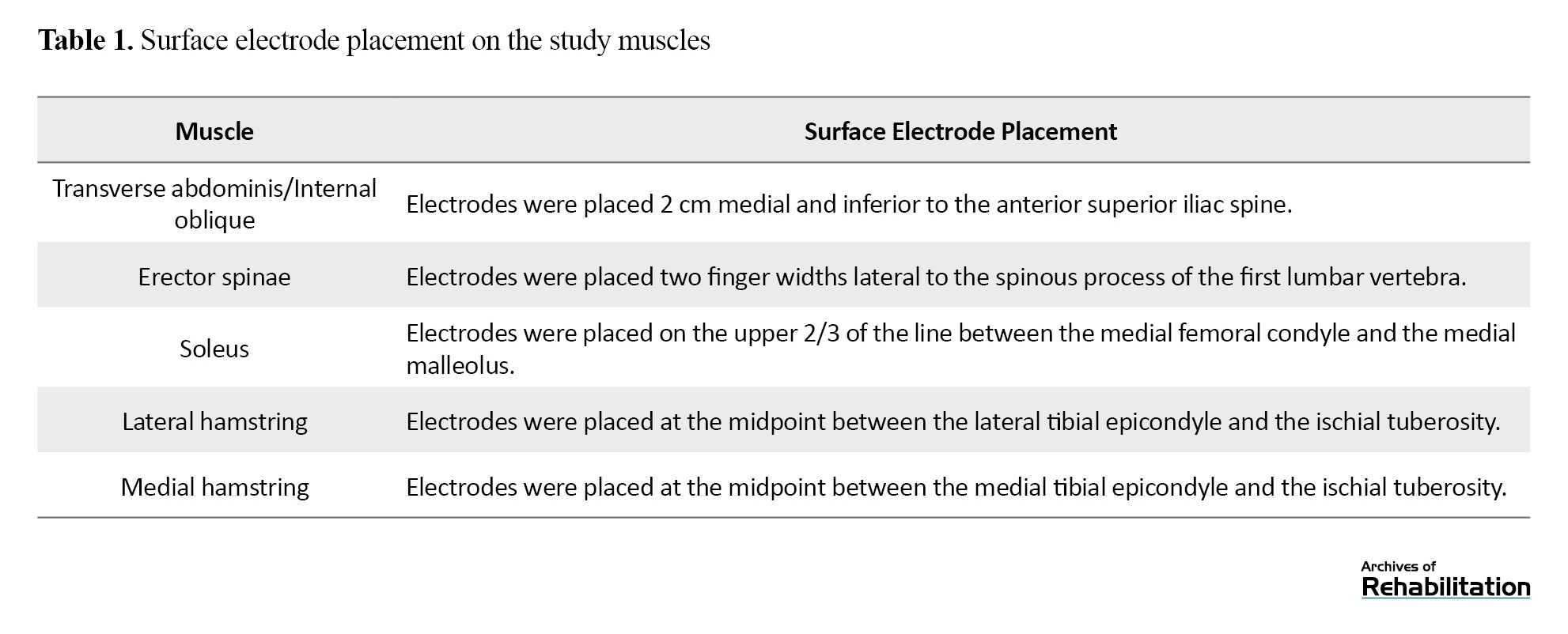
Using a wireless surface EMG device and surface electrode placement, the EMG activity of the trunk and lower-limb postural muscles, including the transverse abdominis/internal oblique, erector spinae, medial and lateral hamstrings, and soleus on the right side, was measured. The selection of muscles was made according to previous studies reporting the contribution of these muscles to PAs, and considering type of activity being studied (functional reach). After cleaning the skin using alcohol, electrodes were positioned in parallel with the muscle fibers. The electrode placement method was performed based on the SENIAM standard guide (Table 1). In order to process the EMG data using an accelerometer, the moment when the subject started to move the limb (T0) was determined. Then, the two main variables of PA, including the onset time (delay) of activity and the electrical activity of the muscles were calculated from 150 ms before to 200 ms after the start of limb movement relative to T0. For this purpose, two time intervals were considered: 150 ms before to 50 ms after relative to T0 (considered to examine APAs) and 50 ms after to 200 ms after relative to T0 (considered to examine CPAs).
MATLAB 2016 software was applied for data processing. The EMG signals were filtered at 10-500 Hz and then sampled at a frequency of 1000 Hz. To determine the delay in the start of muscle electrical activity, it is first necessary to determine the onset time of muscle activity. The onset time was considered as the moment when the increase in signal amplitude exceeded the mean level of the background electrical activity by two standard deviations and this increase persisted for 50 ms. The time interval between the onset of muscle electrical activity and the moment of maximum deflection of initial accelerometer was then considered as the delay in the onset of muscle electrical activity. To determine the level of muscle electrical activity, after rectifying and applying a two-way Butterworth low-pass filter with a cutoff of 250 Hz, the background electrical activity was determined 600-800 ms before the start of movement. Then, the root mean square of the muscle electrical activity in the anticipatory and compensatory activity interval was calculated. Thus, the average of EMG signals in the time intervals were integrated. The integrated electrical activity refers to the sum of the muscle activity in each time interval for each muscle from which the background muscle activity was subtracted. Also, to make the electrical activity of muscles comparable between different individuals, the ratio of the integrated muscle activity to the background muscle activity was calculated. For both EMG variables (delay in onset of electrical activity and muscle electrical activity level), the average of the signals of three repetitions was calculated for each individual.
Dynamic balance assessment
The CoP data including the torque and ground reaction force were recorded during the FRT with a six-channel Kistler force plate at a sampling frequency of 100 Hz. After coding in MATLAB 2016 software, the amount of CoP displacement in the anterior–posterior (AP) and medial–lateral (ML) directions was used for subsequent analyses.
Oswestry disability index
The ODI clarifies how low back pain affects the individual’s capability to do activities of daily living and includes 10 items rated on a Likert scale ranging from 0 to 5. The total score is divided by the maximum possible score (i.e. 50), and multiplied by 100 to produce a percentage. A score of 10-20% indicates mild disability, a score of 21-40% shows moderate disability, and a score of 41-60% reflect severe disability. The psychometric characteristics of the Persian version of ODI were confirmed by Mousavi et al. [30].
Baecke physical activity questionnaire
The BPAQ evaluates a person’s level of physical activity with 16 items and 3 domains: physical activity at work, physical activity in sports, and leisure-time physical activity. Each item was rated on a 5-point Likert scale from 1 (never) to 5 (always). The total score range is 0-15, with higher scores indicating higher physical activity. The psychometric properties of the questionnaire have been reported to be acceptable [31].
Visual analogue scale
The VAS was used to assess the level of low back pain in participants immediately after the their entrance to the research site. For this purpose, a 10 cm horizontal line with the labels “no pain” (left) and “worst pain imaginable” (right) was drawn on a paper sheet and participants were asked to mark a point on this horizontal line to describe their perceived pain.
Statistical analysis
SPSS software, version 29 was using for statistical analysis. Given the normal distribution of the data, the relationship between variables was examined using Pearson’s correlation test. In this test, a correlation coefficient (r) of 0-0.25 shows no correlation, 0.25-0.50 weak correlation, 0.50-0.75 moderate to good correlation, and >0.75 strong correlation. P<0.05 was considered statistically significant.
Results
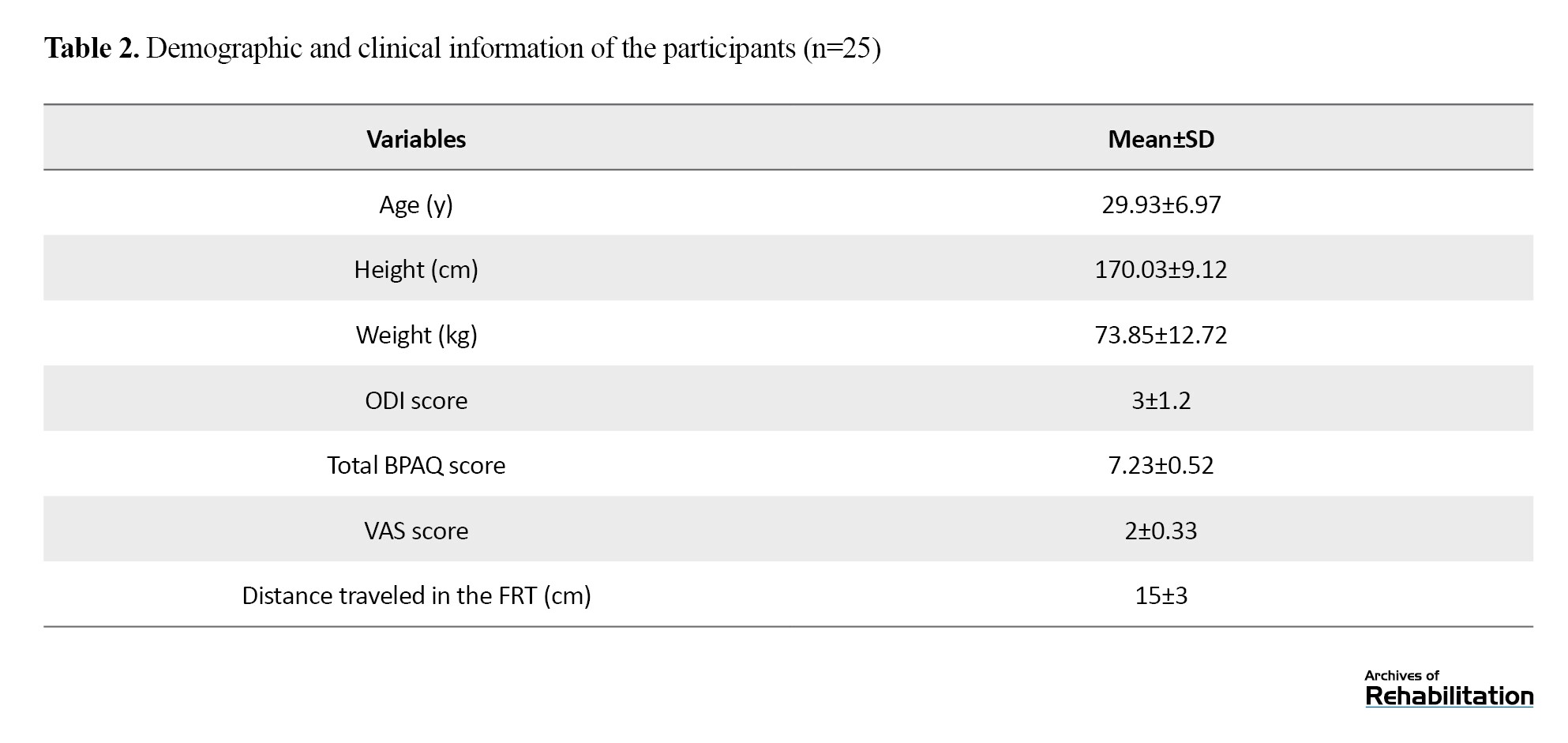
In this study, 25 individuals with chronic NSLBP (15 women and 10 men) with a mean age of about 30 years participated (Table 2).
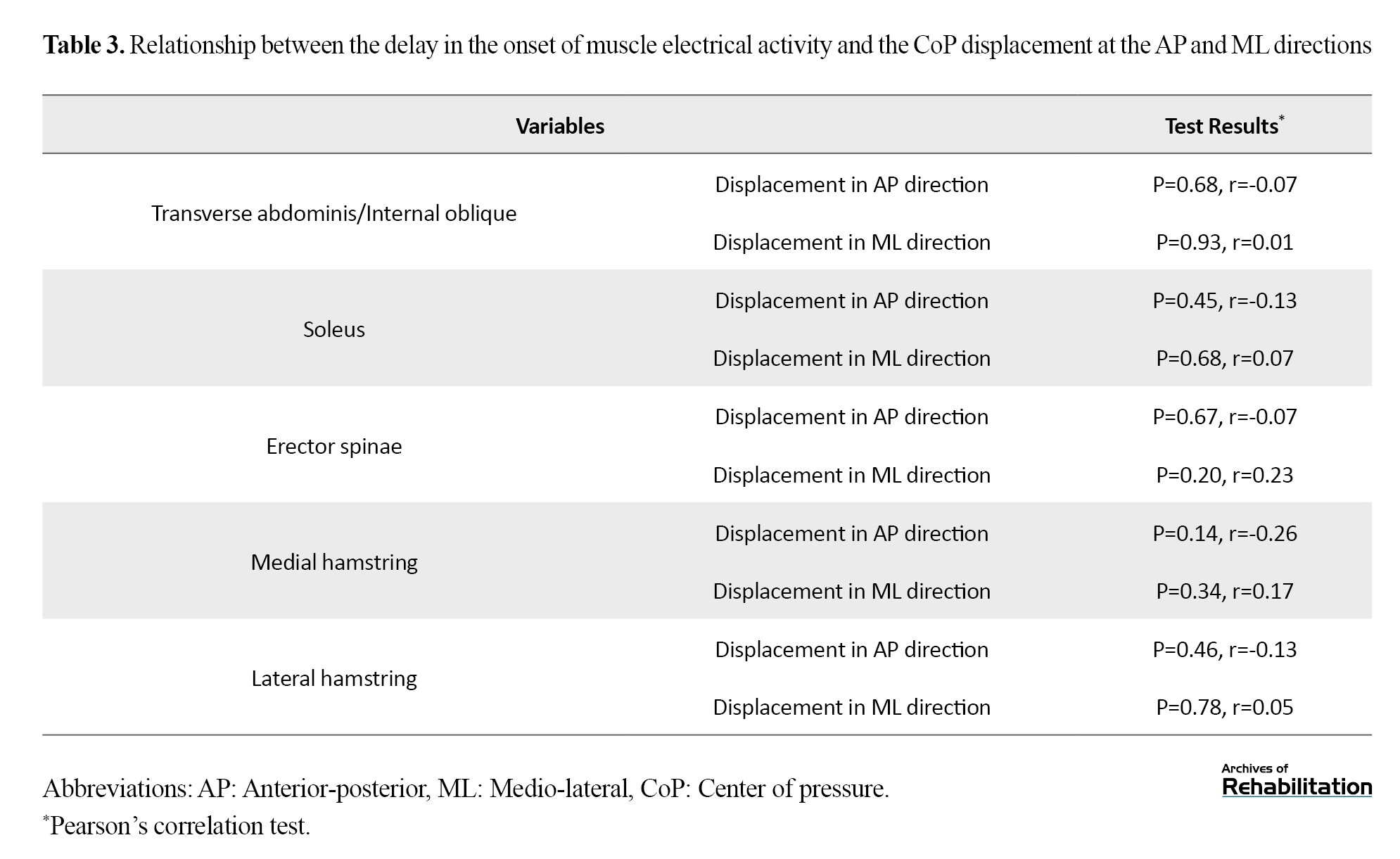
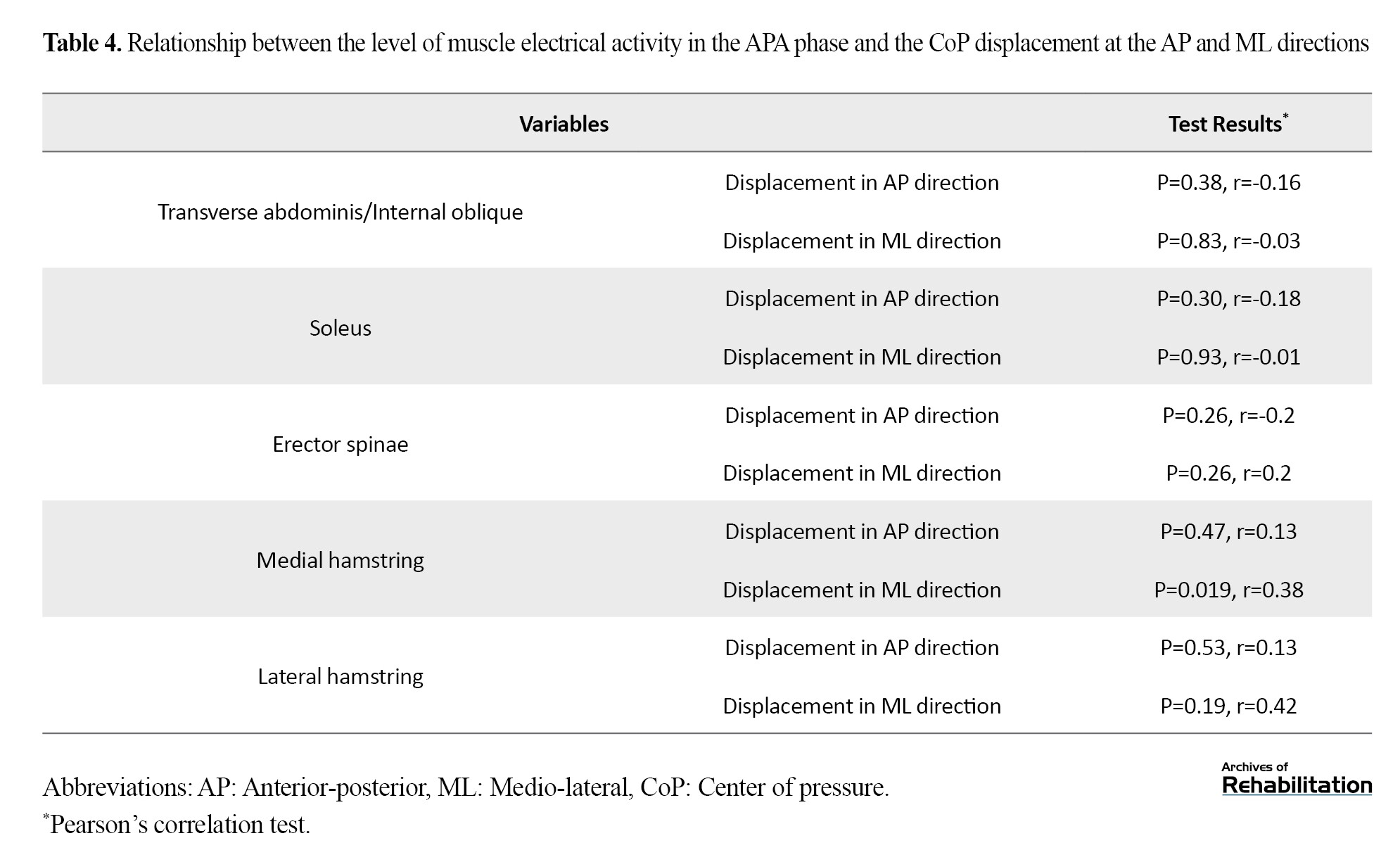
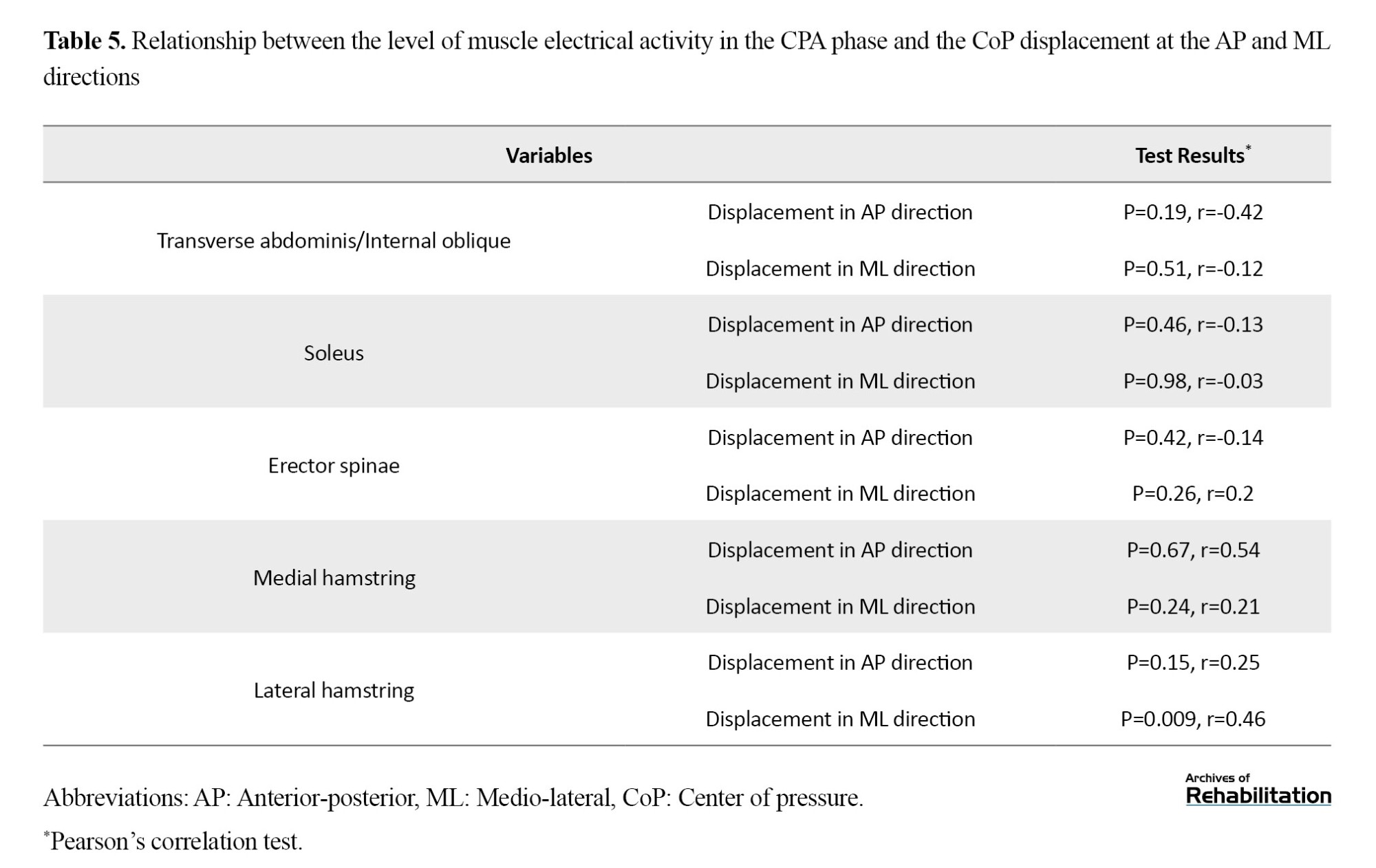
They had a moderate level of physical activity and mild disability. The results of Pearson’s correlation test for assessing the relationship between the delay in the onset of muscle electrical activity and the CoP displacement at AP and ML directions, between the level of muscle electrical activity in the APA phase and the CoP displacement at AP and ML directions, and between the level of muscle electrical activity in the CPA phase and the CoP displacement at AP and ML directions are presented in Tables 3, 4, and 5, respectively. According to the results, the relationship between the electrical activity level of the medial hamstring in the APA phase and the ML CoP displacement (r=0.38, P=0.019) and the relationship between the electrical activity level of the external hamstring in the CPA phase and the ML CoP displacement (r=0.46, P=0.009) was significant and positive. Given that the correlation coefficient value was less than 0.50, these relationship were weak. No statistically significant relationship was observed in other muscles.
Discussion
The primary objective of this study was to determine the relationship between PAs and dynamic balance control during a FRT in individuals with chronic NSLBP. Based on the results, a significant positive relationship was found between the electrical activity level of the medial and external hamstrings in both the APA and CPA phases and the ML CoP displacement. In other words, in individuals with chronic NSLBP, changes in anticipatory and compensatory movement control strategies are associated with a greater CoP displacement in the ML plane and, eventually, with the occurrence of dynamic balance control disorders in this direction (plane) during a FRT. In a recent study, deficits in dynamic balance control in the ML plane was also reported in individuals with chronic low back pain [32]. Noteworthy, in our study, the participants were young and had moderate physical activity and their level of disability was mild. Therefore, although the observed associations between the variables were weak, it can be said that the worsening of motor control deficits with the increase of age, duration of low back pain, pain severity, and disability in individuals with chronic low back pain may be more strongly associated with impaired range of stability and the inability to maintain dynamic balance. However, this hypothesis requires further investigation.
According to previous studies, the amount of muscle electrical activity during the CPA phase relies on the accessibility of the muscles’ anticipatory activity. Thus, production of strong APAs can lead to less compensatory responses [33, 34]. In other words, the CNS, after examining the effects of APAs, plans to produce or weaken compensatory postural activity [35]. Since the production of high levels of electrical activity after the onset of voluntary movement and during the CPA phase, in addition to increasing energy expenditure, can threaten to create a disturbance in the system that need to be controlled by other control strategies when faced with large postural disturbances, optimal use of anticipatory postural corrections and consequently reduced compensatory activity of postural muscles is a general rule of the CNS [35]. However, in cases where anticipatory activity is insufficient or the disturbance is large, the production of large muscle activity in the compensatory phase is inevitable to maintain balance. In these cases, the disturbances introduced by the initiation of voluntary movement can be counteracted by the muscle responses produced after the disturbance [36].
According to previous studies, the FRT used to measure the stability of individuals is affected by multiple factors, including physical (flexibility and strength) and psychological (fear of falling and depression) [37, 38]. Although these factors were not directly measured in our study, given the low mean age (approximately 30 years) and minimal disability reported using the ODI, it can be assumed that the PA deficits during the FRT are well compensated by other factors in individuals with chronic NSLBP. It is recommended to investigate this hypothesis among older individuals suffering from low back pain with severe pain and disability.
This study had some limitations. Age and level of disability of the participants was low. Despite the importance of the CoP displacement as a repeatable indicator in the study of balance control, which was used in our study, it is recommended that other CoP variables such as displacement speed and oscillation area be analyzed in future studies. Due to laboratory limitations, electrical activity was recorded in only five muscles in the present study. It is recommended that electrical activity be recorded in more muscles and bilaterally in future studies.
Conclusion
Changes in the anticipatory and compensatory movement control strategies of the lower limb postural muscles in individuals with chronic NSLBP are associated with greater CoP displacement in the ML plane during the FRT.
Ethical Considerations
Compliance with ethical guidelines
This study has an ethical approval code from the Ethics Committee of Ahvaz Jundishapur University of Medical Sciences, Ahvaz, Iran (Code: IR.AJUMS.REC.1401.239). Before data collection, participants were informed about the study process and signed an informed consent form. All participants were free to withdraw from the study at any stage. Confidentiality of participants’ information was maintained
Funding
This article was extracted from Fatemeh Barati’s master's thesis in Physiotherapy (Code: PHT-0117), funded by Ahvaz Jundishapur University of Medical Sciences.
Authors' contributions
Conceptualization and writing: Neda Orakifar; investigation: Fatemeh Barati; editing and review: Razieh Mofateh and Amin Behdarondan; methodology: Mohammad Mehravar and Ramin Saki; statistical analysis: Maryam Seyyed Tabib.
Conflict of interest
The authors declared no conflict of interest.
AI tools disclosure statement
The authors acknowledge that no AI tools were used in the preparation of this article.
Acknowledgments
Special thanks to Ahvaz Jundishapur University of Medical Sciences for the financial support.
Low back pain is a common experience among people all over the world [1].About 85% of individuals report low back pain at least once in their lives [1, 2]. In 85% of people with low back pain, paraclinical findings are negative and no specific pathology is found [2]. This type of back pain is called non-specific low back pain (NSLBP) [3]. In 80% of people with NSLBP, chronic symptoms persist for up to one year after the onset of pain [4]. Chronic NSLBP has an adverse effect on the independence and quality of life and it is considered as the most important reason for activity restriction among people aged <45 years [5, 6]. Although, available evidences confirm the multifactorial nature of chronic NSLBP, it seems that among numerous physical and psychosocial causes known [7, 8], changes in motor control represent one of the key factors involved in the development and chronicity of low back pain [7-9]. Thus, motor control deficits are strongly associated with chronicity and recurrence of low back pain [10]. In addition, motor control deficits have been identified as factors contributing to the occurrence of balance disorders in people with chronic NSLBP [11]. The ability to maintain dynamic balance control during daily activities is essential and balance dysfunctions can increase risk of falls [12].
Motor control is often studied using the concept of postural adjustments (PAs). Accordingly, to maintain dynamic balance, the central nervous system (CNS) controls the initiation of voluntary movements using overlapping and related PAs, such as anticipatory (APAs) and compensatory (CPAs) [11]. APAs are generated through a feedforward control strategy before the commencement of voluntary movement. APAs are typically generated 100–150 ms before voluntary movement [12–14]. They reflect neural control strategies employed by the CNS to preserve postural stability by regulating the position of the body’s center of mass within the base of support and compensation for perturbing forces generated by voluntary movements and by pre-activating specific muscle groups, thereby reducing the postural perturbations imposed by the initiation of voluntary movement [15]. After a postural perturbation is induced by a voluntary movement, body posture is controlled by the CNS using a feedback-based strategy [16], and these responses are identified as CPAs [17]. Therefore, the goal of CPAs is to restore the location of the center of mass following a perturbation [18]. These adjustments are typically made 50–300 ms after the perturbation [19–21] and utilize the flow of sensory information entering the system [19]. Importantly, effective control of the APA system can reduce the need for CPAs [22]. Therefore, motor control system employes different strategies, such as APAs and CPAs, to control body posture during dynamic activities.
A review study found a delayed activation of the trunk muscles in response to expected perturbations (e.g. voluntary limb movements) and unexpected perturbations in individuals with low back pain, indicating the impairment of APAs and CPAs in these individuals [23], although a research gap in this area still remains. Previous studies have mostly examined the maintenance of a neutral trunk position during upper limb lifting [24-26]and have not assessed PAs during large trunk movements. This is despite the association between the risk of low back pain and large trunk movements [27, 28]. Therefore, it is essential to examine motor control during activities involving trunk movement and displacement. Although PAs have often been studied in standing positions, the role of lower limb postural muscles has received less attention. According to Allery et al., low back pain is not necessarily linked with defect in motor control system in a specific muscle or muscle group, and this disorder can be caused by broad alterations in neural control of the complex lumbopelvic-lower limb segment that manifests itself based on postural demands or specific functional activities [25]. Motor control deficits in the gastrocnemius, hamstring, and gluteus maximus muscles have been indicated in individuals with low back pain [24]. On the other hand, the association between PA deficits and balance has not been examined in individuals with low back pain during functional reach test (FRT), a common, simple, and reproducible clinical tool for assessing dynamic balance control, which is performed in a standing position and is accompanied by trunk movement. Maintaining balance during this test requires the ability to control optimal movement in the trunk and lower limb muscles [29]. Therefore, considering the existing research gap, this study aimed to examine the relationship between PAs and dynamic balance control during a FRT in individuals with chronic NSLBP.
Materials & Methods
This cross-sectional study was performed at the Rehabilitation Research Center, Ahvaz Jundishapur University of Medical Sciences, Ahvaz, Iran. Participants included men and women aged 18-45 years with chronic NSLBP referred to physiotherapy clinics. The sample size was calculated as 25 based on previous studies [23, 24] and considering a test power of 80%, a significance level of 0.05, and an effect size of 0.25. Sampling was performed using a convenience sampling method. Pain in the right lumbar region (between the first lumbar vertebra and the gluteal fold) with or without pain referred to the right lower limb, which was present for at least 3 months and a visual analogue scale (VAS) <3 were considered as inclusion criteria. Considering the impact of chronic pain on muscle function, only people with low back pain on the right side were included in the study. Dizziness, epilepsy, inner ear problems, low back pain due to infection, fracture or pathology, low back pain with neurological symptoms, history of surgery in the back or lower limbs, having other musculoskeletal problems such as previous fractures of the lower limbs, neck pain, knee pain, severe brain injury and inability to follow instructions, history of cardiovascular problems, and use of opioid drugs were considered as exclusion criteria.
Initially, the levels of disability and physical activity were assessed using the Oswestry disability index (ODI) and the Baecke physical activity questionnaire (BPAQ), respectively. Next, a FRT in standing position was performed for dynamic balance assessment. During this test, electrical muscle activity using an electromyography (EMG) device and the center of pressure (CoP) using a force plate were recorded simultaneously. For this purpose, an accelerometer was attached to the participants’ right elbow. After connecting the EMG surface electrodes to the individual’s body, the individual stood on the force plate with their right side facing the wall and both feet shoulder-width apart. A tape measure was attached to the wall at the individual’s shoulder level. Then, the individual raised both arms 90 degrees with the elbows fully extended and the wrists pronated, holding a small bar in the hand and standing in a relaxed and alert position. Next, after hearing the command “move”, the individual was asked to count to 3 and then reach forward as far as possible without stepping or losing the balance, while standing in a fixed position. The distance between the initial and final positions was measured in centimeters (Figure 1). This FRT was performed three times, with a one-minute rest interval between repetitions. The mean distance traveled was recorded. Noteworthy, due to the effect of height on distance traveled in the FRT, the average distance traveled was divided by height, and the resulting number indicated the individual’s functional balance score, used for subsequent analyses.
Recording the muscle electrical activity
Using a wireless surface EMG device and surface electrode placement, the EMG activity of the trunk and lower-limb postural muscles, including the transverse abdominis/internal oblique, erector spinae, medial and lateral hamstrings, and soleus on the right side, was measured. The selection of muscles was made according to previous studies reporting the contribution of these muscles to PAs, and considering type of activity being studied (functional reach). After cleaning the skin using alcohol, electrodes were positioned in parallel with the muscle fibers. The electrode placement method was performed based on the SENIAM standard guide (Table 1). In order to process the EMG data using an accelerometer, the moment when the subject started to move the limb (T0) was determined. Then, the two main variables of PA, including the onset time (delay) of activity and the electrical activity of the muscles were calculated from 150 ms before to 200 ms after the start of limb movement relative to T0. For this purpose, two time intervals were considered: 150 ms before to 50 ms after relative to T0 (considered to examine APAs) and 50 ms after to 200 ms after relative to T0 (considered to examine CPAs).
MATLAB 2016 software was applied for data processing. The EMG signals were filtered at 10-500 Hz and then sampled at a frequency of 1000 Hz. To determine the delay in the start of muscle electrical activity, it is first necessary to determine the onset time of muscle activity. The onset time was considered as the moment when the increase in signal amplitude exceeded the mean level of the background electrical activity by two standard deviations and this increase persisted for 50 ms. The time interval between the onset of muscle electrical activity and the moment of maximum deflection of initial accelerometer was then considered as the delay in the onset of muscle electrical activity. To determine the level of muscle electrical activity, after rectifying and applying a two-way Butterworth low-pass filter with a cutoff of 250 Hz, the background electrical activity was determined 600-800 ms before the start of movement. Then, the root mean square of the muscle electrical activity in the anticipatory and compensatory activity interval was calculated. Thus, the average of EMG signals in the time intervals were integrated. The integrated electrical activity refers to the sum of the muscle activity in each time interval for each muscle from which the background muscle activity was subtracted. Also, to make the electrical activity of muscles comparable between different individuals, the ratio of the integrated muscle activity to the background muscle activity was calculated. For both EMG variables (delay in onset of electrical activity and muscle electrical activity level), the average of the signals of three repetitions was calculated for each individual.
Dynamic balance assessment
The CoP data including the torque and ground reaction force were recorded during the FRT with a six-channel Kistler force plate at a sampling frequency of 100 Hz. After coding in MATLAB 2016 software, the amount of CoP displacement in the anterior–posterior (AP) and medial–lateral (ML) directions was used for subsequent analyses.
Oswestry disability index
The ODI clarifies how low back pain affects the individual’s capability to do activities of daily living and includes 10 items rated on a Likert scale ranging from 0 to 5. The total score is divided by the maximum possible score (i.e. 50), and multiplied by 100 to produce a percentage. A score of 10-20% indicates mild disability, a score of 21-40% shows moderate disability, and a score of 41-60% reflect severe disability. The psychometric characteristics of the Persian version of ODI were confirmed by Mousavi et al. [30].
Baecke physical activity questionnaire
The BPAQ evaluates a person’s level of physical activity with 16 items and 3 domains: physical activity at work, physical activity in sports, and leisure-time physical activity. Each item was rated on a 5-point Likert scale from 1 (never) to 5 (always). The total score range is 0-15, with higher scores indicating higher physical activity. The psychometric properties of the questionnaire have been reported to be acceptable [31].
Visual analogue scale
The VAS was used to assess the level of low back pain in participants immediately after the their entrance to the research site. For this purpose, a 10 cm horizontal line with the labels “no pain” (left) and “worst pain imaginable” (right) was drawn on a paper sheet and participants were asked to mark a point on this horizontal line to describe their perceived pain.
Statistical analysis
SPSS software, version 29 was using for statistical analysis. Given the normal distribution of the data, the relationship between variables was examined using Pearson’s correlation test. In this test, a correlation coefficient (r) of 0-0.25 shows no correlation, 0.25-0.50 weak correlation, 0.50-0.75 moderate to good correlation, and >0.75 strong correlation. P<0.05 was considered statistically significant.
Results
In this study, 25 individuals with chronic NSLBP (15 women and 10 men) with a mean age of about 30 years participated (Table 2).
They had a moderate level of physical activity and mild disability. The results of Pearson’s correlation test for assessing the relationship between the delay in the onset of muscle electrical activity and the CoP displacement at AP and ML directions, between the level of muscle electrical activity in the APA phase and the CoP displacement at AP and ML directions, and between the level of muscle electrical activity in the CPA phase and the CoP displacement at AP and ML directions are presented in Tables 3, 4, and 5, respectively. According to the results, the relationship between the electrical activity level of the medial hamstring in the APA phase and the ML CoP displacement (r=0.38, P=0.019) and the relationship between the electrical activity level of the external hamstring in the CPA phase and the ML CoP displacement (r=0.46, P=0.009) was significant and positive. Given that the correlation coefficient value was less than 0.50, these relationship were weak. No statistically significant relationship was observed in other muscles.
Discussion
The primary objective of this study was to determine the relationship between PAs and dynamic balance control during a FRT in individuals with chronic NSLBP. Based on the results, a significant positive relationship was found between the electrical activity level of the medial and external hamstrings in both the APA and CPA phases and the ML CoP displacement. In other words, in individuals with chronic NSLBP, changes in anticipatory and compensatory movement control strategies are associated with a greater CoP displacement in the ML plane and, eventually, with the occurrence of dynamic balance control disorders in this direction (plane) during a FRT. In a recent study, deficits in dynamic balance control in the ML plane was also reported in individuals with chronic low back pain [32]. Noteworthy, in our study, the participants were young and had moderate physical activity and their level of disability was mild. Therefore, although the observed associations between the variables were weak, it can be said that the worsening of motor control deficits with the increase of age, duration of low back pain, pain severity, and disability in individuals with chronic low back pain may be more strongly associated with impaired range of stability and the inability to maintain dynamic balance. However, this hypothesis requires further investigation.
According to previous studies, the amount of muscle electrical activity during the CPA phase relies on the accessibility of the muscles’ anticipatory activity. Thus, production of strong APAs can lead to less compensatory responses [33, 34]. In other words, the CNS, after examining the effects of APAs, plans to produce or weaken compensatory postural activity [35]. Since the production of high levels of electrical activity after the onset of voluntary movement and during the CPA phase, in addition to increasing energy expenditure, can threaten to create a disturbance in the system that need to be controlled by other control strategies when faced with large postural disturbances, optimal use of anticipatory postural corrections and consequently reduced compensatory activity of postural muscles is a general rule of the CNS [35]. However, in cases where anticipatory activity is insufficient or the disturbance is large, the production of large muscle activity in the compensatory phase is inevitable to maintain balance. In these cases, the disturbances introduced by the initiation of voluntary movement can be counteracted by the muscle responses produced after the disturbance [36].
According to previous studies, the FRT used to measure the stability of individuals is affected by multiple factors, including physical (flexibility and strength) and psychological (fear of falling and depression) [37, 38]. Although these factors were not directly measured in our study, given the low mean age (approximately 30 years) and minimal disability reported using the ODI, it can be assumed that the PA deficits during the FRT are well compensated by other factors in individuals with chronic NSLBP. It is recommended to investigate this hypothesis among older individuals suffering from low back pain with severe pain and disability.
This study had some limitations. Age and level of disability of the participants was low. Despite the importance of the CoP displacement as a repeatable indicator in the study of balance control, which was used in our study, it is recommended that other CoP variables such as displacement speed and oscillation area be analyzed in future studies. Due to laboratory limitations, electrical activity was recorded in only five muscles in the present study. It is recommended that electrical activity be recorded in more muscles and bilaterally in future studies.
Conclusion
Changes in the anticipatory and compensatory movement control strategies of the lower limb postural muscles in individuals with chronic NSLBP are associated with greater CoP displacement in the ML plane during the FRT.
Ethical Considerations
Compliance with ethical guidelines
This study has an ethical approval code from the Ethics Committee of Ahvaz Jundishapur University of Medical Sciences, Ahvaz, Iran (Code: IR.AJUMS.REC.1401.239). Before data collection, participants were informed about the study process and signed an informed consent form. All participants were free to withdraw from the study at any stage. Confidentiality of participants’ information was maintained
Funding
This article was extracted from Fatemeh Barati’s master's thesis in Physiotherapy (Code: PHT-0117), funded by Ahvaz Jundishapur University of Medical Sciences.
Authors' contributions
Conceptualization and writing: Neda Orakifar; investigation: Fatemeh Barati; editing and review: Razieh Mofateh and Amin Behdarondan; methodology: Mohammad Mehravar and Ramin Saki; statistical analysis: Maryam Seyyed Tabib.
Conflict of interest
The authors declared no conflict of interest.
AI tools disclosure statement
The authors acknowledge that no AI tools were used in the preparation of this article.
Acknowledgments
Special thanks to Ahvaz Jundishapur University of Medical Sciences for the financial support.
References
- Dankaerts W, O’Sullivan PB, Straker LM, Burnett AF, Skouen JS. The inter-examiner reliability of a classification method for non-specific chronic low back pain patients with motor control impairment. Manual Therapy. 2006; 11(1):28-39. [DOI:10.1016/j.math.2005.02.001] [PMID]
- Jacobs JV, Lomond KV, Hitt JR, DeSarno MJ, Bunn JY, Henry SM. Effects of low back pain and of stabilization or movement-system-impairment treatments on induced postural responses: A planned secondary analysis of a randomised controlled trial. Manual Therapy. 2016; 21:210-9. [DOI:10.1016/j.math.2015.08.006] [PMID]
- Meier ML, Vrana A, Schweinhardt P. Low back pain: The potential contribution of supraspinal motor control and proprioception. The Neuroscience. 2019; 25(6):583-96. [DOI:10.1177/1073858418809074] [PMID]
- Brennan GP, Fritz JM, Hunter SJ, Thackeray A, Delitto A, Erhard RE. Identifying subgroups of patients with acute/subacute “nonspecific” low back pain: Results of a randomized clinical trial. Spine. 2006; 31(6):623-31. [DOI:10.1097/01.brs.0000202807.72292.a8] [PMID]
- Krismer M, Van Tulder M. Low back pain (non-specific). Best Practice & Research Clinical Rheumatology. 2007 ; 21(1):77-91. [DOI:10.1016/j.berh.2006.08.004]
- Melzack R, Wall PD. Pain mechanisms: A new theory. Science. 1965; 150(3699):971-9. [DOI:10.1126/science.150.3699.971] [PMID]
- Falla D, Hodges PW. Individualized exercise interventions for spinal pain. Exercise and Sport Sciences Reviews.2017; 45(2):105-15. [DOI:10.1249/JES.0000000000000103] [PMID]
- Yojana E, Zahari Z, Bukry SA. Factors that influence motor control in individuals with nonspecific low back pain: A scoping review. The Medical Journal of Malaysia. 2024; 79(Suppl 1):209-14. [PMID]
- Hodges PW, Smeets RJ. Interaction between pain, movement, and physical activity: Short-term benefits, long-term consequences, and targets for treatment. The Clinical Journal of Pain. 2015; 31(2):97-107. [DOI:10.1097/AJP.0000000000000098] [PMID]
- Hodges PW, Moseley GL. Pain and motor control of the lumbopelvic region: effect and possible mechanisms. Journal of Electromyography and Kinesiology . 2003; 13(4):361-70. [DOI:10.1016/s1050-6411(03)00042-7] [PMID]
- Silfies SP, Mehta R, Smith SS, Karduna AR. Differences in feedforward trunk muscle activity in subgroups of patients with mechanical low back pain. Archives of Physical Medicine and Rehabilitation. 2009; 90(7):1159-69. [DOI:10.1016/j.apmr.2008.10.033] [PMID]
- Sun P, Li K, Yao X, Wu Z, Yang Y. Association between functional disability with postural balance among patients with chronic low back pain. Frontiers in Neurology. 2023; 14:1136137. [DOI:10.3389/fneur.2023.1136137] [PMID]
- Belen'kiĭ VE, Gurfinkel' VS, Pal'tsev EI. [Control elements of voluntary movements (Russian)]. Biofizika. 1967; 12(1):135-41. [PMID]
- Massion J. Movement, posture and equilibrium: Interaction and coordination. Progress in Neurobiology. 1992; 38(1):35-56.[DOI:10.1016/0301-0082(92)90034-C] [PMID]
- Aruin AS, Latash ML. Anticipatory postural adjustments during self-initiated perturbations of different magnitude triggered by a standard motor action. Electroencephalography and Clinical Neurophysiology. 1996; 101(6):497-503. [DOI:10.1016/S0921-884X(96)95219-4]
- Bussey MD, Aldabe D, Shemmell J, Jowett T. Anticipatory postural control differs between low back pain and pelvic girdle pain patients in the absence of visual feedback. Human Movement Science. 2020; 69:102529. [DOI:10.1016/j.humov.2019.102529] [PMID]
- Tsang SMH, Chan EHW, Chan JYH, Huang GPY, Lam KKT, Lam EWY, et al. Reactive postural adjustment in response to predictable and unpredictable perturbations in healthy adults: A comparison between swayback, hyperlordotic and erect postures. Gait & Posture. 2024; 108:35-43. [DOI:10.1016/j.gaitpost.2023.11.003] [PMID]
- Macpherson JM, Horak FB, Dunbar DC, Dow RS. Stance dependence of automatic postural adjustments in humans. Experimental Brain Research. 1989; 78(3):557-66. [DOI:10.1007/BF00230243] [PMID]
- Horak FB, Nashner LM. Central programming of postural movements: adaptation to altered support-surface configurations. Journal of Neurophysiology. 55(6):1369-81. [DOI:10.1152/jn.1986.55.6.1369] [PMID]
- Henry SM, Fung J, Horak FB; New Collective Author. EMG responses to maintain stance during multidirectional surface translations. Journal of Neurophysiology. 1998; 80(4):1939-50. [DOI:10.1152/jn.1998.80.4.1939] [PMID]
- Mohapatra S, Krishnan V, Aruin AS. Postural control in response to an external perturbation: Effect of altered proprioceptive information. Experimental Brain Research. 2012; 217(2):197-208.[DOI:10.1007/s00221-011-2986-3] [PMID]
- Lee YJ, Aruin AS. Three components of postural control associated with pushing in symmetrical and asymmetrical stance. Experimental Brain Research. 2013; 228(3):341-51. [DOI:10.1007/s00221-013-3567-4] [PMID]
- Knox MF, Chipchase LS, Schabrun SM, Romero RJ, Marshall PWM. Anticipatory and compensatory postural adjustments in people with low back pain: A systematic review and meta-analysis. The Spine Journal. 2018; 18(10):1934-49. [DOI:10.1016/j.spinee.2018.06.008] [PMID]
- Thomas JS, France CR, Sha D, Vander Wiele N, Moenter S, Swank K. The effect of chronic low back pain on trunk muscle activations in target reaching movements with various loads. Spine. 2007; 32(26):801-8. [DOI:10.1097/BRS.0b013e31815d0003] [PMID]
- Massé-Alarie H, Beaulieu LD, Preuss R, Schneider C. Task-specificity of bilateral anticipatory activation of the deep abdominal muscles in healthy and chronic low back pain populations. Gait & Posture. 2015; 41(2):440-7. [DOI:10.1016/j.gaitpost.2014.11.006] [PMID]
- Young KJ, Je CW, Hwa ST. Effect of proprioceptive neuromuscular facilitation integration pattern and swiss ball training on pain and balance in elderly patients with chronic back pain. Journal of Physical Therapy Science. 2015; 27(10):3237-40. [DOI:10.1589/jpts.27.3237] [PMID]
- Marras WS, Lavender SA, Leurgans SE, Rajulu SL, Allread WG, Fathallah FA, et al. The role of dynamic three dimensional trunk motion in occupationally-related low back disorders. The effects of workplace factors, trunk position, and trunk motion characteristics on risk of injury. Spine. 1993; 18(5):617-28.[DOI:10.1097/00007632-199304000-00015] [PMID]
- Punnett L, Fine LJ, Keyserling WM, Herrin GD, Chaffin DB. Back disorders and nonneutral trunk postures of automobile assembly workers. Scandinavian Journal of Work, Environment & Health. 1991; 17(5):337-46. [DOI:10.5271/sjweh.1700] [PMID]
- Duray M, Yagci N, Ok N. Determination of physical parameters associated with self-efficacy in patients with chronic mechanic low back pain. Journal of Back and Musculoskeletal Rehabilitation. 2018; 31(4):743-8. [DOI:10.3233/BMR-170993] [PMID]
- Mousavi SJ, Parnianpour M, Mehdian H, Montazeri A, Mobini B. The Oswestry disability index, the Roland-Morris disability questionnaire, and the Quebec back pain disability scale: Translation and validation studies of the Iranian versions. Spine. 2006; 31(14):E454-9. [DOI:10.1097/01.brs.0000222141.61424.f7] [PMID]
- Fogelholm MI, Malmberg J, Suni J, Santtila M, Kyrolainen H, Mantysaari M, et al. International physical activity questionnaire: Validity against fitness. Medicine and Science in Sports and Exercise. 2006; 38(4):753-60. [DOI:10.1249/01.mss.0000194075.16960.20] [PMID]
- Sung P, Lee D. Sensory integration strategies on repeated postural stability and neuromuscular adaptation in individuals with low back pain. European Spine Journal. 2025; 34(6):2367-76.[DOI:10.1007/s00586-025-08879-w] [PMID]
- Santos MJ, Kanekar N, Aruin AS. The role of anticipatory postural adjustments in compensatory control of posture: 2. Biomechanical analysis. Journal of Electromyography and Kinesiology. 2010; 20(3):398-405. [DOI:10.1016/j.jelekin.2010.01.002] [PMID]
- Kaewmanee T, Liang H, Aruin A. Effect of predictability of the magnitude of a perturbation on anticipatory and compensatory postural adjustments. Experimental Brain Research. 2020; 238(10):2207-19. [DOI:10.1007/s00221-020-05883-y] [PMID]
- Santos MJ, Kanekar N, Aruin AS. The role of anticipatory postural adjustments in compensatory control of posture: 1. Electromyographic analysis. Journal of Electromyography and Kinesiology. 2010; 20(3):388-97. [DOI:10.1016/j.jelekin.2009.06.006] [PMID]
- Bloem BR, Allum JH, Carpenter MG, Verschuuren JJ, Honegger F. Triggering of balance corrections and compensatory strategies in a patient with total leg proprioceptive loss. Experimental Brain Research. 2002; 142(1):91-107. [DOI:10.1007/s00221-001-0926-3] [PMID]
- Rosa MV, Perracini MR, Ricci NA. Usefulness, assessment and normative data of the Functional Reach Test in older adults: A systematic review and meta-analysis. Archives of Gerontology and Geriatrics. 2019; 81:149-70. [DOI:10.1016/j.archger.2018.11.015] [PMID]
- Moriyama Y, Yamada T, Shimamura R, Ohmi T, Hirosawa M, Yamauchi T, et al. Movement patterns of the functional reach test do not reflect physical function in healthy young and older participants. PLoS One. 2022; 17(3):e0266195. [DOI:10.1371/journal.pone.0266195] [PMID]
Type of Study: Original |
Subject:
Physical Therapy
Send email to the article author
| Rights and permissions | |
 |
This work is licensed under a Creative Commons Attribution-NonCommercial 4.0 International License. |

Copyright © The Author(s);
This is an open access article distributed under the terms of the Creative Commons Attribution-NonCommercial 4.0 (CC-By-NC 4.0), which permits use, distribution, and reproduction in any medium, provided the original work is properly cited and is not used for commercial purposes.
Contact Information
This is an open access article distributed under the terms of the Creative Commons Attribution-NonCommercial 4.0 (CC-By-NC 4.0), which permits use, distribution, and reproduction in any medium, provided the original work is properly cited and is not used for commercial purposes.
Contact Information