

Volume 27, Issue 1 (5-2026)
Arch Rehabil 2026, 27(1): 88-109 |
Back to browse issues page




Download citation:
BibTeX | RIS | EndNote | Medlars | ProCite | Reference Manager | RefWorks
Send citation to:


BibTeX | RIS | EndNote | Medlars | ProCite | Reference Manager | RefWorks
Send citation to:
Mohammad Otaghsara F, Bahmani B, Jafari P, Bidhendi R, Kheirkhah Alavi S M. The Relationship Between Adverse Childhood Experiences and Onset of Multiple Sclerosis: The Mediator Role of Sense of Coherence. Arch Rehabil 2026; 27 (1) :88-109
URL: http://rehabilitationj.uswr.ac.ir/article-1-3691-en.html
URL: http://rehabilitationj.uswr.ac.ir/article-1-3691-en.html
Fatemeh Mohammad Otaghsara1  , Bahman Bahmani *2 , Parvin Jafari1, Raziyeh Bidhendi3 , Seyed Mohsen Kheirkhah Alavi4
, Bahman Bahmani *2 , Parvin Jafari1, Raziyeh Bidhendi3 , Seyed Mohsen Kheirkhah Alavi4
1- Department of Counseling, Faculty of Behavior Sciences, University of Social Welfare and Rehabilitation Science, Tehran, Iran.
2- Department of Counseling, Faculty of Behavior Sciences, University of Social Welfare and Rehabilitation Science, Tehran, Iran. ,bbahmani43@gmail.com
3- Department of Biostatistics and Epidemiology, Faculty of Social Welfare, University of Social Welfare and Rehabilitation Science, Tehran, Iran.
4- Department of Counseling, Student Research Committee, Faculty of Behavior Sciences, University of Social Welfare and Rehabilitation Science, Tehran, Iran.
2- Department of Counseling, Faculty of Behavior Sciences, University of Social Welfare and Rehabilitation Science, Tehran, Iran. ,
3- Department of Biostatistics and Epidemiology, Faculty of Social Welfare, University of Social Welfare and Rehabilitation Science, Tehran, Iran.
4- Department of Counseling, Student Research Committee, Faculty of Behavior Sciences, University of Social Welfare and Rehabilitation Science, Tehran, Iran.
Full-Text [PDF 2482 kb]
(393 Downloads)
| Abstract (HTML) (2356 Views)
Full-Text: (256 Views)
Introduction
Multiple sclerosis (MS) is a long-term, immune-mediated disorder affecting the central nervous system marked by inflammatory processes and the loss of myelin sheaths around neurons in the brain and spinal cord, with no known cure currently available [1, 2]. Among the most prevalent central nervous system disorders, MS impacts around 2.8 million people globally, with a worldwide prevalence of 35.9 cases per 100,000 individuals [3]. Although Iran was once thought to have a low risk for MS, it is now acknowledged as a region with a high prevalence of the condition [4, 5]. MS symptoms can significantly impair individuals through various sensory, motor, cognitive, and sexual difficulties [2, 6, 7]. Moreover, the psychological effects of MS, such as stress, feelings of helplessness, guilt, a diminished sense of self, job loss, decreased social engagement, and strained relationships impact nearly all areas of a person’s life [8, 9].
The rising incidence of MS, combined with its severe impact, highlights the need to investigate its underlying causes. Although considerable progress has been made in medicine, the exact cause remains unclear, though current evidence points to a complex interaction between genetic predisposition and environmental influences in disease development [10-12]. Among environmental factors, a history of abuse, neglect, or exposure to violence in early life is more common in MS patients than in the general population, suggesting a possible connection between these experiences and the development of the disease [13]. These experiences can be understood within the framework of adverse childhood experiences (ACEs). As defined by the World Health Organization (WHO) [14], ACEs represent some of the most common and severe stressors in early childhood, including physical, sexual, and emotional abuse; physical and emotional neglect; domestic violence between caregivers; family substance abuse; and peer, societal, or community-based violence.
Research exploring the impact of ACEs on MS incidence has produced inconsistent findings. Some studies [13, 15-19] report a link between these early life events and the start or worsening of MS, whereas others [20-23] found no significant correlation. This variation in results might be due to the use of differing definitions and assessment tools. Additionally, it is important to recognize that stress does not act in a straightforward manner; psychosocial elements like social support, resilience, and specific coping mechanisms can modulate the range of outcomes [15].
The sense of coherence (SOC) is another potentially relevant factor. SOC describes an individual’s capacity to handle life’s difficulties and stressors in a way that maintains both psychological and physical well-being, allowing them to endure significant stress and mental strain. SOC is a global life orientation indicating how much a person finds their world understandable, its demands surmountable, and their life purposeful [24]. Those with high SOC view stressful events as manageable challenges and actively seek out and employ their available resources to address them [25]. While prior research has shown that SOC directly correlates with better health-related quality of life (QoL) and life satisfaction, and inversely correlates with depression and psychological issues in MS patients, its role in mediating the connection between ACEs and the onset of this condition remains unexplored [26].
Given the conflicting findings on the link between ACEs and MS, and the lack of research on whether SOC mediates this relationship, this study aimed to examine the association between ACEs and MS development. Using the WHO’s comprehensive definition of ACEs and the ACEs international questionnaire (ACE-IQ), the study also assessed the potential mediating role of SOC. The primary research question was whether SOC mediate the relationship between ACEs and the onset of MS.
Materials and Methods
Study design
This study is cross-sectional in design, with a descriptive-correlational approach, and specifically uses mediation analysis to examine the relationships under investigation.
Study participants
The study population included individuals aged 18 and older with MS and age- and gender-matched healthy controls. Patients were recruited from the “Emrooz Chand Ghadam?!” (How Many Steps Today?!) NGO, while the control group was drawn from members of the Bale, Eitaa, and Telegram platforms. Convenience sampling was used, and the sample size was determined using the following formula (Equation 1) [20]:

With a type i error of 0.05, power of 0.80, effect size of 0.4, and an expected attrition rate of 10%, the minimum required sample size was 110 participants per group, totaling 220 individuals (Equation 2).

The inclusion criteria were literacy (reading and writing ability), capacity to complete online questionnaires, and age ≥18 years (due to the ACE-IQ’s age standardization). To avoid confounding from pre-diagnosis ACEs, MS patients must have received their diagnosis after age 18. The exclusion criteria included failure to answer any questionnaire item.
Study instruments
ACE-IQ: The questionnaire was developed by WHO and designed to support research on ACEs prevalence and outcomes in low-income settings. It consists of 43 items across 7 sections: demographic data (7 items), marital status (5 items), parent/caregiver relationships (5 items, 5-point Likert scale), family environment (16 items—first 5 in Yes/No, next 11 in 4-point Likert), peer violence (3 items—items 1 and 3 in 4-point Likert, item 2 in 7-point Likert), witnessing community violence (3 items, 4-point Likert), and exposure to collective violence or war (4 items, 4-point Likert). The total score is derived from sections 3–7, ranging from 26 to 114, and is suitable for individuals aged 18 and above [13, 14]. In a study by Kazeem [27], subscale Cronbach α values ranged from 0.69 to 0.81, and the ACE-IQ total score correlated positively with the childhood trauma questionnaire (r=0.72, P<0.01). In Iran, internal consistency was assessed via Cronbach’s α (0.53–0.78 across subscales), and discriminant validity was confirmed as average variance extracted (AVE) exceeded both maximum shared squared variance (MSV) and average shared squared variance (ASV) [28].
SOC questionnaire: This questionnaire was introduced by Antonovsky [29] and measures a global orientation to life. It contains 29 items rated on a 7-point Likert scale (1–7), with reverse scoring for items 1, 4, 5, 6, 7, 11, 13, 14, 16, 20, 23, 25, and 27. The total score ranges from 29 to 203, where higher values reflect stronger SOC. The scale includes 3 subscales: comprehensibility (items 1, 3, 5, 10, 12, 15, 17, 19, 21, 24, 26), manageability (items 2, 6, 9, 13, 18, 20, 23, 25, 27, 29), and meaningfulness (items 4, 7, 8, 11, 14, 16, 22, 28). Across 26 studies, Cronbach α values ranged from 0.82 to 0.95, and test-retest reliability was 0.54 over two years [30]. In Iran, factor analysis confirmed a single-factor structure explaining 76.5% of variance, with all items loading on this factor; internal consistency was 0.969, indicating high reliability [31].
Study procedure
After obtaining ethical approval from the University of Social Welfare and Rehabilitation Sciences Ethics Committee, coordination was made with the manager of the “Emrooz Chand Ghadam?!” NGO to recruit MS patients. The research goals and procedures were explained to the manager and subsequently to the members; with 861 members, this NGO was anticipated to provide maximum variance for the study sample. Following the manager’s consent, a participation call detailing the study’s aims and methods was published to members. Considering the sensory-motor impairments and mobility issues common in MS, questionnaires were distributed online to eligible applicants after they completed the informed consent form. Once MS patient responses were collected, they were stratified by age and gender to define the necessary distribution for the healthy control group. A subsequent invitation was posted in student groups on Bale, Eitaa, and Telegram, outlining the objectives and inviting volunteers whose age and gender matched the established stratification (either for themselves or acquaintances). Questionnaires, preceded by informed consent, were sent online to these volunteers, and data collection continued until all targeted age and gender quotas were filled.
Statistical analysis
Frequency tables and indices of central and dispersion tendency were utilized to describe the data. For data inference, independent samples t-test, linear and logistic regression, and mediation analysis were employed. Data processing was conducted using SPSS 26 and R software.
Results
The participants of this study consisted of 224 individuals (following the exclusion of cases meeting the exclusion criteria), who were equally divided into two groups: patients with MS and non-patient counterparts, matched for gender and age categories. As shown in Table 1, the majority of participants were female, within the 40-44 age range, held higher education degrees (associate’s and bachelor’s), and were married.
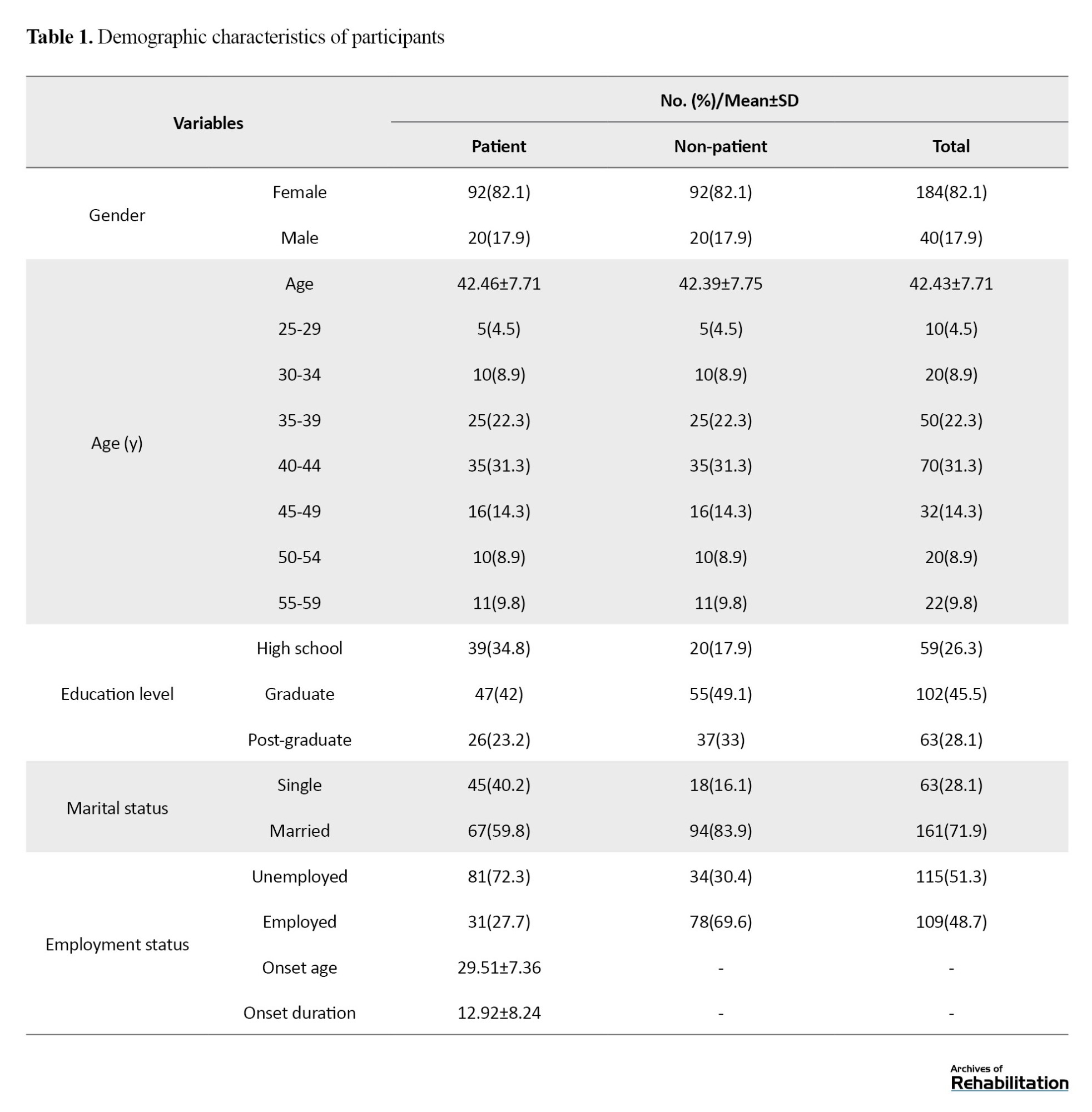
Most patients were unemployed, whereas the majority of non-patients were employed. The mean age and duration of MS were 29.51±7.36 and 12.92±8.24 years, respectively.
Table 2 presents the mean and standard deviation of ACEs and SOC scores for the participants, separated by patient and non-patient groups, as well as the significance of the difference between them (using the independent samples t-test).
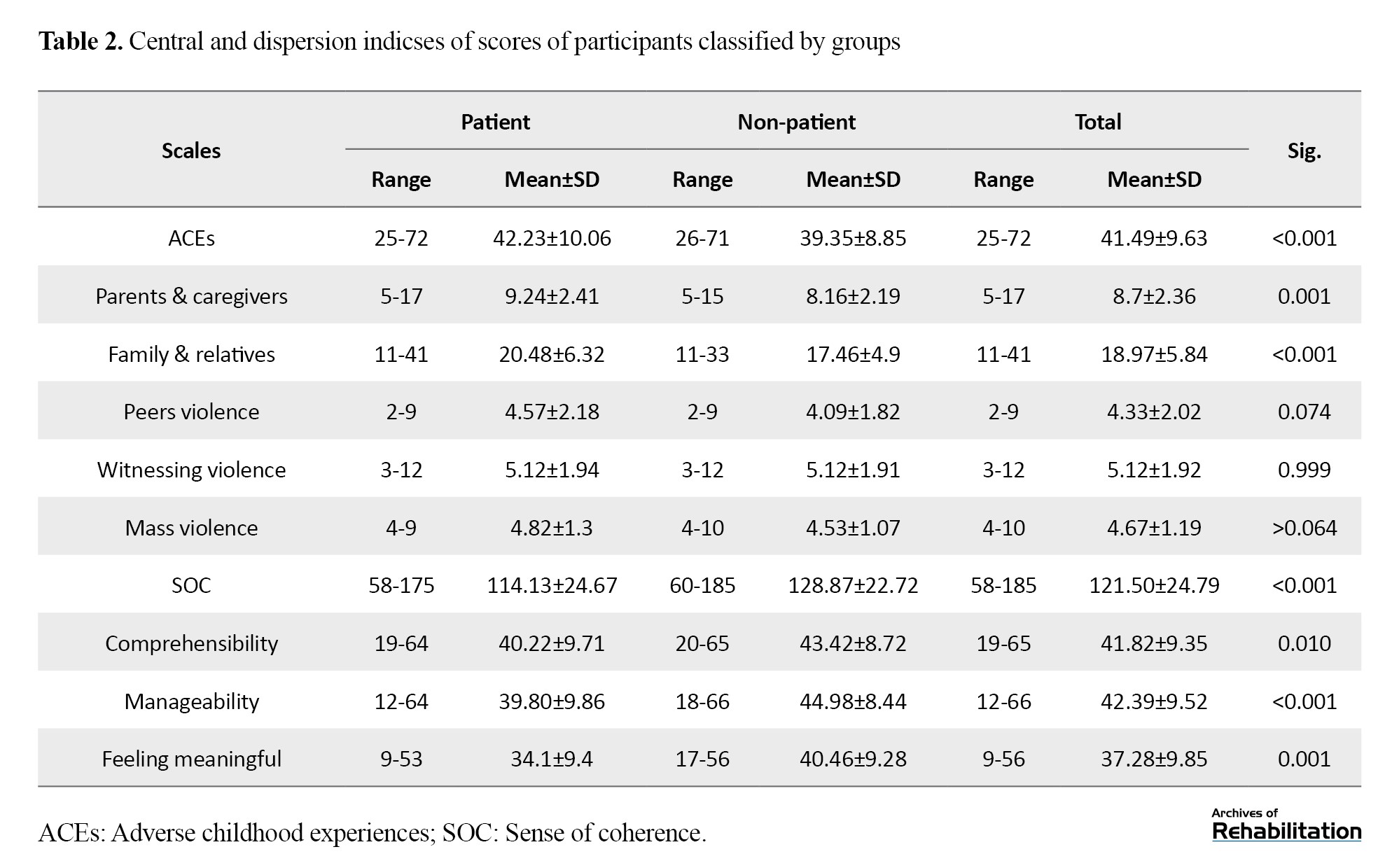
As observed, with the exception of the subscales for peer violence (P=0.074), witnessing violence (P>0.999), and collective violence (P>0.064), the two groups differed significantly in all other subscales (P<0.05). Specifically, the patient group scored higher on ACEs—particularly in the parents and family subscales—and lower on the SOC and its subscales compared to the non-patient group.
To examine the assumption of normality in data distribution, kurtosis and skewness indices were utilized, the results of which confirmed this assumption (values were within ±1 for both ACEs and SOC variables in both groups). Furthermore, an examination of standard z-scores indicated that all scores fell within the standard range of ±3. The Durbin-Watson statistic was calculated to be within the range of 1.5 to 2.5 (1.95), indicating the independence of errors. Additionally, the variance inflation factor (VIF) and Tolerance index were both equal to 1, confirming the assumption of no multicollinearity. Figure 1 displays the scatter plot of ACEs values against the predicted SOC values.
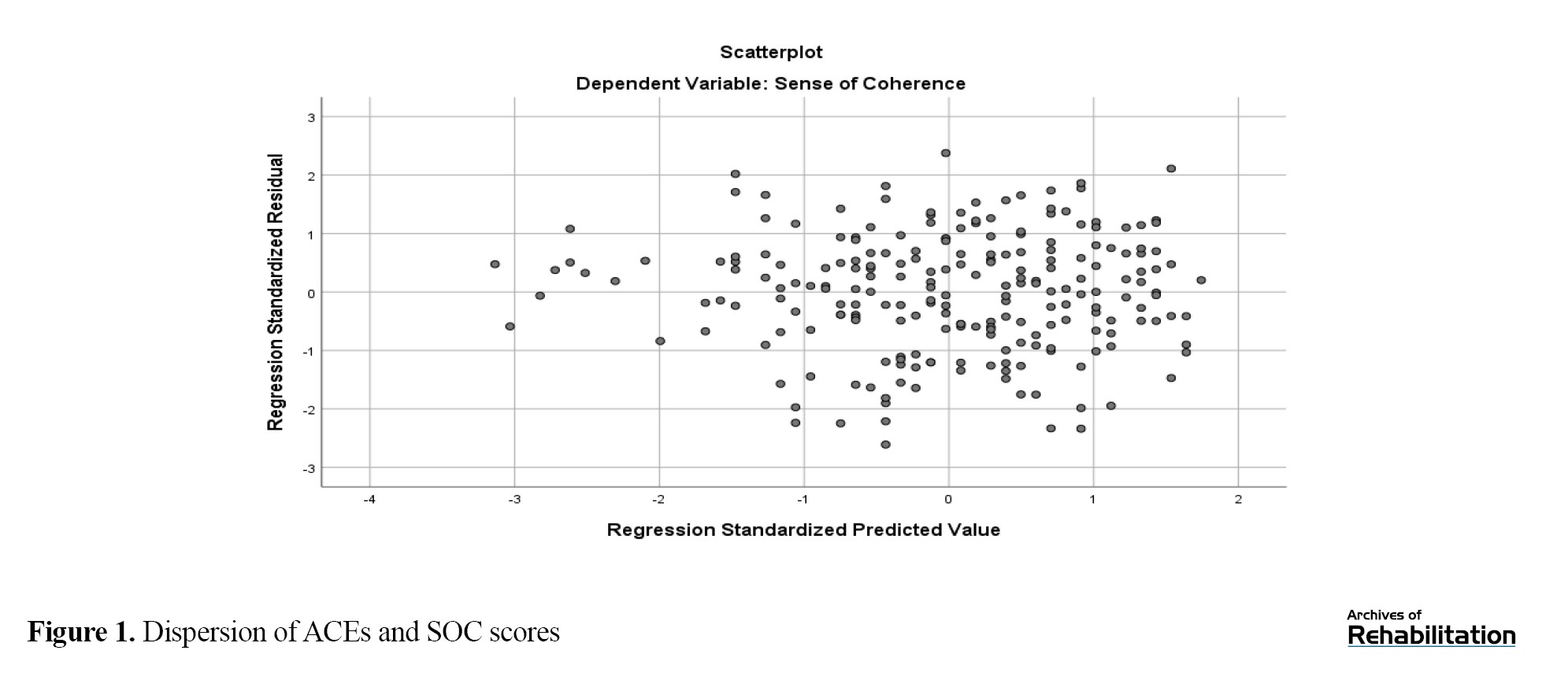 As observed, the values of ACEs and the predicted SOC exhibit a relatively linear relationship. Moreover, the relatively uniform dispersion of data along the horizontal axis indicates homoscedasticity.
To examine the normality of the residual distribution, the Kolmogorov-Smirnov test was employed; the resulting statistic was 0.024, which was not significant at the 0.2 level, thereby confirming the assumption of normality of the residuals. Based on this, the assumptions for linear regression were met, allowing for the utilization of this test.
To verify the assumptions for logistic regression, linearity in the logit scale was tested, which was not significant for either ACEs (P=0.956) or SOC (P=0.704), thus confirming this assumption. Furthermore, to check the assumption of no multicollinearity, Tolerance indices and VIF were calculated, both of which equaled 1, confirming the absence of multicollinearity.
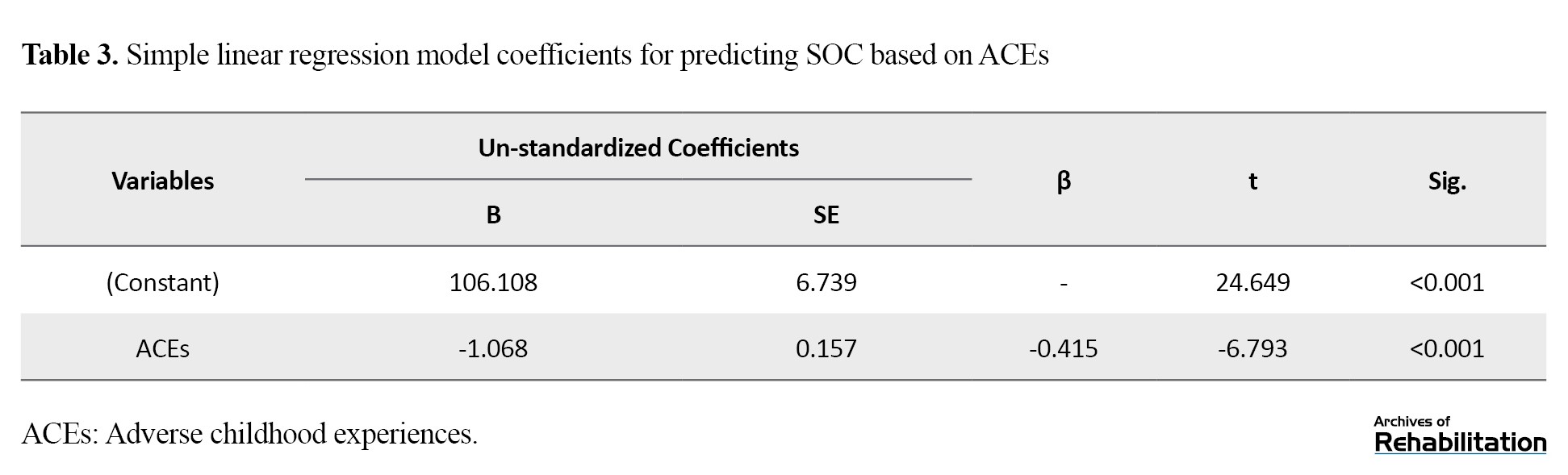
Simple linear regression was used to examine the predictability of SOC by ACEs. Upon executing the model, the R2 was found to be 0.172. This indicates that the proposed model is capable of predicting 17.2% of the variance of the SOC. Additionally, the analysis of variance confirmed the significance of the regression model (F=46.143, P<0.001). As shown in Table 3, the unstandardized and standardized beta coefficients for ACEs are -1.068 and -0.415, respectively, which are statistically significant (P<0.001); this implies that for every unit change in ACEs, the SOC changes by 1.068 units in the opposite direction.
Multiple logistic regression was employed to investigate the predictability of MS incidence by ACEs and SOC. The Omnibus test (χ2(2)=25.728) indicated that the overall model is statistically significant (P<0.001); this means the regression model can predict the incidence of MS in individuals. Furthermore, the Hosmer-Lemeshow test (χ2(8)=6.567) indicated a good fit of the model to the data (P=0.584). This model was able to predict between 10.9% and 14.5% of the variance in the criterion variable. The diagnostic accuracy of the regression model is presented in Table 4.
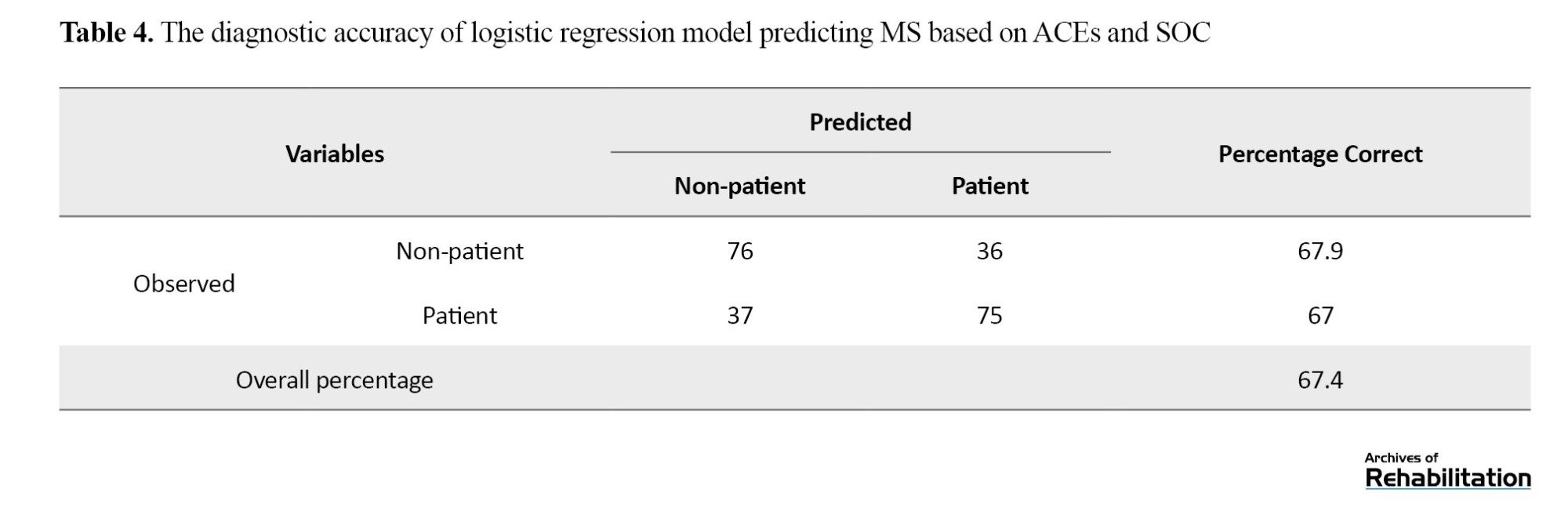
As observed, the regression model was generally able to correctly classify 67.4% of individuals as either patients or non-patients. The specificity of the model (correct classification of non-patients) was 67.9%, and the sensitivity of the model (correct classification of patients) was 67%.
Table 5 displays the coefficients of the regression model.
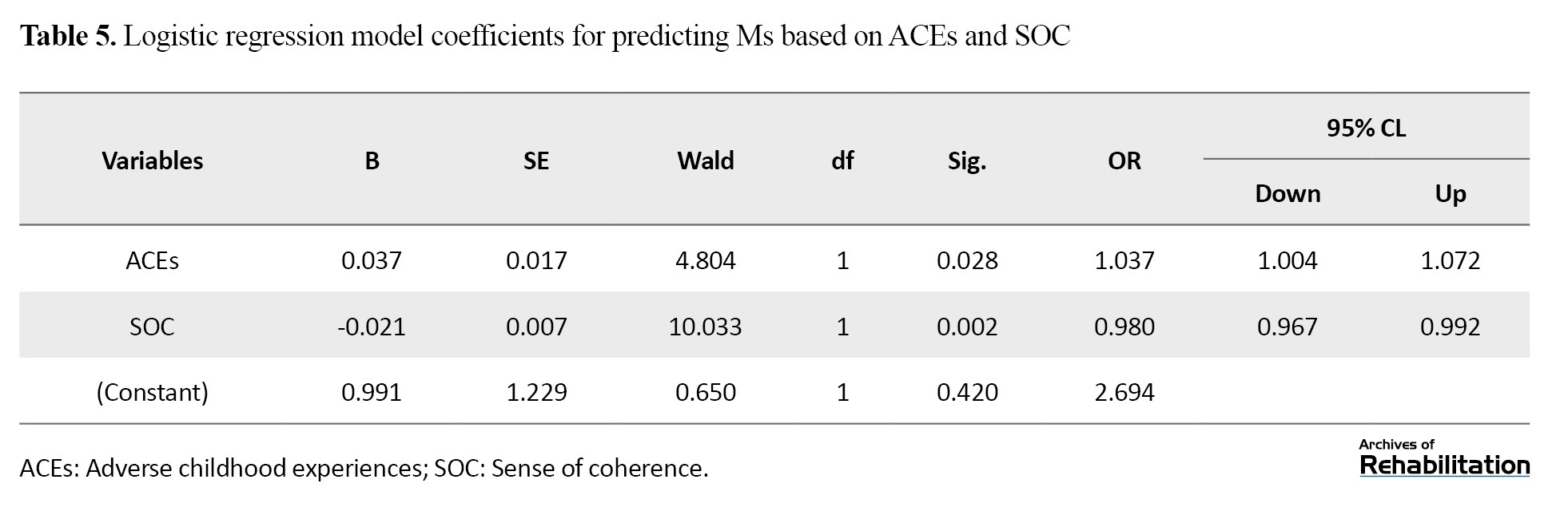
As observed, ACEs are a significant positive predictor for the incidence of MS (P=0.028). Given that the odds ratio (OR) is greater than 1 (1.037), it is concluded that for every unit increase in ACEs, the odds of developing MS increase by 3.7%, and vice versa. On the other hand, SOC is a significant negative predictor for the incidence of MS (P=0.002). Given that the odds ratio is less than 1 (0.980), it is concluded that for every unit increase in SOC, the odds of developing MS decrease by 2.1%, and vice versa.
To examine the mediating role of SOC in the relationship between ACEs and the incidence of MS, mediation analysis using bootstrapping (with 10000 simulations) was employed. As listed in Table 6, ACEs generally have a significant effect on the incidence of MS (P=0.002).
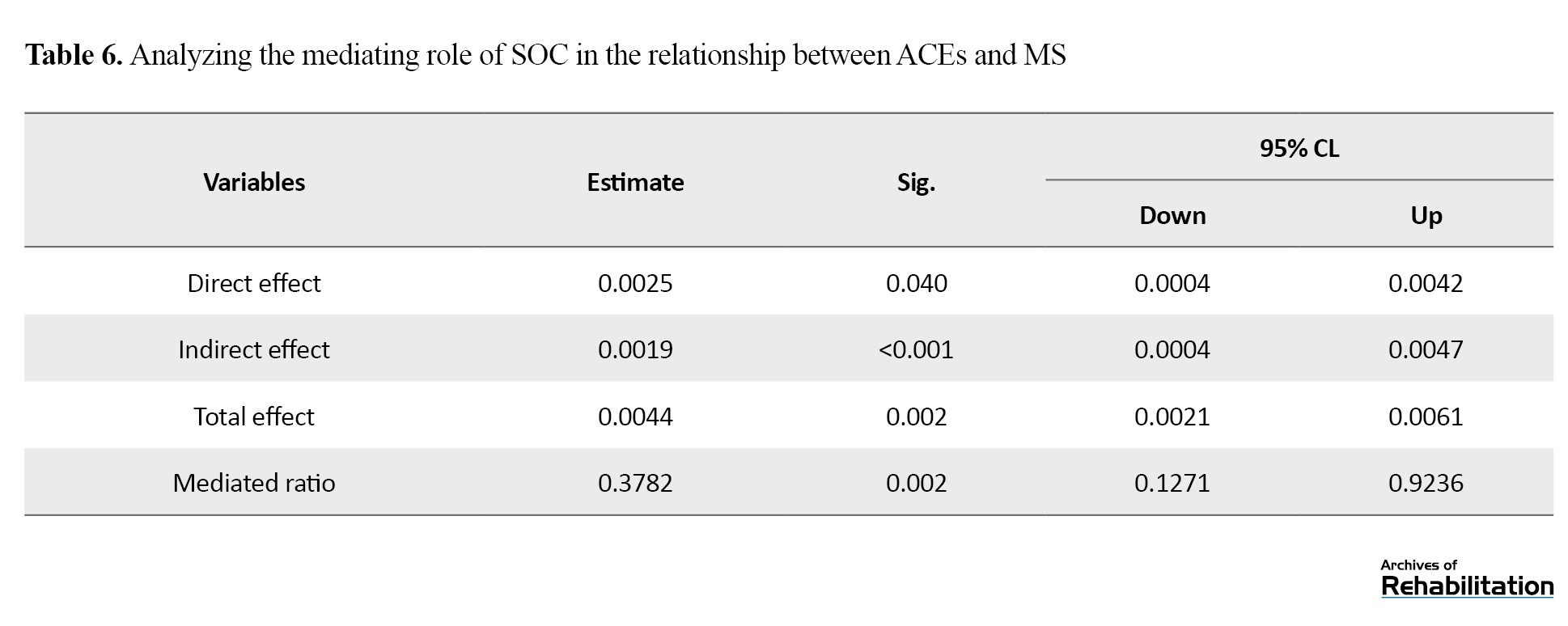
This effect is significant both directly (P=0.04) and indirectly through the SOC (P<0.001). Ultimately, 37.8% of the total effect of ACEs on the incidence of MMS is mediated by the SOC (P=0.002).
Discussion
The study found a significant positive association between ACEs and MS incidence, especially for familial experiences, aligning with some research but conflicting with others. This finding suggests a complex, context-dependent relationship, supporting the need for further investigation into mediating factors like SOC. Some studies [13, 15-19] report a link between these early life events and the start or worsening of MS, whereas others [20-23] found no significant correlation. The heterogeneity of these results provides an opportunity for a deeper understanding of this complex phenomenon. Explaining this association requires a biopsychosocial framework and can be justified through two primary pathways: a direct biological pathway and an indirect behavioral pathway. In the biological pathway, chronic and repetitive childhood stressors lead to persistent alterations in stress response systems, such as the hypothalamic-pituitary-adrenal axis (HPA), resulting in a state of chronic inflammation and immune system dysfunction. In the behavioral pathway, high-risk behaviors adopted by individuals to cope with the psychological pain and suffering stemming from such experiences increase the risk of disease [32].
The second finding, indicated a significant negative correlation between ACEs and SOC. This finding is consistent with numerous studies; however, the evidence in this area is not entirely uniform. While some researchers [33, 34] confirmed that childhood experiences play a determinative role in the formation of SOC, others [35] failed to find such a relationship. To elucidate this relationship, one must return to the core of salutogenic theory. Antonovsky believed that SOC is not an innate trait but rather the result of learning processes that begin at birth and stem from exposure to constructive experiences. ACEs systematically dismantle the foundations for forming a strong SOC by creating an unpredictable environment (undermining comprehensibility), inducing a sense of powerlessness and helplessness (undermining manageability), and conveying messages of worthlessness and meaninglessness (undermining meaningfulness). An individual growing up with such experiences enters adulthood with a fragile and vulnerable worldview, rendering them more susceptible to subsequent life stressors [29, 36].
The third finding of the study reveals that SOC and all its subscales correlate negatively with the incidence of MS. This finding aligns with a large portion of the research literature while also contrasting with certain other findings. While some researchers [37, 38] support our finding, others [39, 40] were unable to find a significant difference in SOC levels between patients and healthy groups or questioned its relationship with physical health. The negative association between SOC and the incidence of MS can be explained from two complementary perspectives. On one hand, a low SOC may act as a pre-morbid vulnerability factor, making the individual more susceptible to the physiological effects of stress. An individual with a low SOC views the world as an uncontrollable and threatening place; this attitude leads to chronic activation of stress response systems, immune system dysfunction, and consequently, an increased risk of autoimmune diseases in susceptible individuals [41]. On the other hand, a low SOC can be a consequence of suffering from a chronic, unpredictable, and debilitating disease like MS. The nature of MS, through its unpredictability (undermining comprehensibility), induction of disability (undermining manageability), and challenging of life’s meaning (undermining meaningfulness), weakens all three components of SOC [30].
The most definitive and pivotal finding of this study revealed that SOC plays a mediating role in the correlation between ACEs and the incidence of MS. This finding suggests that a substantial portion of the deleterious impact of ACEs is exerted through the attenuation of this psychological buffer. Although none of the reviewed studies had explicitly tested the mediation model of SOC in the correlation between ACEs and the onset of MS, the findings of this study are explicable within the existing theoretical framework. Indeed, the novelty of this research lies in bridging three distinct domains of inquiry: (1) the burgeoning literature on the association between ACEs and physical morbidity, (2) salutogenic theory and the role of SOC in health, and (3) research concerning risk factors for MS.
The mediation finding offers a coherent causal narrative: ACEs within the family shape the child’s worldview and attenuate their SOC [42]. A diminished SOC renders the individual, in adulthood, highly vulnerable—both psychologically and physiologically—to life stressors [30]. This chronic vulnerability, through the hyperactivation of stress response systems, dysregulates the immune system and, ultimately, in the presence of genetic predisposition, may manifest as an autoimmune disease such as MS [43]. This model underscores the paramount importance of psychosocial interventions focused on bolstering SOC in survivors of childhood trauma as a potential strategy for the prevention of chronic diseases in adulthood.
Finally, it is necessary to acknowledge that this study was subject to certain limitations. The cross-sectional nature of the design limits the ability to draw definitive causal inferences. Data were collected based on participant self-reports, which may be susceptible to recall bias. Matching based solely on age and gender, failure to account for differences in employment status, marital status, and socioeconomic status, lack of control for other variables influencing MS, and the omission of disease severity and type assessment in patients constitute other limitations of this study. Furthermore, individuals lacking access to electronic devices for completing questionnaires or those unwilling to join messaging platforms were excluded from participation. The stated limitations may compromise the generalizability of the findings; therefore, it is recommended that future studies employ longitudinal designs to better elucidate these relationships and investigate the role of other demographic, psychological, and behavioral mediators and moderators. The utilization of paper-and-pencil questionnaires may also prove beneficial.
Conclusion
The study aimed to examine whether SOC mediates the relationship between ACEs and MS incidence, using mediation analysis to assess the indirect effect of ACEs on MS through SOC. Its findings provide a multidimensional and meaningful picture of the complex interaction between early life experiences, psychological resources, and physical health in adulthood. The pivotal result of this study demonstrated that ACEs, particularly those occurring within the family context and in relation to parents, constitute a significant risk factor for the development of MS. However, the most critical inference of this research was the elucidation of the psychological mechanism underlying this association; specifically, the destructive impact of these experiences does not proceed solely through a direct biological pathway. Rather, a substantial portion of this impact (approximately 38%) operates through the attenuation and erosion of a fundamental coping resource: the SOC. This finding implies that toxic childhood stress, by shattering the individual’s worldview and their ability to perceive life as a comprehensible, manageable, and meaningful phenomenon, renders them more vulnerable to future chronic pathogenic processes.
One of the key implications of this research is the necessity of expanding the perspective on MS risk factors beyond purely genetic frameworks and moving towards an integrated biopsychosocial model. The results confirm that the body “embodies” the individual’s psychological history, and relational experiences in childhood can lead to persistent physiological alterations in stress response systems and immune function. This research demonstrated that the family is not merely a social context but a biological environment wherein the foundations of an individual’s health or vulnerability to inflammatory diseases are established. Therefore, trauma within the family can be considered a serious environmental risk factor alongside other established factor. These findings also shift the focus from a pathogenic perspective to a salutogenic one, emphasizing the vital importance of protective resources (like SOC).
At an applied level, the results of this study have clear implications for the fields of prevention, intervention, and health policy-making. At the prevention level, these findings highlight the importance of investing in family health and preventing child abuse as a long-term strategy to reduce the burden of chronic diseases. At the clinical level, this research identifies a specific therapeutic target: the enhancement of SOC. For individuals with a history of ACEs, psychological interventions focused on reconstructing the components of SOC can serve as an effective strategy for reducing vulnerability. Ultimately, by linking psychological experiences in childhood to a complex neurological disease in adulthood, this research underscores the fact that mental health and physical health are inextricably intertwined, and that protecting childhood is an investment in a lifetime of health.
Ethical Considerations
Compliance with ethical guidelines
Ethical approval for this study was obtained from the Ethics Committee of the University of Social Welfare and Rehabilitation Sciences, Tehran, Iran (Code: IR.USWR.REC.1403.182). Throughout the study, the ethical principles of voluntary participation, autonomy, and confidentiality were strictly observed regarding the participants. Written informed consent was obtained from all individuals prior to their inclusion in the study. Participation was entirely voluntary, and participants reserved the right to withdraw from the study at any time without penalty. Furthermore, they were assured regarding the confidentiality of their data. Prior to the administration of the questionnaires, the subjects were provided with necessary information regarding the objectives and methodology of the study.
Funding
This article was extracted from the master’s thesis of Fatemeh Mohammad Otaghsara, approved by theDepartment of Counseling, School of Behavioral Sciences and Mental Health, University of Social Welfare and Rehabilitation Sciences, Tehran, Iran. This research did not receive any specific grant from funding agencies in the public, commercial, or not-for-profit sectors.
Authors' contributions
Conceptualization: Bahman Bahmani and Fatemeh Mohammadi Otaghsara; Investigation: Fatemeh Mohammadi Otaghsara; Statistical analysis: Razieh Bidhendi and Seyed Mohsen Kheirkhah Alavi; Methodology and writing: All authors.
Conflict of interest
The authors declared no conflict of interest.
Acknowledgments
The researchers express their sincere gratitude to all individuals who contributed to this study, particularly the participants whose cooperation made this research possible.
References
Multiple sclerosis (MS) is a long-term, immune-mediated disorder affecting the central nervous system marked by inflammatory processes and the loss of myelin sheaths around neurons in the brain and spinal cord, with no known cure currently available [1, 2]. Among the most prevalent central nervous system disorders, MS impacts around 2.8 million people globally, with a worldwide prevalence of 35.9 cases per 100,000 individuals [3]. Although Iran was once thought to have a low risk for MS, it is now acknowledged as a region with a high prevalence of the condition [4, 5]. MS symptoms can significantly impair individuals through various sensory, motor, cognitive, and sexual difficulties [2, 6, 7]. Moreover, the psychological effects of MS, such as stress, feelings of helplessness, guilt, a diminished sense of self, job loss, decreased social engagement, and strained relationships impact nearly all areas of a person’s life [8, 9].
The rising incidence of MS, combined with its severe impact, highlights the need to investigate its underlying causes. Although considerable progress has been made in medicine, the exact cause remains unclear, though current evidence points to a complex interaction between genetic predisposition and environmental influences in disease development [10-12]. Among environmental factors, a history of abuse, neglect, or exposure to violence in early life is more common in MS patients than in the general population, suggesting a possible connection between these experiences and the development of the disease [13]. These experiences can be understood within the framework of adverse childhood experiences (ACEs). As defined by the World Health Organization (WHO) [14], ACEs represent some of the most common and severe stressors in early childhood, including physical, sexual, and emotional abuse; physical and emotional neglect; domestic violence between caregivers; family substance abuse; and peer, societal, or community-based violence.
Research exploring the impact of ACEs on MS incidence has produced inconsistent findings. Some studies [13, 15-19] report a link between these early life events and the start or worsening of MS, whereas others [20-23] found no significant correlation. This variation in results might be due to the use of differing definitions and assessment tools. Additionally, it is important to recognize that stress does not act in a straightforward manner; psychosocial elements like social support, resilience, and specific coping mechanisms can modulate the range of outcomes [15].
The sense of coherence (SOC) is another potentially relevant factor. SOC describes an individual’s capacity to handle life’s difficulties and stressors in a way that maintains both psychological and physical well-being, allowing them to endure significant stress and mental strain. SOC is a global life orientation indicating how much a person finds their world understandable, its demands surmountable, and their life purposeful [24]. Those with high SOC view stressful events as manageable challenges and actively seek out and employ their available resources to address them [25]. While prior research has shown that SOC directly correlates with better health-related quality of life (QoL) and life satisfaction, and inversely correlates with depression and psychological issues in MS patients, its role in mediating the connection between ACEs and the onset of this condition remains unexplored [26].
Given the conflicting findings on the link between ACEs and MS, and the lack of research on whether SOC mediates this relationship, this study aimed to examine the association between ACEs and MS development. Using the WHO’s comprehensive definition of ACEs and the ACEs international questionnaire (ACE-IQ), the study also assessed the potential mediating role of SOC. The primary research question was whether SOC mediate the relationship between ACEs and the onset of MS.
Materials and Methods
Study design
This study is cross-sectional in design, with a descriptive-correlational approach, and specifically uses mediation analysis to examine the relationships under investigation.
Study participants
The study population included individuals aged 18 and older with MS and age- and gender-matched healthy controls. Patients were recruited from the “Emrooz Chand Ghadam?!” (How Many Steps Today?!) NGO, while the control group was drawn from members of the Bale, Eitaa, and Telegram platforms. Convenience sampling was used, and the sample size was determined using the following formula (Equation 1) [20]:
With a type i error of 0.05, power of 0.80, effect size of 0.4, and an expected attrition rate of 10%, the minimum required sample size was 110 participants per group, totaling 220 individuals (Equation 2).
The inclusion criteria were literacy (reading and writing ability), capacity to complete online questionnaires, and age ≥18 years (due to the ACE-IQ’s age standardization). To avoid confounding from pre-diagnosis ACEs, MS patients must have received their diagnosis after age 18. The exclusion criteria included failure to answer any questionnaire item.
Study instruments
ACE-IQ: The questionnaire was developed by WHO and designed to support research on ACEs prevalence and outcomes in low-income settings. It consists of 43 items across 7 sections: demographic data (7 items), marital status (5 items), parent/caregiver relationships (5 items, 5-point Likert scale), family environment (16 items—first 5 in Yes/No, next 11 in 4-point Likert), peer violence (3 items—items 1 and 3 in 4-point Likert, item 2 in 7-point Likert), witnessing community violence (3 items, 4-point Likert), and exposure to collective violence or war (4 items, 4-point Likert). The total score is derived from sections 3–7, ranging from 26 to 114, and is suitable for individuals aged 18 and above [13, 14]. In a study by Kazeem [27], subscale Cronbach α values ranged from 0.69 to 0.81, and the ACE-IQ total score correlated positively with the childhood trauma questionnaire (r=0.72, P<0.01). In Iran, internal consistency was assessed via Cronbach’s α (0.53–0.78 across subscales), and discriminant validity was confirmed as average variance extracted (AVE) exceeded both maximum shared squared variance (MSV) and average shared squared variance (ASV) [28].
SOC questionnaire: This questionnaire was introduced by Antonovsky [29] and measures a global orientation to life. It contains 29 items rated on a 7-point Likert scale (1–7), with reverse scoring for items 1, 4, 5, 6, 7, 11, 13, 14, 16, 20, 23, 25, and 27. The total score ranges from 29 to 203, where higher values reflect stronger SOC. The scale includes 3 subscales: comprehensibility (items 1, 3, 5, 10, 12, 15, 17, 19, 21, 24, 26), manageability (items 2, 6, 9, 13, 18, 20, 23, 25, 27, 29), and meaningfulness (items 4, 7, 8, 11, 14, 16, 22, 28). Across 26 studies, Cronbach α values ranged from 0.82 to 0.95, and test-retest reliability was 0.54 over two years [30]. In Iran, factor analysis confirmed a single-factor structure explaining 76.5% of variance, with all items loading on this factor; internal consistency was 0.969, indicating high reliability [31].
Study procedure
After obtaining ethical approval from the University of Social Welfare and Rehabilitation Sciences Ethics Committee, coordination was made with the manager of the “Emrooz Chand Ghadam?!” NGO to recruit MS patients. The research goals and procedures were explained to the manager and subsequently to the members; with 861 members, this NGO was anticipated to provide maximum variance for the study sample. Following the manager’s consent, a participation call detailing the study’s aims and methods was published to members. Considering the sensory-motor impairments and mobility issues common in MS, questionnaires were distributed online to eligible applicants after they completed the informed consent form. Once MS patient responses were collected, they were stratified by age and gender to define the necessary distribution for the healthy control group. A subsequent invitation was posted in student groups on Bale, Eitaa, and Telegram, outlining the objectives and inviting volunteers whose age and gender matched the established stratification (either for themselves or acquaintances). Questionnaires, preceded by informed consent, were sent online to these volunteers, and data collection continued until all targeted age and gender quotas were filled.
Statistical analysis
Frequency tables and indices of central and dispersion tendency were utilized to describe the data. For data inference, independent samples t-test, linear and logistic regression, and mediation analysis were employed. Data processing was conducted using SPSS 26 and R software.
Results
The participants of this study consisted of 224 individuals (following the exclusion of cases meeting the exclusion criteria), who were equally divided into two groups: patients with MS and non-patient counterparts, matched for gender and age categories. As shown in Table 1, the majority of participants were female, within the 40-44 age range, held higher education degrees (associate’s and bachelor’s), and were married.
Most patients were unemployed, whereas the majority of non-patients were employed. The mean age and duration of MS were 29.51±7.36 and 12.92±8.24 years, respectively.
Table 2 presents the mean and standard deviation of ACEs and SOC scores for the participants, separated by patient and non-patient groups, as well as the significance of the difference between them (using the independent samples t-test).
As observed, with the exception of the subscales for peer violence (P=0.074), witnessing violence (P>0.999), and collective violence (P>0.064), the two groups differed significantly in all other subscales (P<0.05). Specifically, the patient group scored higher on ACEs—particularly in the parents and family subscales—and lower on the SOC and its subscales compared to the non-patient group.
To examine the assumption of normality in data distribution, kurtosis and skewness indices were utilized, the results of which confirmed this assumption (values were within ±1 for both ACEs and SOC variables in both groups). Furthermore, an examination of standard z-scores indicated that all scores fell within the standard range of ±3. The Durbin-Watson statistic was calculated to be within the range of 1.5 to 2.5 (1.95), indicating the independence of errors. Additionally, the variance inflation factor (VIF) and Tolerance index were both equal to 1, confirming the assumption of no multicollinearity. Figure 1 displays the scatter plot of ACEs values against the predicted SOC values.
To examine the normality of the residual distribution, the Kolmogorov-Smirnov test was employed; the resulting statistic was 0.024, which was not significant at the 0.2 level, thereby confirming the assumption of normality of the residuals. Based on this, the assumptions for linear regression were met, allowing for the utilization of this test.
To verify the assumptions for logistic regression, linearity in the logit scale was tested, which was not significant for either ACEs (P=0.956) or SOC (P=0.704), thus confirming this assumption. Furthermore, to check the assumption of no multicollinearity, Tolerance indices and VIF were calculated, both of which equaled 1, confirming the absence of multicollinearity.
Simple linear regression was used to examine the predictability of SOC by ACEs. Upon executing the model, the R2 was found to be 0.172. This indicates that the proposed model is capable of predicting 17.2% of the variance of the SOC. Additionally, the analysis of variance confirmed the significance of the regression model (F=46.143, P<0.001). As shown in Table 3, the unstandardized and standardized beta coefficients for ACEs are -1.068 and -0.415, respectively, which are statistically significant (P<0.001); this implies that for every unit change in ACEs, the SOC changes by 1.068 units in the opposite direction.
Multiple logistic regression was employed to investigate the predictability of MS incidence by ACEs and SOC. The Omnibus test (χ2(2)=25.728) indicated that the overall model is statistically significant (P<0.001); this means the regression model can predict the incidence of MS in individuals. Furthermore, the Hosmer-Lemeshow test (χ2(8)=6.567) indicated a good fit of the model to the data (P=0.584). This model was able to predict between 10.9% and 14.5% of the variance in the criterion variable. The diagnostic accuracy of the regression model is presented in Table 4.
As observed, the regression model was generally able to correctly classify 67.4% of individuals as either patients or non-patients. The specificity of the model (correct classification of non-patients) was 67.9%, and the sensitivity of the model (correct classification of patients) was 67%.
Table 5 displays the coefficients of the regression model.
As observed, ACEs are a significant positive predictor for the incidence of MS (P=0.028). Given that the odds ratio (OR) is greater than 1 (1.037), it is concluded that for every unit increase in ACEs, the odds of developing MS increase by 3.7%, and vice versa. On the other hand, SOC is a significant negative predictor for the incidence of MS (P=0.002). Given that the odds ratio is less than 1 (0.980), it is concluded that for every unit increase in SOC, the odds of developing MS decrease by 2.1%, and vice versa.
To examine the mediating role of SOC in the relationship between ACEs and the incidence of MS, mediation analysis using bootstrapping (with 10000 simulations) was employed. As listed in Table 6, ACEs generally have a significant effect on the incidence of MS (P=0.002).
This effect is significant both directly (P=0.04) and indirectly through the SOC (P<0.001). Ultimately, 37.8% of the total effect of ACEs on the incidence of MMS is mediated by the SOC (P=0.002).
Discussion
The study found a significant positive association between ACEs and MS incidence, especially for familial experiences, aligning with some research but conflicting with others. This finding suggests a complex, context-dependent relationship, supporting the need for further investigation into mediating factors like SOC. Some studies [13, 15-19] report a link between these early life events and the start or worsening of MS, whereas others [20-23] found no significant correlation. The heterogeneity of these results provides an opportunity for a deeper understanding of this complex phenomenon. Explaining this association requires a biopsychosocial framework and can be justified through two primary pathways: a direct biological pathway and an indirect behavioral pathway. In the biological pathway, chronic and repetitive childhood stressors lead to persistent alterations in stress response systems, such as the hypothalamic-pituitary-adrenal axis (HPA), resulting in a state of chronic inflammation and immune system dysfunction. In the behavioral pathway, high-risk behaviors adopted by individuals to cope with the psychological pain and suffering stemming from such experiences increase the risk of disease [32].
The second finding, indicated a significant negative correlation between ACEs and SOC. This finding is consistent with numerous studies; however, the evidence in this area is not entirely uniform. While some researchers [33, 34] confirmed that childhood experiences play a determinative role in the formation of SOC, others [35] failed to find such a relationship. To elucidate this relationship, one must return to the core of salutogenic theory. Antonovsky believed that SOC is not an innate trait but rather the result of learning processes that begin at birth and stem from exposure to constructive experiences. ACEs systematically dismantle the foundations for forming a strong SOC by creating an unpredictable environment (undermining comprehensibility), inducing a sense of powerlessness and helplessness (undermining manageability), and conveying messages of worthlessness and meaninglessness (undermining meaningfulness). An individual growing up with such experiences enters adulthood with a fragile and vulnerable worldview, rendering them more susceptible to subsequent life stressors [29, 36].
The third finding of the study reveals that SOC and all its subscales correlate negatively with the incidence of MS. This finding aligns with a large portion of the research literature while also contrasting with certain other findings. While some researchers [37, 38] support our finding, others [39, 40] were unable to find a significant difference in SOC levels between patients and healthy groups or questioned its relationship with physical health. The negative association between SOC and the incidence of MS can be explained from two complementary perspectives. On one hand, a low SOC may act as a pre-morbid vulnerability factor, making the individual more susceptible to the physiological effects of stress. An individual with a low SOC views the world as an uncontrollable and threatening place; this attitude leads to chronic activation of stress response systems, immune system dysfunction, and consequently, an increased risk of autoimmune diseases in susceptible individuals [41]. On the other hand, a low SOC can be a consequence of suffering from a chronic, unpredictable, and debilitating disease like MS. The nature of MS, through its unpredictability (undermining comprehensibility), induction of disability (undermining manageability), and challenging of life’s meaning (undermining meaningfulness), weakens all three components of SOC [30].
The most definitive and pivotal finding of this study revealed that SOC plays a mediating role in the correlation between ACEs and the incidence of MS. This finding suggests that a substantial portion of the deleterious impact of ACEs is exerted through the attenuation of this psychological buffer. Although none of the reviewed studies had explicitly tested the mediation model of SOC in the correlation between ACEs and the onset of MS, the findings of this study are explicable within the existing theoretical framework. Indeed, the novelty of this research lies in bridging three distinct domains of inquiry: (1) the burgeoning literature on the association between ACEs and physical morbidity, (2) salutogenic theory and the role of SOC in health, and (3) research concerning risk factors for MS.
The mediation finding offers a coherent causal narrative: ACEs within the family shape the child’s worldview and attenuate their SOC [42]. A diminished SOC renders the individual, in adulthood, highly vulnerable—both psychologically and physiologically—to life stressors [30]. This chronic vulnerability, through the hyperactivation of stress response systems, dysregulates the immune system and, ultimately, in the presence of genetic predisposition, may manifest as an autoimmune disease such as MS [43]. This model underscores the paramount importance of psychosocial interventions focused on bolstering SOC in survivors of childhood trauma as a potential strategy for the prevention of chronic diseases in adulthood.
Finally, it is necessary to acknowledge that this study was subject to certain limitations. The cross-sectional nature of the design limits the ability to draw definitive causal inferences. Data were collected based on participant self-reports, which may be susceptible to recall bias. Matching based solely on age and gender, failure to account for differences in employment status, marital status, and socioeconomic status, lack of control for other variables influencing MS, and the omission of disease severity and type assessment in patients constitute other limitations of this study. Furthermore, individuals lacking access to electronic devices for completing questionnaires or those unwilling to join messaging platforms were excluded from participation. The stated limitations may compromise the generalizability of the findings; therefore, it is recommended that future studies employ longitudinal designs to better elucidate these relationships and investigate the role of other demographic, psychological, and behavioral mediators and moderators. The utilization of paper-and-pencil questionnaires may also prove beneficial.
Conclusion
The study aimed to examine whether SOC mediates the relationship between ACEs and MS incidence, using mediation analysis to assess the indirect effect of ACEs on MS through SOC. Its findings provide a multidimensional and meaningful picture of the complex interaction between early life experiences, psychological resources, and physical health in adulthood. The pivotal result of this study demonstrated that ACEs, particularly those occurring within the family context and in relation to parents, constitute a significant risk factor for the development of MS. However, the most critical inference of this research was the elucidation of the psychological mechanism underlying this association; specifically, the destructive impact of these experiences does not proceed solely through a direct biological pathway. Rather, a substantial portion of this impact (approximately 38%) operates through the attenuation and erosion of a fundamental coping resource: the SOC. This finding implies that toxic childhood stress, by shattering the individual’s worldview and their ability to perceive life as a comprehensible, manageable, and meaningful phenomenon, renders them more vulnerable to future chronic pathogenic processes.
One of the key implications of this research is the necessity of expanding the perspective on MS risk factors beyond purely genetic frameworks and moving towards an integrated biopsychosocial model. The results confirm that the body “embodies” the individual’s psychological history, and relational experiences in childhood can lead to persistent physiological alterations in stress response systems and immune function. This research demonstrated that the family is not merely a social context but a biological environment wherein the foundations of an individual’s health or vulnerability to inflammatory diseases are established. Therefore, trauma within the family can be considered a serious environmental risk factor alongside other established factor. These findings also shift the focus from a pathogenic perspective to a salutogenic one, emphasizing the vital importance of protective resources (like SOC).
At an applied level, the results of this study have clear implications for the fields of prevention, intervention, and health policy-making. At the prevention level, these findings highlight the importance of investing in family health and preventing child abuse as a long-term strategy to reduce the burden of chronic diseases. At the clinical level, this research identifies a specific therapeutic target: the enhancement of SOC. For individuals with a history of ACEs, psychological interventions focused on reconstructing the components of SOC can serve as an effective strategy for reducing vulnerability. Ultimately, by linking psychological experiences in childhood to a complex neurological disease in adulthood, this research underscores the fact that mental health and physical health are inextricably intertwined, and that protecting childhood is an investment in a lifetime of health.
Ethical Considerations
Compliance with ethical guidelines
Ethical approval for this study was obtained from the Ethics Committee of the University of Social Welfare and Rehabilitation Sciences, Tehran, Iran (Code: IR.USWR.REC.1403.182). Throughout the study, the ethical principles of voluntary participation, autonomy, and confidentiality were strictly observed regarding the participants. Written informed consent was obtained from all individuals prior to their inclusion in the study. Participation was entirely voluntary, and participants reserved the right to withdraw from the study at any time without penalty. Furthermore, they were assured regarding the confidentiality of their data. Prior to the administration of the questionnaires, the subjects were provided with necessary information regarding the objectives and methodology of the study.
Funding
This article was extracted from the master’s thesis of Fatemeh Mohammad Otaghsara, approved by theDepartment of Counseling, School of Behavioral Sciences and Mental Health, University of Social Welfare and Rehabilitation Sciences, Tehran, Iran. This research did not receive any specific grant from funding agencies in the public, commercial, or not-for-profit sectors.
Authors' contributions
Conceptualization: Bahman Bahmani and Fatemeh Mohammadi Otaghsara; Investigation: Fatemeh Mohammadi Otaghsara; Statistical analysis: Razieh Bidhendi and Seyed Mohsen Kheirkhah Alavi; Methodology and writing: All authors.
Conflict of interest
The authors declared no conflict of interest.
Acknowledgments
The researchers express their sincere gratitude to all individuals who contributed to this study, particularly the participants whose cooperation made this research possible.
References
- Compston A, Coles A. Multiple sclerosis. Lancet. 2008; 372(9648):1502-17. [DOI:10.1016/S0140-6736(08)61620-7] [PMID]
- Pakenham KI, Samios C. Couples coping with multiple sclerosis: A dyadic perspective on the roles of mindfulness and acceptance. Journal of Behavioral Medicine. 2013; 36(4):389-400. [DOI:10.1007/s10865-012-9434-0] [PMID]
- Walton C, King R, Rechtman L, Kaye W, Leray E, Marrie RA, et al. Rising prevalence of multiple sclerosis worldwide: Insights from the Atlas of MS. Multiple Sclerosis. 2020; 26(14):1816-21. [DOI:10.1177/1352458520970841] [PMID]
- Azami M, YektaKooshali MH, Shohani M, Khorshidi A, Mahmudi L. Epidemiology of multiple sclerosis in Iran: A systematic review and meta-analysis. PloS one. 2019; 14(4):e0214738. [DOI:10.1371/journal.pone.0214738] [PMID]
- Mirmosayyeb O, Shaygannejad V, Bagherieh S, Hosseinabadi AM, Ghajarzadeh M. Prevalence of multiple sclerosis (MS) in Iran: a systematic review and meta-analysis. Neurological Sciences. 2022; 43(1):233-41. [DOI:10.1007/s10072-021-05750-w] [PMID]
- Morris G, Reiche EMV, Murru A, Carvalho AF, Maes M, Berk M, et al. Multiple immune-inflammatory and oxidative and nitrosative stress pathways explain the frequent presence of depression in multiple sclerosis. Molecular Neurobiology. 2018; 55(8):6282-306. [DOI:10.1007/s12035-017-0843-5] [PMID]
- Parsaeian M, Najl-Rahim A, Karimlou M, Mozaffari M. [Comparing normal and multiple sclerotic patients short term memory (Persian)]. Archives of Rehabilitation. 2006; 7(2):56-60. [Link]
- Abdekhodaie Z, Shahidi S, Mazaheri MA, Panaghi L, Nejati V. [The family relationship in patients with multiple sclerosis: A phenomenological study (Persian)]. Journal of Family Research. 2016; 12(47):437-59. [Link]
- Noori M, Hosseini SA, Shiri V, Akbarfahimi N. [The relationship between balance and activities of daily living with the quality of life of patients with relapsing-remitting multiple sclerosis (Persian)]. Archives of Rehabilitation. 2019; 19(4):292-301. [DOI:10.32598/rj.19.4.292]
- Amato MP, Derfuss T, Hemmer B, Liblau R, Montalban X, Soelberg Sørensen P, et al. Environmental modifiable risk factors for multiple sclerosis: Report from the 2016 ECTRIMS focused workshop. Multiple Sclerosis Journal. 2018; 24(5):590-603. [DOI:10.1177/1352458516686847] [PMID]
- Goodin DS, Khankhanian P, Gourraud PA, Vince N. The nature of genetic and environmental susceptibility to multiple sclerosis. PLoS One. 2021; 16(3):e0246157. [DOI:10.1371/journal.pone.0246157] [PMID]
- Pouramiri M, Azimian M, Akbarfahimi N, Pishyareh E, Hossienzadeh S. Investigating the relationship between individual and clinical characteristics and executive dysfunction of multiple sclerosis individuals. Archives of Rehabilitation. 2019; 20(2):114-23. [DOI:10.32598/rj.20.2.114]
- Wan A, Bernstein CN, Graff LA, Patten SB, Sareen J, Fisk JD, et al. Childhood maltreatment and psychiatric comorbidity in immune-mediated inflammatory disorders. Psychosomatic medicine. 2022; 84(1):10-9. [DOI:10.1097/PSY.0000000000001025] [PMID]
- WHO. Adverse Childhood Experiences International Questionnaire (ACE-IQ). Geneva: World Health Organization; 2020 [Link]
- Eid K, Bjørk MH, Gilhus NE, Torkildsen Ø. Adverse childhood experiences and the risk of multiple sclerosis development: A review of potential mechanisms. International Journal of Molecular Sciences. 2024; 25(3):1520. [DOI:10.3390/ijms25031520] [PMID]
- O’Mahony J, Bernstein CN, Marrie RA. A nested case-control study evaluating the relationship between adverse childhood experiences and immune-mediated inflammatory disease in the Canadian Longitudinal Study on Aging. BMJ Open. 2025; 15(1):e087133. [DOI:10.1136/bmjopen-2024-087133] [PMID]
- Polick CS, Ploutz-Snyder R, Braley TJ, Connell CM, Stoddard SA. Associations among stressors across the lifespan, disability, and relapses in adults with multiple sclerosis. Brain and Behavior. 2023; 13(7):e3073. [DOI:10.1002/brb3.3073] [PMID]
- Rehan ST, Khan Z, Shuja SH, Salman A, Hussain Hu, Abbasi MS, et al. Association of adverse childhood experiences with adulthood multiple sclerosis: A systematic review of observational studies. Brain and Behavior. 2023; 13(6):e3024. [DOI:10.1002/brb3.3024] [PMID]
- Shaw MT, Pawlak NO, Frontario A, Sherman K, Krupp LB, Charvet LE. Adverse childhood experiences are linked to age of onset and reading recognition in multiple sclerosis. Frontiers in Neurology. 2017; 8:242. [DOI:10.3389/fneur.2017.00242] [PMID]
- Briones-Buixassa L, Milà R, Arrufat FX, Aragonès JM, Bufill E, Luminet O, et al. A case-control study of psychosocial factors and their relationship to impairment and functionality in multiple sclerosis. Journal of Health Psychology. 2019; 24(8):1023-32. [DOI:10.1177/1359105317692142] [PMID]
- Gatto NM, Thordardottir EB, Tomasson G, Rúnarsdóttir H, Song H, Jakobsdóttir J, et al. Association between adverse childhood experiences and multiple sclerosis in Icelandic women-a population-based cohort study. Brain Sciences. 2022; 12(11):1559. [DOI:10.3390/brainsci12111559] [PMID]
- Horton MK, McCurdy S, Shao X, Bellesis K, Chinn T, Schaefer C, et al. Case-control study of adverse childhood experiences and multiple sclerosis risk and clinical outcomes. PLoS One. 2022; 17(1):e0262093. [DOI:10.1371/journal.pone.0262093] [PMID]
- Riise T, Mohr DC, Munger KL, Rich-Edwards JW, Kawachi I, Ascherio A. Stress and the risk of multiple sclerosis. Neurology. 2011; 76(22):1866-71. [DOI:10.1212/WNL.0b013e31821d74c5] [PMID]
- Imani Z, Zanganeh Motlagh F, Abbasi M. [The mediating role of psychological cohesion in the relationship between psychological suffering and spiritual adjustment to marital turmoil in mothers of children with Autism (Persian)]. Islamic Lifestyle Centered on Health. 2022; 6(1):163-72. [Link]
- Norouzi S, Bashardoust S, Mojtabaie M. Presenting a structural model for predicting mental disturbance based on time perspective with the mediation of psychological coherence and cognitive flexibility in male and female students. Journal of Adolescent and Youth Psychological Studies. 2023; 4(1):90-102. [DOI:10.61838/kman.jayps.4.1.10]
- Calandri E, Graziano F, Borghi M, Bonino S. Coping strategies and adjustment to multiple sclerosis among recently diagnosed patients: the mediating role of sense of coherence. Clinical Rehabilitation. 2017; 31(10):1386-95. [DOI:10.1177/0269215517695374] [PMID]
- Kazeem OT. A validation of the adverse childhood experiences scale in Nigeria. Research on Humanities and Social Sciences. 2015; 5(11):18-23. [Link]
- Lotfi M, Pourshahriari M, Rezaeian H. [Psychometric properties of the international adverse childhood experience questionnaire in Mashhad (Persian)]. Journal of Psychological Science. 2023; 22(125):865-80. [Link]
- Antonovsky A. Unraveling the mystery of health: How people manage stress and stay well. San Francisco: Jossey-Bass; 1987. [Link]
- Antonovsky A. The structure and properties of the sense of coherence scale. Social Science & Medicine. 1993; 36(6):725-33. [DOI:10.1016/0277-9536(93)90033-Z] [PMID]
- Alipour A, Sharif N. [Validity and reliability of the Sense of Coherence (SOC) questionnaire in university students (Persian)]. Researcher Bulletin of Medical Sciences. 2012; 17(1):50-6. [Link]
- Monnat SM, Chandler RF. Long-term physical health consequences of adverse childhood experiences. The Sociological Quarterly. 2015; 56(4):723-52. [DOI:10.1111/tsq.12107] [PMID]
- Karakaş M, Çingöl N. The relationship of childhood trauma experiences with cognitive distortions and sense of coherence in nursing students. Perspectives in Psychiatric Care. 2022; 58(4):1546-53. [DOI:10.1111/ppc.12962]
- Volanen SM, Lahelma E, Silventoinen K, Suominen S. Factors contributing to sense of coherence among men and women. The European Journal of Public Health. 2004; 14(3):322-30. [DOI:10.1093/eurpub/14.3.322] [PMID]
- Krantz G, Östergren PO. Does it make sense in a coherent way? Determinants of sense of coherence in Swedish women 40 to 50 years of age. International Journal of Behavioral Medicine. 2004; 11(1):18-26. [DOI:10.1207/s15327558ijbm1101_3] [PMID]
- Glaser D. Emotional abuse and neglect (psychological maltreatment): A conceptual framework. Child Abuse & Neglect. 2002; 26(6-7):697-714. [DOI:10.1016/S0145-2134(02)00342-3] [PMID]
- Eriksson M, Lindström B. Antonovsky’s sense of coherence scale and the relation with health: A systematic review. Journal of Epidemiology & Community Health. 2006; 60(5):376-81. [DOI:10.1136/jech.2005.041616] [PMID]
- Hejazi Zadeh N, Pirzadeh F, Monjazebi F. Sense of coherence among patients with multiple sclerosis and its relevant factors. British Journal of Neuroscience Nursing. 2022; 18(S 1):S26-30. [DOI:10.12968/bjnn.2022.18.Sup1.S26]
- Flensborg-Madsen T, Ventegodt S, Merrick J. Sense of coherence and physical health. Testing Antonovsky’s theory. The Scientific World Journal. 2006; 6:2212-9. [DOI:10.1100/tsw.2006.351] [PMID]
- Gawrział O, Prentka M. Sense of coherence in patients with multiple sclerosis. The Annals of Kujawy and Pomorze University. 2018; 13:289-300. [Link]
- Dube SR, Fairweather D, Pearson WS, Felitti VJ, Anda RF, Croft JB. Cumulative childhood stress and autoimmune diseases in adults. Psychosomatic Medicine. 2009; 71(2):243-50. [DOI:10.1097/PSY.0b013e3181907888] [PMID]
- Renck B, Rahm G. Sense of coherence in women with a history of childhood sexual abuse. International Journal of Social Welfare. 2005; 14(2):127-33. [DOI:10.1111/j.1369-6866.2005.00349.x]
- Danese A, Moffitt TE, Harrington H, Milne BJ, Polanczyk G, Pariante CM, et al. Adverse childhood experiences and adult risk factors for age-related disease: Depression, inflammation, and clustering of metabolic risk markers. Archives of Pediatrics & Adolescent Medicine. 2009; 163(12):1135-43. [DOI:10.1001/archpediatrics.2009.214] [PMID]
Type of Study: Original |
Subject:
Rehabilitation Counseling
Send email to the article author
| Rights and permissions | |
 |
This work is licensed under a Creative Commons Attribution-NonCommercial 4.0 International License. |

Copyright © The Author(s);
This is an open access article distributed under the terms of the Creative Commons Attribution-NonCommercial 4.0 (CC-By-NC 4.0), which permits use, distribution, and reproduction in any medium, provided the original work is properly cited and is not used for commercial purposes.
Contact Information
This is an open access article distributed under the terms of the Creative Commons Attribution-NonCommercial 4.0 (CC-By-NC 4.0), which permits use, distribution, and reproduction in any medium, provided the original work is properly cited and is not used for commercial purposes.
Contact Information