

Volume 27, Issue 1 (5-2026)
Arch Rehabil 2026, 27(1): 154-173 |
Back to browse issues page



Ethics code: IR.IUMS.REC.1400.082


Download citation:
BibTeX | RIS | EndNote | Medlars | ProCite | Reference Manager | RefWorks
Send citation to:


BibTeX | RIS | EndNote | Medlars | ProCite | Reference Manager | RefWorks
Send citation to:
Gharebaghi S, Rassafiani M, Shafaroodi N, Moeini S D, AkbarFahimi M. Effects of the CO-OP Intervention on the Acquisition Performance of Children With Specific Learning Disorders in Trained and Untrained Tasks: A Clinical Trial. Arch Rehabil 2026; 27 (1) :154-173
URL: http://rehabilitationj.uswr.ac.ir/article-1-3587-en.html
URL: http://rehabilitationj.uswr.ac.ir/article-1-3587-en.html
Soraya Gharebaghi1  , Mahdi Rassafiani2 , Narges Shafaroodi3 , Seyed Dawood Moeini4 , Malahat AkbarFahimi *5
, Mahdi Rassafiani2 , Narges Shafaroodi3 , Seyed Dawood Moeini4 , Malahat AkbarFahimi *5
1- Department of Occupational Therapy, School of Paramedical and Rehabilitation Sciences, Mashhad University of Medical Sciences, Mashhad, Iran.
2- Pediatric Neurorehabilitation Research Center, University of Social Welfare and Rehabilitation Sciences, Tehran, Iran. & School of Allied Health, Exercise and Sports Sciences, Charles Sturt University, Albury, New South Wales, Australia.
3- Department of Occupational Therapy, School of Rehabilitation Sciences, Iran University of Medical Sciences (IUMS), Tehran, Iran.
4- Naghshbandi Day Rehabilitation and Educational Center for Psychological Disorders, Sanandaj, Kurdistan, Iran.
5- Department of Occupational Therapy, Neuroscience Research Center, School of Rehabilitation Sciences, Iran University of Medical Sciences (IUMS), Tehran, Iran. ,akbarfahimi.m@iums.ac.ir
2- Pediatric Neurorehabilitation Research Center, University of Social Welfare and Rehabilitation Sciences, Tehran, Iran. & School of Allied Health, Exercise and Sports Sciences, Charles Sturt University, Albury, New South Wales, Australia.
3- Department of Occupational Therapy, School of Rehabilitation Sciences, Iran University of Medical Sciences (IUMS), Tehran, Iran.
4- Naghshbandi Day Rehabilitation and Educational Center for Psychological Disorders, Sanandaj, Kurdistan, Iran.
5- Department of Occupational Therapy, Neuroscience Research Center, School of Rehabilitation Sciences, Iran University of Medical Sciences (IUMS), Tehran, Iran. ,
Full-Text [PDF 2183 kb]
(379 Downloads)
| Abstract (HTML) (2425 Views)
Full-Text: (174 Views)
Introduction
The ultimate goal of rehabilitation intervention is to enable clients to apply the skills and strategies learnt in the sessions to different situations in everyday life and help them act independently and perform activities of daily living [1-3]. To achieve this goal, the transfer of learning from trained to untrained tasks should be done [2, 4]. This requires that occupational therapists teach strategies and skills in a way that clients can use them independently in situations that may be different from the initial conditions [5]. Therefore, facilitating the transfer of learned strategies and skills to untrained tasks in real-life situations is very important for the clinical success of any intervention [6, 7]. Transfer of learned strategies to untrained tasks is one of the fundamental objectives of the cognitive orientation to daily occupational performance (CO-OP) approach [8]. This approach essentially applies a cognitive strategy to overcome motor-based occupational performance difficulties [9]. In the CO-OP approach, learning transfer is as important as skill acquisition [10]. Transfer occurs when clients become able to adopt discovered strategies to meet the demands of new tasks encountered in daily life [8, 9].
By measuring changes in performance on untrained tasks through analysis of differences in performance before and after the CO-OP intervention based on the Canadian occupational performance measure (COPM) and performance quality rating scale (PQRS), the extent to which strategy transfer to new, untrained tasks has occurred can be evaluated [11]. Seven key features of the CO-OP approach promote the transfer and generalization of learned skills [8, 10]. Evidence supports the effectiveness of the CO-OP approach an intervention for acquiring trained tasks in children with developmental coordination disorders (DCDs) [12-16], cerebral palsy (CP) [17, 18], Asperger syndrome [19-21], attention deficit hyperactivity disorder [22] and specific learning disorders (SLD) [23].
Studies have examined the effectiveness of the CO-OP in promoting the transfer of strategies to tasks that have not been addressed during intervention. The results of these studies are contradictory; some children demonstrated improvement on transfer tasks while others did not show improvement [12, 24-26].
Previous studies have shown that children with SLD have an inability in “strategy transfer”. These children do not spontaneously transfer acquired newly learned skills and strategies to new tasks or situations that differ from the original task [27, 28]. Multiple studies have shown that due to several factors, children with SLD are not able to spontaneously apply trained strategies in new situations [27, 29]. Despite having average or above-average intelligence, these children demonstrate deficits in problem-solving abilities [30], which may limit their capacity to recognize underlying structural similarities between problems and, consequently to transfer learning. Children with SLD often have difficulty processing task features, tend to focus on irrelevant or isolated details, and therefore fail to recognize structural similarities between tasks [31]. Moreover, they often lack a sufficient understanding of appropriate strategies to generalize them to new situations. These children also show deficits in the executive functions required for strategy execution—such as judging the appropriateness of a strategy for a given task or monitoring task progress and strategy effective [27]. Additionally, repeated experiences of failure reduce their motivation, and motivation is a key factor in the acquisition, maintenance, and transfer of strategies [28].
In the CO-OP approach, the children learn to think about what and how to do things [9]. By actively engaging a SLD child in the thinking process, it can bring about a necessary state of mindfulness during strategy learning, which can enhance the transfer of learning in these children [32]. Guided discovery is a key feature of the CO-OP, wherein an adult acts as a mediator to facilitate the child’s active learning process [10]. Discovering of strategies and plans by the child and with the guidance of a therapist, increases the chance that children attribute success outcomes to their own efforts which may enhance their perception of competence and confidence in their abilities [9]. Increasing self-efficacy can enhance the transfer of learned strategies [33]. Despite the emphasis on the importance of learning transfer in the CO-OP approach, studies directly investigating this phenomenon remain limited. In a case study by McEwen et al. the results indicated that learning transfer occur between tasks in adults with stroke [11]. In contrast, Martini et al. found that group-based CO-OP intervention did not lead to significant improvement in children with DCDs [34]. Similarly, Capistran and Martini found that learning transfer was observed in two tasks but not in the other two tasks [12].
Given the importance of learning transfer in occupational therapy and difficulties in transfer among children with SLD, there is currently no evidence regarding the effectiveness of the CO-OP in promoting strategy transfer in this population. Therefore, the present study aims to investigate the efficacy of the CO-OP in facilitating transfer of strategies in children with SLD. Specifically, the study examines the impact of the CO-OP on acquisition performance in trained tasks and compares it with performance in untrained tasks among children with SLDs.
Materials and Methods
Study design
This is a clinical trial with a pre-test/post-test design as well as a two-month follow-up phase to examine the long-term effectiveness of an intervention [35, 36]. The design aimed to investigate the impact of the CO-OP approach on performance in trained task as well as the transfer of strategies to novel and untrained tasks. Occupational performance outcomes for both trained and untrained tasks were assessed at baseline, immediately after the intervention and at the two-month follow-up.
Participants
The participants were 10 children with SLD who were recruited from SLS treatment centers in Tehran, Iran, using a convenience sampling method. The inclusion criteria were age 7-12 years, diagnosis of SLD by a pediatric psychiatrist according to DSM-V criteria, difficulties in the performance of motor-based occupational performance, and absence of any coexisting diseases or observable clinical symptoms of neurological or neuromuscular disorders.
Instruments
The measures that were used in this study included the COPM, PQRS, and Bruninks Oseretsky test of motor proficiency-edition 2 (BOT-2).
The COPM scoring system was utilized to assess the perceived performance and satisfaction in both children and parents regarding trained and untrained tasks [37]. It includes a semi-structured interview developed to facilitate goal setting for everyday living performance, subsequently allowing both parties to rate related performance and satisfaction levels. The instrument has demonstrated favourable psychometric properties, with confirmed reliability and validity for measuring both performance and satisfaction. In 1996, Lowe and Stuart reported reliability coefficients ranging from 70 to 75% for both performance and satisfaction domains in children with different disabilities. The Persian version of the COPM also has acceptable content validity, assessed among parents of children withCP (80.95±0.222). The Spearman-Brown correlation coefficient for test-re-test reliability was 84% for performance and 87% for satisfaction, indicating a high test-re-test reliability and confirming the acceptable repeatability of the Persian version [38]. For this study, five goals were identified, three goals were used as training tasks (were therapeutically intervened by the therapist during the CO-OP intervention) and two goals were selected as transfer tasks (were not directly intervened during the intervention) Perceived changes in performance were recorded using a 10-point self-report scale. Improvements by two points or more were interpreted as clinically significant change [37, 39].
PQRS is a 10-point scale that uses behavioral observation techniques applied to rate the videotaped performance of the child during the tasks (goals). It is scores from 1 (cannot perform the task at all) to 10 (can perform the task very well). Two independent assessors that were blind to the trained and untrained tasks and the time of each task (pre-test, post-test, follow-up) watched the videos and rated the child’s performance on five goals in three assessment phases. A high inter-rater reliability has been reported for the PQRS [34].
The BOT-2 includes eight subtests that can measure three domains of motor skills including gross motor, fine motor and a combination of both motor skills [34]. This assessment can be used for children aged 4.6-14.6 years and was employed to assess children at two points, prior to and post the intervention. The overall Bot-2 score was used to present motor performance outcomes [40].
Procedure
After assessing the inclusion criteria, the parents received information about the study objectives and signed a written informed consent form. The children were asked to complete the daily activity log with the assistance of their parents if needed, prior to the first session of the intervention. The information from the completed log was used to guide the goal setting. Then, the COPM was used by a trained therapist to identify therapeutic five goals for intervention; three first goals as trained tasks and the remaining two goals as untrained tasks. Based on the methodological approaches described by McEwen et al. and Capistran and Martini [11, 12], children’s performance on the untrained tasks was also assessed to determine whether any learning transferred beyond the tasks directly practiced during the intervention. The 10-point scale was then used to rate the perceived performance and satisfaction across the five goals in children and parents. Then, researcher videotaped the performance of all five tasks during three repetitions for PQRS analysis.
After pre-test assessments, all children participated in 12 sessions of CO-OP intervention, each session for 60 minutes, and twice a week. The intervention was conducted at the Valiasr rehabilitation center in Tehran by an occupational therapist trained in the CO-OP approach, following the protocol recommended by Polatajko and her colleagues [8, 9]. Parents attended in the general cognitive strategy session and were encouraged to be present in more sessions if possible. At the beginning and end of each session, the therapist reviewed the strategies used and the parents were encouraged to support the children to use the strategies at home or other places [9].
After the final session, and again at two-months after the intervention, both children and their parents completed the COPM again for all five goals. Each goal was also performed three times and video-recorded for PQRS. Each child’s motor performance was also assessed again using the BOT-2. Two experienced pediatric occupational therapists independently scored the performance using the PQRS.
Data analysis
Pre-test scores were compared with the post-test and follow-up scores for each participant on the trained and untrained tasks using non-parametric Wilcoxon test. Statistical significance was set at 0.05, and all analyzes were conducted in SPSS software, version 27.
Results
Demographic characters of children and their parents are presented in Table 1.
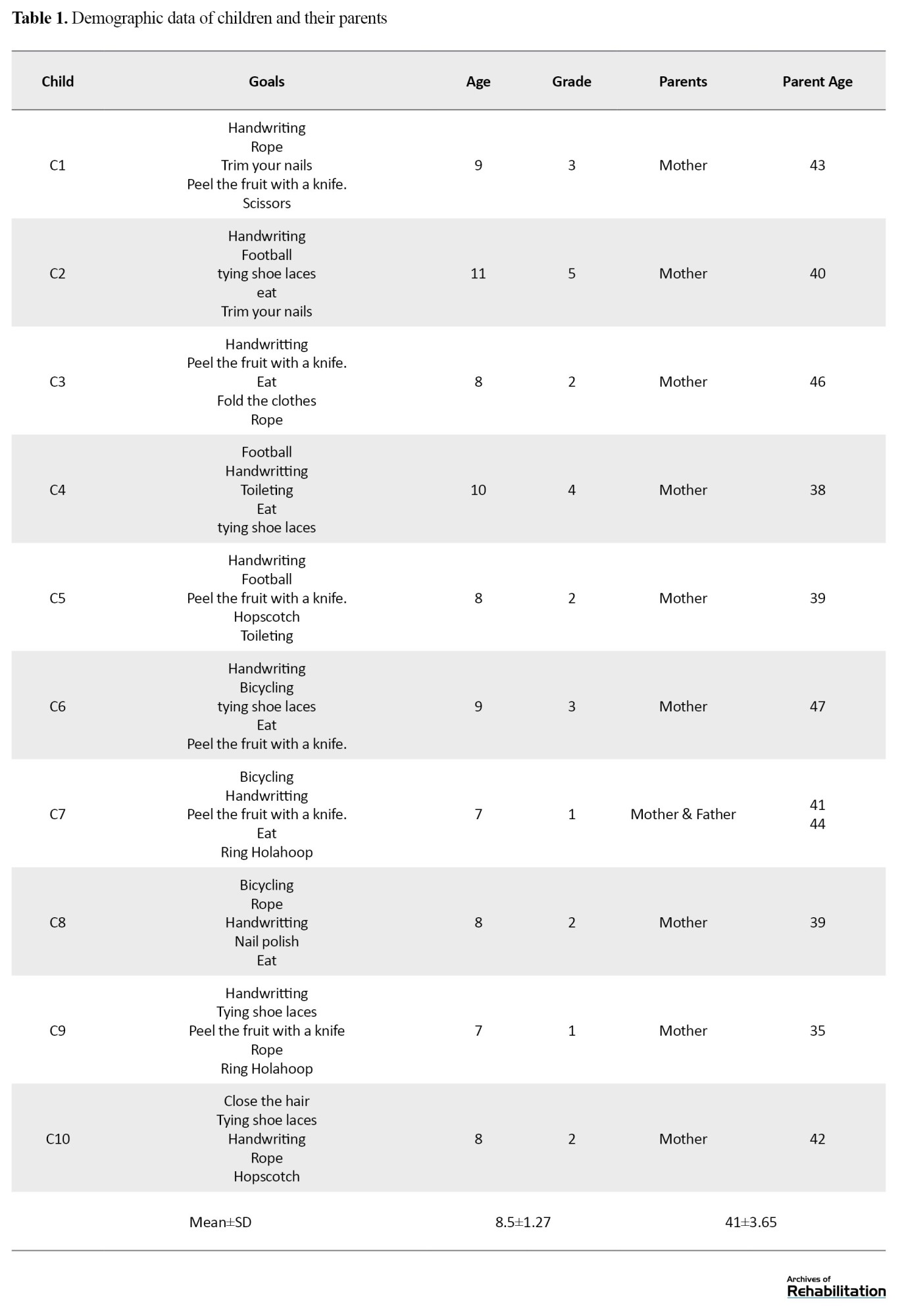
The children’s mean age was 8.5 years. They included 6 males and 4 females. Nine parents who attended the intervention sessions were mothers and only for one participant, both father and mother attended the sessions. Table 2 shows summarizes the descriptive statistics, including mean and standard deviations, for parent- and child-reported performance and satisfaction outcomes, along with PQRS scores, across trained and untrained tasks in three evaluation stages.
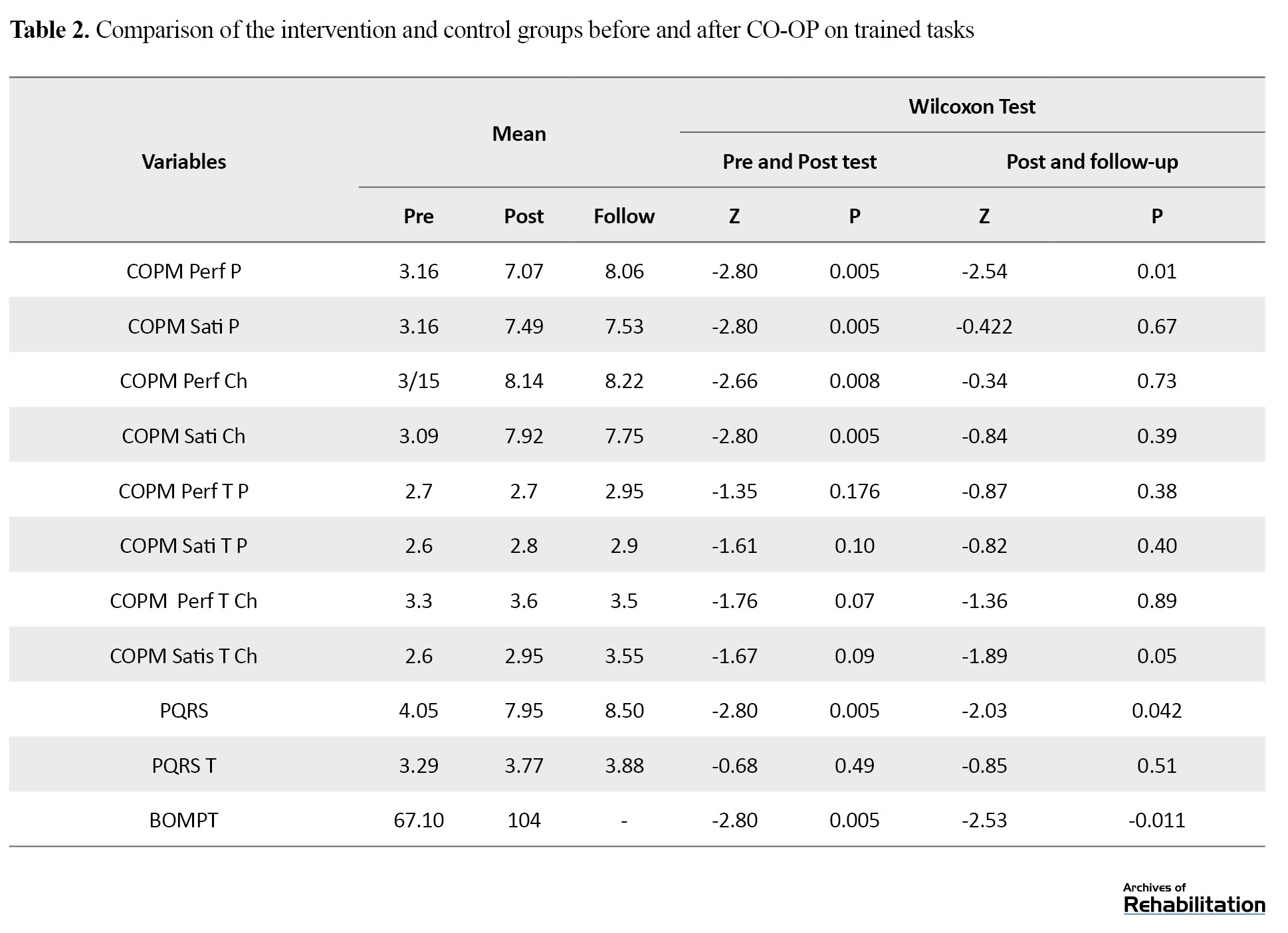
Mean scores of parents and children showed a change in performance on the trained goals after intervention, with both children and parents reporting increases of at least two points in performance. The Wilcoxon test results indicated statistically significant improvements in parent-reported performance (P=0.005) and satisfaction (P=0.005) following intervention on trained tasks. Children also reported significantly higher performance (P=0.008) and satisfaction (P=0.005) on trained tasks compared to the post-test scores. The PQRS score for trained tasks was also significantly different (P=0.005). This indicates that the effect of the CO-OP intervention on the acquisition of the trained goals was significant and that children able to acquire all three chosen goals.
In the untrained tasks, used a measure of learning transfer, there was no significant differences reported in COPM scores in post-intervention phase compared to pre-intervention results. The parent-reported scores on performance (P=0.596) and satisfaction (P=0.22) did not shown a significant change. Children-reported scores in performance (P=0.28) and satisfaction (P=0.359) also showed no significant change. The PQRS score was not significantly different in untrained task (P=0.05). No clinically significant improvements were observed in outcomes related to the untrained goals, indicating that the learning transfer to untrained tasks did not occur. The BOT-2 scores showed a significant improvement in overall motor performance from pre- to post-intervention (P=0.005).
Discussion
The present study examined the effectiveness of CO-OP intervention in improving the acquisition performance of children with SLD in trained tasks compared to untrained tasks. Overall, children demonstrated significant improvement in performance in trained tasks and satisfaction according to both child- and parent-reported COPM scores. These findings are consistent with the results of earlier studies, that reported the effectiveness of CO-OP in performance acquisition in children with DCD [12-16], CP [17, 18], Asperger syndrome [19-21], ADHD [22] and SLD [23]. This suggests that the CO-OP approach can effectively support children with SLD who present with motor-related challenges in occupational performance and can apply cognitive strategies to achieve their goals. These children are generally capable of learning and applying cognitive strategies when instruction is appropriately provided [28]. As indicated by the COPM and PQRS scores for trained tasks, all children with SLD in this study were able to learn and apply the general cognitive strategies and independently generate domain specific strategies through guided discovery and showed significant improvement in all trained tasks. Unlike the traditional approaches that emphasize the direct teaching of a single strategy, CO-OP children actively participate in discovering domain specific strategies, and it encourages self-instruction to rely on sophisticated thinking. Sophisticated thinking give the children the opportunity to learn that they have the ability to solve many learning problems by themselves [27, 28], and attribute their performance to their own ability and effort which can increase their learning motivation [41].
In this study, no significant improvement was found for untrained tasks, indicating that learning transfer did not occur under the conditions used in this study. These results are against the findings of Capistran and Martini and Araújo et al. [12, 24], where the learning transfer was observed in children with DCD. In these studies, parents received more extensive support and additional information, which may have contributed to strategy carryover . In the study by Araujo et al. more support to parents helped them to guide their children to explore new strategies when transferring strategies to new tasks; therefore, transfer of strategies to new and untrained tasks was reported [25]. Mandich and Polatajko emphasized that parents play a crucial role in reinforcing strategy use beyond the clinical setting, where structured guidance can facilitate the transfer of learned strategies [9]. It seems that more parental involvement in therapy sessions can facilitate the transfer of learning to new tasks and by providing a systematic way for parents to be involved, the transfer of learning in these children can be improved.
Capistran and Martini believe that the lack of significant change in the untrained tasks may be due to difference in the degree of similarity between the two trained and untrained tasks. Therefore, it seems that the child simply adapt the strategies from the untrained tasks to a similar trained task [12]. In our study, it seems that the degree of similarity is lower. In many cases, new strategies should be discovered to perform the new task. Examining the degree of similarity between the tasks selected by the child is important for an accurate assessment of the learning transfer, which was not examined in the present study.
The results of the studies by Capistran and Martini and Araújo et al. [12, 24] are not consistent with the results of the present study, because in both studies, children with DCD participated in the intervention. Children with SLD often struggle to spontaneously select or adapt appropriate strategies and effectively implement them in a variety of tasks. General problem-solving skills have a wide range of applications and can be used to acquire many new skills, but these children do not use problem-solving skills to perform new skills or do not make an effort to modify and use the skill for the new task [42]. Another possible explanation for the absence of learning transfer may be that the training for transfer was brief and not specifically focused on transfer. In McEwen et al.’s study, participants stated that there was a need for more emphasis on transfer tasks and homework to encourage spontaneous use of strategies [11]. According to Geusgens et al. we can not expect the transfer to occur automatically. One of the prerequisites for facilitating transfer is that transfer should be addressed during learning [2]. To promote the transfer of skills and strategies in this study, during the intervention, children were guided to think of other situations in which they might use the strategy and how they could apply the strategies beyond the intervention session. Then they were asked to practice the strategies in new tasks.
Parents reported that their children did not use cognitive strategies at home and did not cooperate with them in practicing the strategies they had been taught. Based on the researcher’s experience, parents’ suboptimal parenting style made it difficult to effectively engage with their children, as some parents had a challenging relationship with their children. Parents of children with disabilities frequently experience challenges in managing their children’s behaviours, and do not have appropriate and positive strategies to increase their children’s cooperation in using the strategies they had discovered. On the other hand, parents placed more responsibility for the intervention on the therapists, thus becoming less involved in the treatment process. Also, it seems that homework alone during intervention sessions was not sufficient to transfer learning. In the CO-OP approach, parents are not only involved in helping children with learning strategies and skills acquired during intervention and applying them the clinical setting and at home, but also encourage them to use the strategies and skills in new tasks encountered in everyday situations [8, 9]. Also, since students with SLD lack good thinking skills and the ability to use active thinking, they can have the best learning experience with mediated learning and instructional scaffolding [28]. Therefore, parents play a main role in supporting the learning transfer to out of treatment sessions [9] and the use of self-regulated learning process in children, such as planning strategy use and monitoring and evaluating performance. Their ongoing presence in the child’s life makes them prime candidates for facilitating the learning transfer in children [16]. Given the importance of parents in facilitating the transfer of strategies, it is necessary to develop the strategies to increase parental participation in the transfer process.
This study had some limitations including a small sample size and absence of a control group, both of which can restrict the generalizability of findings. Although the degree of similarity between trained and untrained tasks is an important factor in the learning transfer, we did not find an appropriate tool to measure the degree of similarity and complexity of transfer tasks. The Generalization and Transfer Scale (G&T scale) designed by Holden et al. [43] can be used for addressing this limitation in assessing the amount of learning transfer. It is recommended to use this scale in future studies to examine the extent of transfer.
Conclusion
The CO-OP intervention can lead to significant improvements in performance on trained tasks in children with SLD, but it is not effective in helping them transfer the discovered strategies to new and untrained tasks. Increasing the CO-OP intervention sessions that directly focus on strategy transfer and discovery of new strategies may facilitate the learning transfer. In addition, active parental involvement during therapy sessions can play a key role in promoting learning transfer. Future research should focus on enhancing parental involvement during therapy sessions to promote the transfer of discovered strategies to untrained tasks.
Ethical Considerations
Compliance with ethical guidelines
This study was approved by the Ethics Committee of Iran University of Medical Sciences (Code: IR.IUMS.REC.1400.082) and was registered by the Iranian Registry of Clinical Trial (ID: IRCT20201019049080N2).Participants were fully informed about the intervention procedures and their right to discontinue participation at any stage. Written informed consent was obtained prior to data collection. All study data were handled confidentially and were accessible solely to the research team.
Funding
The article was extracted from a research project of the Corresponding author, Malahat AkbarFahimi, Department of Occupational Therapy, School of Rehabilitation Sciences, Iran University of Medical Sciences. This research was supported by the research project (NO 19233) funded by the Iran University of Medical Sciences.
Authors' contributions
Supervision and project management: Mehdi Rasafiani, Narges Shafaroudi, and Malahat Akbarfahimi; data collection, draft Preparation, and editing & review: Soraya Ghorbaghi, Narges Shafaroudi, Malahit Akbarfahimi, and Mehdi Rassafiani; intervention implementation: Seyed Davood Moeini.
Conflict of interest
The authors declare no conflict of interest.
Acknowledgments
The authors would like to thank the children and their parents who participated in this research.
References
The ultimate goal of rehabilitation intervention is to enable clients to apply the skills and strategies learnt in the sessions to different situations in everyday life and help them act independently and perform activities of daily living [1-3]. To achieve this goal, the transfer of learning from trained to untrained tasks should be done [2, 4]. This requires that occupational therapists teach strategies and skills in a way that clients can use them independently in situations that may be different from the initial conditions [5]. Therefore, facilitating the transfer of learned strategies and skills to untrained tasks in real-life situations is very important for the clinical success of any intervention [6, 7]. Transfer of learned strategies to untrained tasks is one of the fundamental objectives of the cognitive orientation to daily occupational performance (CO-OP) approach [8]. This approach essentially applies a cognitive strategy to overcome motor-based occupational performance difficulties [9]. In the CO-OP approach, learning transfer is as important as skill acquisition [10]. Transfer occurs when clients become able to adopt discovered strategies to meet the demands of new tasks encountered in daily life [8, 9].
By measuring changes in performance on untrained tasks through analysis of differences in performance before and after the CO-OP intervention based on the Canadian occupational performance measure (COPM) and performance quality rating scale (PQRS), the extent to which strategy transfer to new, untrained tasks has occurred can be evaluated [11]. Seven key features of the CO-OP approach promote the transfer and generalization of learned skills [8, 10]. Evidence supports the effectiveness of the CO-OP approach an intervention for acquiring trained tasks in children with developmental coordination disorders (DCDs) [12-16], cerebral palsy (CP) [17, 18], Asperger syndrome [19-21], attention deficit hyperactivity disorder [22] and specific learning disorders (SLD) [23].
Studies have examined the effectiveness of the CO-OP in promoting the transfer of strategies to tasks that have not been addressed during intervention. The results of these studies are contradictory; some children demonstrated improvement on transfer tasks while others did not show improvement [12, 24-26].
Previous studies have shown that children with SLD have an inability in “strategy transfer”. These children do not spontaneously transfer acquired newly learned skills and strategies to new tasks or situations that differ from the original task [27, 28]. Multiple studies have shown that due to several factors, children with SLD are not able to spontaneously apply trained strategies in new situations [27, 29]. Despite having average or above-average intelligence, these children demonstrate deficits in problem-solving abilities [30], which may limit their capacity to recognize underlying structural similarities between problems and, consequently to transfer learning. Children with SLD often have difficulty processing task features, tend to focus on irrelevant or isolated details, and therefore fail to recognize structural similarities between tasks [31]. Moreover, they often lack a sufficient understanding of appropriate strategies to generalize them to new situations. These children also show deficits in the executive functions required for strategy execution—such as judging the appropriateness of a strategy for a given task or monitoring task progress and strategy effective [27]. Additionally, repeated experiences of failure reduce their motivation, and motivation is a key factor in the acquisition, maintenance, and transfer of strategies [28].
In the CO-OP approach, the children learn to think about what and how to do things [9]. By actively engaging a SLD child in the thinking process, it can bring about a necessary state of mindfulness during strategy learning, which can enhance the transfer of learning in these children [32]. Guided discovery is a key feature of the CO-OP, wherein an adult acts as a mediator to facilitate the child’s active learning process [10]. Discovering of strategies and plans by the child and with the guidance of a therapist, increases the chance that children attribute success outcomes to their own efforts which may enhance their perception of competence and confidence in their abilities [9]. Increasing self-efficacy can enhance the transfer of learned strategies [33]. Despite the emphasis on the importance of learning transfer in the CO-OP approach, studies directly investigating this phenomenon remain limited. In a case study by McEwen et al. the results indicated that learning transfer occur between tasks in adults with stroke [11]. In contrast, Martini et al. found that group-based CO-OP intervention did not lead to significant improvement in children with DCDs [34]. Similarly, Capistran and Martini found that learning transfer was observed in two tasks but not in the other two tasks [12].
Given the importance of learning transfer in occupational therapy and difficulties in transfer among children with SLD, there is currently no evidence regarding the effectiveness of the CO-OP in promoting strategy transfer in this population. Therefore, the present study aims to investigate the efficacy of the CO-OP in facilitating transfer of strategies in children with SLD. Specifically, the study examines the impact of the CO-OP on acquisition performance in trained tasks and compares it with performance in untrained tasks among children with SLDs.
Materials and Methods
Study design
This is a clinical trial with a pre-test/post-test design as well as a two-month follow-up phase to examine the long-term effectiveness of an intervention [35, 36]. The design aimed to investigate the impact of the CO-OP approach on performance in trained task as well as the transfer of strategies to novel and untrained tasks. Occupational performance outcomes for both trained and untrained tasks were assessed at baseline, immediately after the intervention and at the two-month follow-up.
Participants
The participants were 10 children with SLD who were recruited from SLS treatment centers in Tehran, Iran, using a convenience sampling method. The inclusion criteria were age 7-12 years, diagnosis of SLD by a pediatric psychiatrist according to DSM-V criteria, difficulties in the performance of motor-based occupational performance, and absence of any coexisting diseases or observable clinical symptoms of neurological or neuromuscular disorders.
Instruments
The measures that were used in this study included the COPM, PQRS, and Bruninks Oseretsky test of motor proficiency-edition 2 (BOT-2).
The COPM scoring system was utilized to assess the perceived performance and satisfaction in both children and parents regarding trained and untrained tasks [37]. It includes a semi-structured interview developed to facilitate goal setting for everyday living performance, subsequently allowing both parties to rate related performance and satisfaction levels. The instrument has demonstrated favourable psychometric properties, with confirmed reliability and validity for measuring both performance and satisfaction. In 1996, Lowe and Stuart reported reliability coefficients ranging from 70 to 75% for both performance and satisfaction domains in children with different disabilities. The Persian version of the COPM also has acceptable content validity, assessed among parents of children withCP (80.95±0.222). The Spearman-Brown correlation coefficient for test-re-test reliability was 84% for performance and 87% for satisfaction, indicating a high test-re-test reliability and confirming the acceptable repeatability of the Persian version [38]. For this study, five goals were identified, three goals were used as training tasks (were therapeutically intervened by the therapist during the CO-OP intervention) and two goals were selected as transfer tasks (were not directly intervened during the intervention) Perceived changes in performance were recorded using a 10-point self-report scale. Improvements by two points or more were interpreted as clinically significant change [37, 39].
PQRS is a 10-point scale that uses behavioral observation techniques applied to rate the videotaped performance of the child during the tasks (goals). It is scores from 1 (cannot perform the task at all) to 10 (can perform the task very well). Two independent assessors that were blind to the trained and untrained tasks and the time of each task (pre-test, post-test, follow-up) watched the videos and rated the child’s performance on five goals in three assessment phases. A high inter-rater reliability has been reported for the PQRS [34].
The BOT-2 includes eight subtests that can measure three domains of motor skills including gross motor, fine motor and a combination of both motor skills [34]. This assessment can be used for children aged 4.6-14.6 years and was employed to assess children at two points, prior to and post the intervention. The overall Bot-2 score was used to present motor performance outcomes [40].
Procedure
After assessing the inclusion criteria, the parents received information about the study objectives and signed a written informed consent form. The children were asked to complete the daily activity log with the assistance of their parents if needed, prior to the first session of the intervention. The information from the completed log was used to guide the goal setting. Then, the COPM was used by a trained therapist to identify therapeutic five goals for intervention; three first goals as trained tasks and the remaining two goals as untrained tasks. Based on the methodological approaches described by McEwen et al. and Capistran and Martini [11, 12], children’s performance on the untrained tasks was also assessed to determine whether any learning transferred beyond the tasks directly practiced during the intervention. The 10-point scale was then used to rate the perceived performance and satisfaction across the five goals in children and parents. Then, researcher videotaped the performance of all five tasks during three repetitions for PQRS analysis.
After pre-test assessments, all children participated in 12 sessions of CO-OP intervention, each session for 60 minutes, and twice a week. The intervention was conducted at the Valiasr rehabilitation center in Tehran by an occupational therapist trained in the CO-OP approach, following the protocol recommended by Polatajko and her colleagues [8, 9]. Parents attended in the general cognitive strategy session and were encouraged to be present in more sessions if possible. At the beginning and end of each session, the therapist reviewed the strategies used and the parents were encouraged to support the children to use the strategies at home or other places [9].
After the final session, and again at two-months after the intervention, both children and their parents completed the COPM again for all five goals. Each goal was also performed three times and video-recorded for PQRS. Each child’s motor performance was also assessed again using the BOT-2. Two experienced pediatric occupational therapists independently scored the performance using the PQRS.
Data analysis
Pre-test scores were compared with the post-test and follow-up scores for each participant on the trained and untrained tasks using non-parametric Wilcoxon test. Statistical significance was set at 0.05, and all analyzes were conducted in SPSS software, version 27.
Results
Demographic characters of children and their parents are presented in Table 1.
The children’s mean age was 8.5 years. They included 6 males and 4 females. Nine parents who attended the intervention sessions were mothers and only for one participant, both father and mother attended the sessions. Table 2 shows summarizes the descriptive statistics, including mean and standard deviations, for parent- and child-reported performance and satisfaction outcomes, along with PQRS scores, across trained and untrained tasks in three evaluation stages.
Mean scores of parents and children showed a change in performance on the trained goals after intervention, with both children and parents reporting increases of at least two points in performance. The Wilcoxon test results indicated statistically significant improvements in parent-reported performance (P=0.005) and satisfaction (P=0.005) following intervention on trained tasks. Children also reported significantly higher performance (P=0.008) and satisfaction (P=0.005) on trained tasks compared to the post-test scores. The PQRS score for trained tasks was also significantly different (P=0.005). This indicates that the effect of the CO-OP intervention on the acquisition of the trained goals was significant and that children able to acquire all three chosen goals.
In the untrained tasks, used a measure of learning transfer, there was no significant differences reported in COPM scores in post-intervention phase compared to pre-intervention results. The parent-reported scores on performance (P=0.596) and satisfaction (P=0.22) did not shown a significant change. Children-reported scores in performance (P=0.28) and satisfaction (P=0.359) also showed no significant change. The PQRS score was not significantly different in untrained task (P=0.05). No clinically significant improvements were observed in outcomes related to the untrained goals, indicating that the learning transfer to untrained tasks did not occur. The BOT-2 scores showed a significant improvement in overall motor performance from pre- to post-intervention (P=0.005).
Discussion
The present study examined the effectiveness of CO-OP intervention in improving the acquisition performance of children with SLD in trained tasks compared to untrained tasks. Overall, children demonstrated significant improvement in performance in trained tasks and satisfaction according to both child- and parent-reported COPM scores. These findings are consistent with the results of earlier studies, that reported the effectiveness of CO-OP in performance acquisition in children with DCD [12-16], CP [17, 18], Asperger syndrome [19-21], ADHD [22] and SLD [23]. This suggests that the CO-OP approach can effectively support children with SLD who present with motor-related challenges in occupational performance and can apply cognitive strategies to achieve their goals. These children are generally capable of learning and applying cognitive strategies when instruction is appropriately provided [28]. As indicated by the COPM and PQRS scores for trained tasks, all children with SLD in this study were able to learn and apply the general cognitive strategies and independently generate domain specific strategies through guided discovery and showed significant improvement in all trained tasks. Unlike the traditional approaches that emphasize the direct teaching of a single strategy, CO-OP children actively participate in discovering domain specific strategies, and it encourages self-instruction to rely on sophisticated thinking. Sophisticated thinking give the children the opportunity to learn that they have the ability to solve many learning problems by themselves [27, 28], and attribute their performance to their own ability and effort which can increase their learning motivation [41].
In this study, no significant improvement was found for untrained tasks, indicating that learning transfer did not occur under the conditions used in this study. These results are against the findings of Capistran and Martini and Araújo et al. [12, 24], where the learning transfer was observed in children with DCD. In these studies, parents received more extensive support and additional information, which may have contributed to strategy carryover . In the study by Araujo et al. more support to parents helped them to guide their children to explore new strategies when transferring strategies to new tasks; therefore, transfer of strategies to new and untrained tasks was reported [25]. Mandich and Polatajko emphasized that parents play a crucial role in reinforcing strategy use beyond the clinical setting, where structured guidance can facilitate the transfer of learned strategies [9]. It seems that more parental involvement in therapy sessions can facilitate the transfer of learning to new tasks and by providing a systematic way for parents to be involved, the transfer of learning in these children can be improved.
Capistran and Martini believe that the lack of significant change in the untrained tasks may be due to difference in the degree of similarity between the two trained and untrained tasks. Therefore, it seems that the child simply adapt the strategies from the untrained tasks to a similar trained task [12]. In our study, it seems that the degree of similarity is lower. In many cases, new strategies should be discovered to perform the new task. Examining the degree of similarity between the tasks selected by the child is important for an accurate assessment of the learning transfer, which was not examined in the present study.
The results of the studies by Capistran and Martini and Araújo et al. [12, 24] are not consistent with the results of the present study, because in both studies, children with DCD participated in the intervention. Children with SLD often struggle to spontaneously select or adapt appropriate strategies and effectively implement them in a variety of tasks. General problem-solving skills have a wide range of applications and can be used to acquire many new skills, but these children do not use problem-solving skills to perform new skills or do not make an effort to modify and use the skill for the new task [42]. Another possible explanation for the absence of learning transfer may be that the training for transfer was brief and not specifically focused on transfer. In McEwen et al.’s study, participants stated that there was a need for more emphasis on transfer tasks and homework to encourage spontaneous use of strategies [11]. According to Geusgens et al. we can not expect the transfer to occur automatically. One of the prerequisites for facilitating transfer is that transfer should be addressed during learning [2]. To promote the transfer of skills and strategies in this study, during the intervention, children were guided to think of other situations in which they might use the strategy and how they could apply the strategies beyond the intervention session. Then they were asked to practice the strategies in new tasks.
Parents reported that their children did not use cognitive strategies at home and did not cooperate with them in practicing the strategies they had been taught. Based on the researcher’s experience, parents’ suboptimal parenting style made it difficult to effectively engage with their children, as some parents had a challenging relationship with their children. Parents of children with disabilities frequently experience challenges in managing their children’s behaviours, and do not have appropriate and positive strategies to increase their children’s cooperation in using the strategies they had discovered. On the other hand, parents placed more responsibility for the intervention on the therapists, thus becoming less involved in the treatment process. Also, it seems that homework alone during intervention sessions was not sufficient to transfer learning. In the CO-OP approach, parents are not only involved in helping children with learning strategies and skills acquired during intervention and applying them the clinical setting and at home, but also encourage them to use the strategies and skills in new tasks encountered in everyday situations [8, 9]. Also, since students with SLD lack good thinking skills and the ability to use active thinking, they can have the best learning experience with mediated learning and instructional scaffolding [28]. Therefore, parents play a main role in supporting the learning transfer to out of treatment sessions [9] and the use of self-regulated learning process in children, such as planning strategy use and monitoring and evaluating performance. Their ongoing presence in the child’s life makes them prime candidates for facilitating the learning transfer in children [16]. Given the importance of parents in facilitating the transfer of strategies, it is necessary to develop the strategies to increase parental participation in the transfer process.
This study had some limitations including a small sample size and absence of a control group, both of which can restrict the generalizability of findings. Although the degree of similarity between trained and untrained tasks is an important factor in the learning transfer, we did not find an appropriate tool to measure the degree of similarity and complexity of transfer tasks. The Generalization and Transfer Scale (G&T scale) designed by Holden et al. [43] can be used for addressing this limitation in assessing the amount of learning transfer. It is recommended to use this scale in future studies to examine the extent of transfer.
Conclusion
The CO-OP intervention can lead to significant improvements in performance on trained tasks in children with SLD, but it is not effective in helping them transfer the discovered strategies to new and untrained tasks. Increasing the CO-OP intervention sessions that directly focus on strategy transfer and discovery of new strategies may facilitate the learning transfer. In addition, active parental involvement during therapy sessions can play a key role in promoting learning transfer. Future research should focus on enhancing parental involvement during therapy sessions to promote the transfer of discovered strategies to untrained tasks.
Ethical Considerations
Compliance with ethical guidelines
This study was approved by the Ethics Committee of Iran University of Medical Sciences (Code: IR.IUMS.REC.1400.082) and was registered by the Iranian Registry of Clinical Trial (ID: IRCT20201019049080N2).Participants were fully informed about the intervention procedures and their right to discontinue participation at any stage. Written informed consent was obtained prior to data collection. All study data were handled confidentially and were accessible solely to the research team.
Funding
The article was extracted from a research project of the Corresponding author, Malahat AkbarFahimi, Department of Occupational Therapy, School of Rehabilitation Sciences, Iran University of Medical Sciences. This research was supported by the research project (NO 19233) funded by the Iran University of Medical Sciences.
Authors' contributions
Supervision and project management: Mehdi Rasafiani, Narges Shafaroudi, and Malahat Akbarfahimi; data collection, draft Preparation, and editing & review: Soraya Ghorbaghi, Narges Shafaroudi, Malahit Akbarfahimi, and Mehdi Rassafiani; intervention implementation: Seyed Davood Moeini.
Conflict of interest
The authors declare no conflict of interest.
Acknowledgments
The authors would like to thank the children and their parents who participated in this research.
References
- Eiriksdottir E, Catrambone R. Procedural instructions, principles, and examples: How to structure instructions for procedural tasks to enhance performance, learning, and transfer. Human Factors. 2011; 53(6):749-70. [DOI:10.1177/0018720811419154] [PMID]
- Geusgens C, van Heugten C, Donkervoort M, van den Ende E, Jolles J, van den Heuvel W. Transfer of training effects in stroke patients with apraxia: An exploratory study. Neuropsychological Rehabilitation. 2006; 16(2):213-29.[DOI:10.1080/09602010500172350] [PMID]
- Toglia J, Goverover Y, Johnston MV, Dain B. Application of the multicontextual approach in promoting learning and transfer of strategy use in an individual with TBI and executive dysfunction. OTJR: Occupation, Participation and Health. 2011; 31(1_suppl):S53-60. [DOI:10.3928/15394492-20101108-09] [PMID]
- Toglia JP. Generalization of treatment: A multicontext approach to cognitive perceptual impairment in adults with brain injury. American Journal of Occupational Therapy. 1991; 45(6):505-16.[DOI:10.5014/ajot.45.6.505] [PMID]
- Toglia J, Johnston MV, Goverover Y, Dain B. A multicontext approach to promoting transfer of strategy use and self regulation after brain injury: An exploratory study. Brain Injury. 2010; 24(4):664-77. [DOI:10.3109/02699051003610474] [PMID]
- Cicerone KD, Dahlberg C, Kalmar K, Langenbahn DM, Malec JF, Bergquist TF, et al. Evidence-based cognitive rehabilitation: Recommendations for clinical practice. Archives of Physical Medicine and Rehabilitation. 2000; 81(12):1596-615. [DOI:10.1053/apmr.2000.19240] [PMID]
- Geusgens CA, Winkens I, van Heugten CM, Jolles J, van den Heuvel WJ. Occurrence and measurement of transfer in cognitive rehabilitation: A critical review. Journal of Rehabilitation Medicine. 2007; 39(6):425-39. [DOI:10.2340/16501977-0092] [PMID]
- Polatajko HJ, Mandich AD, Missiuna C, Miller LT, Macnab JJ, Malloy-Miller T, et al. Cognitive orientation to daily occupational performance (CO-OP) part III-the protocol in brief. Physical & Occupational Therapy in Pediatrics. 2001; 20(2-3):107-23. [DOI:10.1300/J006v20n02_07]
- Mandich A, Polatajko HJ. Enabling occupation in children: The cognitive orientation to daily occupational performance (CO-OP) approach. Ottawa: Canadian Association of Occupational Therapists; 2004. [Link]
- Dawson DR, McEwen SE, Polatajko HJ. Cognitive orientation to daily occupational performance in occupational therapy: Using the CO-OP approach to enable participation across the lifespan. Bethesda (MD): AOTA Press; 2017. [Link]
- McEwen SE, Polatajko HJ, Huijbregts MP, Ryan JD. Inter-task transfer of meaningful, functional skills following a cognitive-based treatment: Results of three multiple baseline design experiments in adults with chronic stroke. Neuropsychological Rehabilitation. 2010; 20(4):541-61; [DOI:10.1080/09602011003638194] [PMID]
- Capistran J, Martini R. Exploring inter-task transfer following a CO-OP approach with four children with DCD: A single subject multiple baseline design. Human Movement Science. 2016; 49:277-90. [DOI:10.1016/j.humov.2016.07.004] [PMID]
- Chan DY. The application of cognitive orientation to daily occupational performance (CO-OP) in children with developmental coordination disorder (DCD) in Hong Kong: A pilot study. Hong Kong Journal of Occupational Therapy. 2007; 17(2):39-44.[DOI:10.1016/S1569-1861(08)70002-0]
- Hyland M, Polatajko H. Enabling children with Developmental Coordination Disorder to self-regulate through the use of Dynamic Performance Analysis: Evidence from the CO-OP approach. Human Movement Science. 2012; 31(4):987-98.[DOI:10.1016/j.humov.2011.09.003] [PMID]
- Thornton A, Licari M, Reid S, Armstrong J, Fallows R, Elliott C. Cognitive orientation to (daily) occupational performance intervention leads to improvements in impairments, activity and participation in children with Developmental Coordination Disorder. Disability and Rehabilitation. 2016; 38(10):979-86. [DOI:10.3109/09638288.2015.1070298] [PMID]
- Ward A, Rodger S. The application of cognitive orientation to daily occupational performance (CO-OP) with children 5-7 years with developmental coordination disorder. British Journal of Occupational Therapy. 2004; 67(6):256-64. [DOI:10.1177/030802260406700604]
- Cameron D, Craig T, Edwards B, Missiuna C, Schwellnus H, Polatajko HJ. Cognitive Orientation to daily Occupational Performance (CO-OP): A new approach for children with cerebral palsy. Physical & Occupational Therapy in Pediatrics. 2017; 37(2):183-98. [DOI:10.1080/01942638.2016.1185500] [PMID]
- Ghorbani N, Rassafiani M, Izadi-Najafabadi S, Yazdani F, Akbarfahimi N, Havaei N, et al. Effectiveness of cognitive orientation to (daily) occupational performance (CO-OP) on children with cerebral palsy: A mixed design. Research in Developmental Disabilities. 2017; 71:24-34. [DOI:10.1016/j.ridd.2017.09.007] [PMID]
- Rodger S, Brandenburg J. Cognitive Orientation to (daily) Occupational Performance (CO‐OP) with children with Asperger’s syndrome who have motor‐based occupational performance goals. Australian Occupational Therapy Journal. 2009; 56(1):41-50. [DOI:10.1111/j.1440-1630.2008.00739.x] [PMID]
- Rodger S, Ireland S, Vun M. Can Cognitive Orientation to daily Occupational Performance (CO-OP) help children with Asperger’s syndrome to master social and organisational goals? British Journal of Occupational Therapy. 2008; 71(1):23-32. [DOI:10.1177/030802260807100105]
- Rodger S, Springfield E, Polatajko HJ. Cognitive orientation for daily occupational performance approach for children with Asperger’s syndrome: A case report. Physical & Occupational Therapy in Pediatrics. 2007; 27(4):7-22. [DOI:10.1300/J006v27n04_02]
- Gharebaghy S, Rassafiani M, Cameron D. Effect of cognitive intervention on children with ADHD. Physical & Occupational Therapy in Pediatrics. 2015; 35(1):13-23. [DOI:10.3109/01942638.2014.957428] [PMID]
- Rassafiani M, Babazadeh N, Behnia F, Gharebaghi S. Applying CO-OP approach in children with specific learning disorder: Single-subject outcome study. OTJR: Occupational Therapy Journal of Research. 2025; 45(2):160-9. [DOI:10.1177/15394492241289623] [PMID]
- Araújo CRS, Cardoso AA, Magalhaes LdC. Efficacy of the cognitive orientation to daily occupational performance with Brazilian children with developmental coordination disorder. Scandinavian Journal of Occupational Therapy. 2019; 26(1):46-54. [DOI:10.1080/11038128.2017.1417476] [PMID]
- Araujo CRS, Cardoso AA, Polatajko HJ, de Castro Magalhães L. Efficacy of the Cognitive Orientation to daily Occupational Performance (CO-OP) approach with and without parental coaching on activity and participation for children with developmental coordination disorder: A randomized clinical trial. Research in Developmental Disabilities. 2021; 110:103862. [DOI:10.1016/j.ridd.2021.103862] [PMID]
- Martini R, Savard J. Cognitive Orientation to Daily Occupational Performance (CO-OP): 1-week Group Intervention with Children Referred for Motor Coordination Difficulties. The Open Journal of Occupational Therapy. 2021; 9(3):1-14.[DOI:10.15453/2168-6408.1765]
- Borkowski JG, Estrada MT, Milstead M, Hale CA. General problem-solving skills: Relations between metacognition and strategic processing. Learning Disability Quarterly. 1989; 12(1):57-70.[DOI:10.2307/1510252]
- Wong BY. Instructional parameters promoting transfer of learned strategies in students with learning disabilities. Learning Disability Quarterly. 1994; 17(2):110-20. [DOI:10.2307/1511181]
- Borkowski JG, Turner LA. Transsituational characteristics of metacognition. In: Schneider W, Weinert FE, editors. Interactions among aptitudes, strategies, and knowledge in cognitive performance. New York: Springer; 1990. [DOI:10.1007/978-1-4612-3268-1_13]
- Alipanah M, Pourmohamadreza-Tajrishi M, Nejati V, Vahedi M. The effectiveness of cognitive rehabilitative program on executive functions in children with dyscalculia. Archives of Rehabilitation. 2022; 23(3):352-71. [DOI:10.32598/RJ.23.3.487.17]
- Brownell MT, Mellard DF, Deshler DD. Differences in the learning and transfer performance between students with learning disabilities and other low-achieving students on problem-solving tasks. Learning Disability Quarterly. 1993; 16(2):138-56.[DOI:10.2307/1511136]
- Salomon G, Globerson T. Skill may not be enough: The role of mindfulness in learning and transfer. International Journal of Educational Research. 1987; 11(6):623-37. [DOI:10.1016/0883-0355(87)90006-1]
- Holladay CL, Quiñones MA. Practice variability and transfer of training: the role of self-efficacy generality. Journal of Applied Psychology. 2003; 88(6):1094-103. [DOI:10.1037/0021-9010.88.6.1094] [PMID]
- Martini R, Rios J, Polatajko H, Wolf T, McEwen S. The performance quality rating scale (PQRS): Reliability, convergent validity, and internal responsiveness for two scoring systems. Disability and Rehabilitation. 2015; 37(3):231-8. [DOI:10.3109/09638288.2014.913702] [PMID]
- Maciejewski ML. Quasi-experimental design. Biostatistics & Epidemiology. 2020; 4(1):38-47. [DOI:10.1080/24709360.2018.1477468]
- Thorpe KE, Zwarenstein M, Oxman AD, Treweek S, Furberg CD, Altman DG, et al. A pragmatic-explanatory continuum indicator summary (PRECIS): A tool to help trial designers. Journal of Clinical Epidemiology. 2009; 62(5):464-75. [DOI:10.1016/j.jclinepi.2008.12.011] [PMID]
- Law MC, Baptiste S, Carswell A, McColl MA, Polatajko H, Pollock N. Canadian occupational performance measure. Ottawa (ON): CAOT Publications ACE; 1998. [Link]
- Dehghan L, Dalvand H, Pourshahbaz A, Samadi SA. [Designing supplement form of the Canadian Occupational Performance Measure: Item analysis and suggestions for refinement (Persian)]. Journal of Rehabilitation. 2014; 15(1):21-8. [Link]
- Dehghan L, Dalvand H, Pourshahbaz A. Translation of Canadian occupational performance measure and testing Persian version validity and reliability among Iranian mothers of children with cerebral palsy. Journal of Modern Rehabilitation. 2015; 9(4):25-31. [Link]
- Van Deusen J, Brunt D. Assessment in occupational therapy and physical therapy. Philadelphia: WB Saunders Company; 1997. [Link]
- Saadati N, Al-Dossary SA, Coelho O, Rostami M, Bulut S, Parsakia K, et al. Investigating Psychological Adaptations of Parents to Childhood Disabilities. Archives of Rehabilitation. 2025; 26(1):118-33. [Link]
- Sadeghi Sedeh S, Mirzaie H, Fatoreh Chy S, Ghayomi Z, Sadeghi Sedeh B. Effect of a Family-centered Early Intervention on Psychological Symptoms and Quality of Life in Mothers of Children with Down Syndrome: A Randomized Clinical Trial. Archives of Rehabilitation. 2025; 26(3):360-79. [DOI:10.32598/RJ.26.3.3358.1]
- Houldin A. Measurement and mechanisms of skill generalization and transfer in the rehabilitation context. Toronto: University of Toronto; 2018. [Link]
Type of Study: Original |
Subject:
Occupational Therapy
Send email to the article author
| Rights and permissions | |
 |
This work is licensed under a Creative Commons Attribution-NonCommercial 4.0 International License. |

Copyright © The Author(s);
This is an open access article distributed under the terms of the Creative Commons Attribution-NonCommercial 4.0 (CC-By-NC 4.0), which permits use, distribution, and reproduction in any medium, provided the original work is properly cited and is not used for commercial purposes.
Contact Information
This is an open access article distributed under the terms of the Creative Commons Attribution-NonCommercial 4.0 (CC-By-NC 4.0), which permits use, distribution, and reproduction in any medium, provided the original work is properly cited and is not used for commercial purposes.
Contact Information