

Volume 27, Issue 3 (9-2026)
Arch Rehabil 2026, 27(3): 502-521 |
Back to browse issues page



Ethics code: IR.USWR.REC.1400.324


Download citation:
BibTeX | RIS | EndNote | Medlars | ProCite | Reference Manager | RefWorks
Send citation to:


BibTeX | RIS | EndNote | Medlars | ProCite | Reference Manager | RefWorks
Send citation to:
Basakha M, Khorasani B, Mohaqeqi Kamal S H, Hosseini Zare S M, Mohsenzadeh S M, Azadi F et al . Activity-based Costing of Inpatient Rehabilitation Services Based on Relative Value Unit Codes at Rofeideh Rehabilitation Hospital, Tehran, Iran. , Arch Rehabil. 2026; 27 (3) :502-521
URL: http://rehabilitationj.uswr.ac.ir/article-1-3704-en.html
URL: http://rehabilitationj.uswr.ac.ir/article-1-3704-en.html
Mehdi Basakha1  , Bijan Khorasani2 , Seyed Hossein Mohaqeqi Kamal *3 , Seyedeh Mahboobeh Hosseini Zare1 , Seyed Mahdi Mohsenzadeh4 , Farhad Azadi5 , Mahdieh Madani Mallak6
1- Social Determinants of Health Research Center, Social Health Institute, University of Social Welfare and Rehabilitation Sciences, Tehran, Iran.
2- Department of Clinical Sciences, School of Rehabilitation Sciences, University of Social Welfare and Rehabilitation Sciences, Tehran, Iran.
3- Social Welfare Management Research Center, Social Health Institute, University of Social Welfare and Rehabilitation Sciences, Tehran, Iran. ,hosseinmohaqeq@gmail.com
4- Deputy of Treatment and Rehabilitation, University of Social Welfare and Rehabilitation Sciences, Tehran, Iran.
5- Neuromusculoskeletal Rehabilitation Research Center, University of Social Welfare and Rehabilitation Sciences, Tehran, Iran.
6- Student Research Community, University of Social Welfare and Rehabilitation Sciences, Tehran, Iran.
2- Department of Clinical Sciences, School of Rehabilitation Sciences, University of Social Welfare and Rehabilitation Sciences, Tehran, Iran.
3- Social Welfare Management Research Center, Social Health Institute, University of Social Welfare and Rehabilitation Sciences, Tehran, Iran. ,
4- Deputy of Treatment and Rehabilitation, University of Social Welfare and Rehabilitation Sciences, Tehran, Iran.
5- Neuromusculoskeletal Rehabilitation Research Center, University of Social Welfare and Rehabilitation Sciences, Tehran, Iran.
6- Student Research Community, University of Social Welfare and Rehabilitation Sciences, Tehran, Iran.
Keywords: Rehabilitation, Inpatient services, Outpatient services, Time-driven activity-based costing, Relative value book
Full-Text [PDF 2475 kb]
(548 Downloads)
| Abstract (HTML) (1580 Views)
Full-Text: (120 Views)
Introduction
Health is one of the fundamental pillars of well-being; however, many countries—especially developing and less developed countries—still face serious challenges in meeting health standards. Given these limitations, over the past two decades, the global emphasis on efficiency and cost-effectiveness in healthcare has led to widespread reforms in health systems [1, 2]. The need for access to accurate financial and cost data has led to the development and implementation of advanced costing systems that are capable of calculating the actual cost of services in real-time and providing data for decision-making [3, 4]. Accurate analysis of costs and expenses of healthcare organizations can help managers and policymakers to be informed about the actual costs of healthcare services and can make service delivery more efficient through the optimal allocation of factors of production [5, 6].
The need to know the detailed cost structure has caused organizations to move away from traditional—and sometimes opaque—costing methods and adopt more advanced methods such as activity-based costing (ABC) and its evolved version, time-driven activity-based costing (TDABC) [7, 8]. The TDABC method offers significant advantages, including effective use of operational capacity data and identification of unused capacity, which reveals inefficiencies more clearly than the classic ABC method [9, 10]. Although traditional methods provide a precise view of operational costs, implementation is often difficult because they require large volumes of data and extensive human resource involvement [11]. The TDABC method addresses this challenge by using time equations and resource capacity, enabling the correction of cost management approaches [8]. Moreover, TDABC treats unused capacity costs as a direct result of managerial inefficiency, increasing accountability and driving organizational improvement [12]. Accurate cost estimation not only ensures financial transparency but also helps insurers allocate resources optimally and ultimately improves health outcomes [13]. However, heterogeneity in patients’ service utilization patterns complicates cost analysis, as aggregate cost allocation can lead to oversimplification and flawed policymaking [14].
Rehabilitation services play a vital role in restoring functional capacity and facilitating the social integration of diverse groups, including people with disabilities and the elderly. Despite existing legal frameworks, the accessibility and affordability of rehabilitation services are strongly influenced by their pricing strategies. In other words, pricing plays a decisive role in the behavior of service providers and recipients; therefore, determining fair and sensitive tariffs for rehabilitation services is a fundamental challenge in health policymaking [15]. In Iran and many other countries, a significant portion of rehabilitation services is excluded from insurance coverage; this increases patients’ out-of-pocket payments and, consequently, the financial burden of disability for individuals and society [16].
In recent years, innovations aimed at integrating digital time recording and automated data collection have been introduced to increase the accuracy of the TDABC method and reduce observer bias in time measurement [17]. Also, hybrid models that combine TDABC with machine learning algorithms have been developed to predict resource consumption patterns and dynamically optimize cost drivers [18]. These technologies help overcome traditional limitations in identifying and allocating cost drivers. Furthermore, studies emphasize the importance of considering patient complexity and service diversity in costing models to provide more accurate estimates of costs, especially in rehabilitation environments where patient treatment methods differ significantly [19].
Like other developing countries, Iran’s rehabilitation sector also faces informational and structural challenges, including a lack of comprehensive insurance coverage for many rehabilitation services. Improving cost transparency through rigorous costing studies can help reform the insurance system and facilitate more effective decision-making regarding resource allocation. Accordingly, the present study aimed to calculate the total cost of inpatient and outpatient rehabilitation services at Rofeideh Rehabilitation Hospital in Tehran, Iran, in 2022. The findings can support evidence-based decision-making, improve financial efficiency, and inform reforms to rehabilitation service delivery policies.
Materials and Methods
This is a cross-sectional study using retrospective performance and financial data. The TDABC method determined costs by multiplying the time required to perform each activity by the cost of the consumed resource. Cost components were divided into two categories: fixed costs and variable costs. Fixed costs included the depreciation expense of buildings and equipment, which were extracted from the hospital’s accounting system. Variable costs included the expenses associated with human resources, contracted services, and consumable materials. Regarding inpatient services, the study also examined predefined case-mix packages approved by the Iran Health Insurance Organization. These packages represent standard 21-day rehabilitation care programs with a fixed set of daily services. The actual cost of providing each package was estimated using the TDABC-derived data and then compared with the insurance reimbursement amount based on official government tariffs.
We obtained data from three sources: the Deputy for Treatment and Rehabilitation, the Financial Information System, and the Staff Attendance System of the University of Social Welfare and Rehabilitation Sciences (USWRS). Rehabilitation services were first identified and coded based on the resource-based relative value units (RBRVUs) reference book to maintain alignment with the national tariff and insurance reimbursement system. To develop time equations for each rehabilitation code, the service delivery process for each code was directly observed in 5-7 patients. Using a stopwatch, the duration of each activity, including treatment sessions, patient preparation, and documentation, was measured. The observed mean time for each code was multiplied by the capacity cost rate of the respective resource to calculate the actual cost of each service. Resource utilization was mapped across cost centers, and a distinction was made between direct and indirect costs. Cost drivers included employee working time (in minutes), equipment operating time, the number of patients in support services, and room area for facilities (in square meters). Overhead costs were allocated proportionally based on these drivers [20]. Finally, the final cost of each service was obtained by aggregating the cost of all activities related to each code/service, providing a standard and comparable basis for cost estimation. To maintain temporal comparability, these figures were also calculated and reported in US dollars (USD) based on the average real exchange rate (each USD was equivalent to 420,660 Iranian Rials [IRR] in the study year). Given the study’s objective, data analysis was descriptive in nature and focused on estimating and explaining the cost structure; therefore, inferential statistical methods were not used.
Results
Overhead costs were allocated to each hospital department using appropriate drivers in TDABC, including employee working time (in minutes for human resources), equipment operating time (for machinery), the number of patients (for maintenance and administrative services), and physical area (for facility costs). The total cost in each category was calculated separately by department. For each resource, the capacity cost rate was calculated by dividing the total cost of that resource by its practical capacity [21]. Time data (5-7 observations for each service code) provided the average minutes spent on each activity; multiplying these times by the respective capacity cost rate determined the cost of each unit of rehabilitation service. This method has also been used in other studies [22].
Table 1 shows the non-personnel costs of Rofeideh Rehabilitation Hospital in 2022.
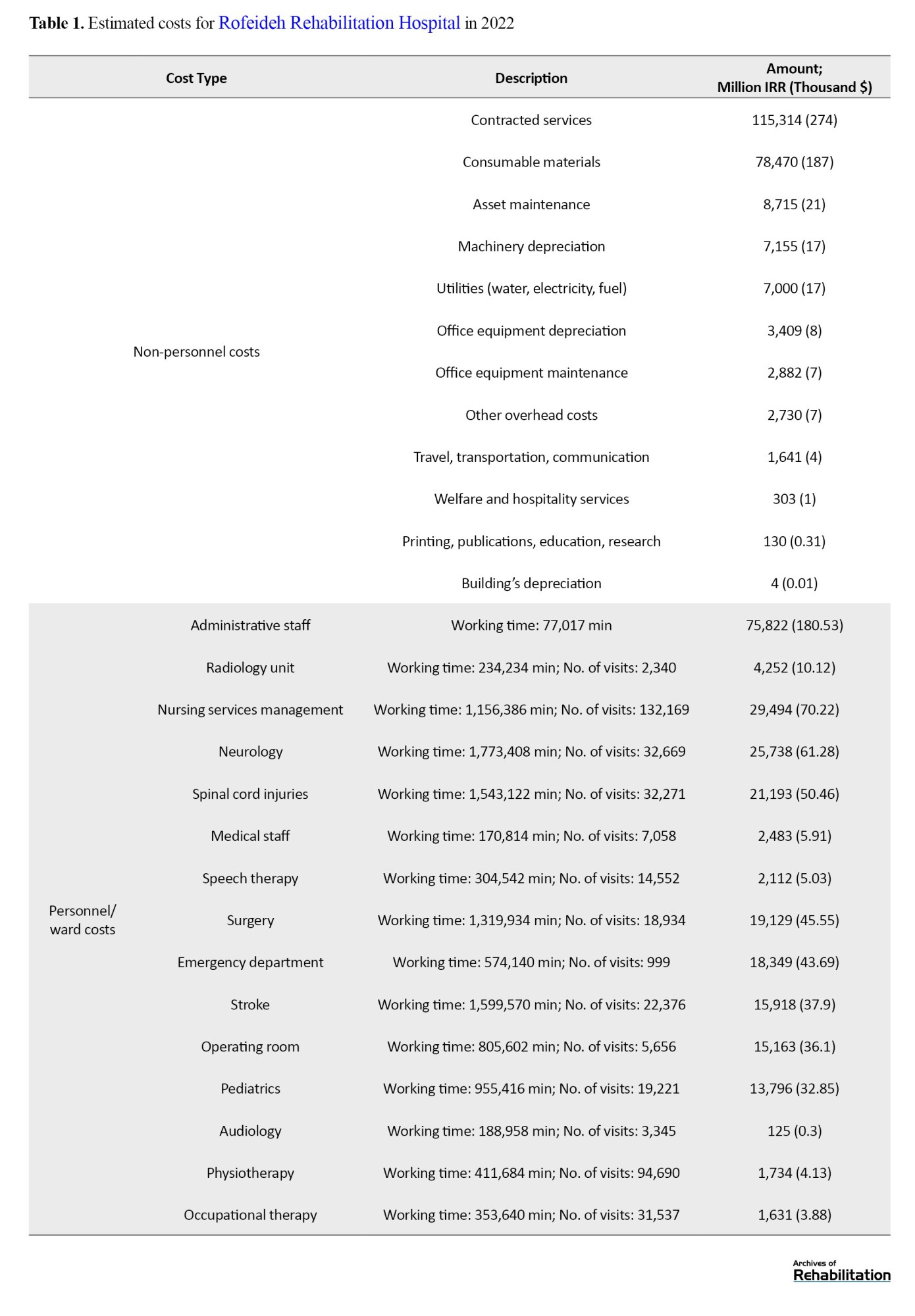
The largest cost items in this hospital were related to contracted services (115,314 million IRR, equivalent to 274,005 USD), consumable materials (78,470 million IRR, equivalent to 187,071 USD), and asset maintenance (8,715 million IRR, equivalent to 20,750 USD). Depreciation costs were negligible because of the building’s ownership and age. Human resource costs made up the largest share of total costs.
The personnel cost per minute was calculated by dividing the total personnel cost by the total activity time for each service (Table 1). The resulting cost per minute was highest for managers (984,000 IRR per minute, equivalent to 2.34 USD) but lower for nurses (25,000 IRR per minute, equivalent to 0.06 USD) and emergency staff (22,000 IRR per minute, equivalent to 0.05 USD). Among specialized therapists, the cost per minute of service was much lower: audiology (659 IRR per minute, equivalent to 0.0016 USD), physiotherapy (4,212 IRR per minute, equivalent to 0.010 USD), occupational therapy (4,611 IRR per minute, equivalent to 0.011 USD), and speech therapy (6,934 IRR per minute, equivalent to 0.017 USD).
To calculate the cost of rehabilitation services based on RBRVUs, we aggregated each department’s expenditures and adjusted them for necessary service-provision drivers. Costs were then calculated per resource unit to determine the actual cost of delivering one unit of each rehabilitation service. These costs were subsequently compared with official tariffs applied in the public sector. The cost comparison showed that the actual cost of nearly all rehabilitation services, except two audiology codes, exceeded the official tariffs for public sector providers (Table 2).
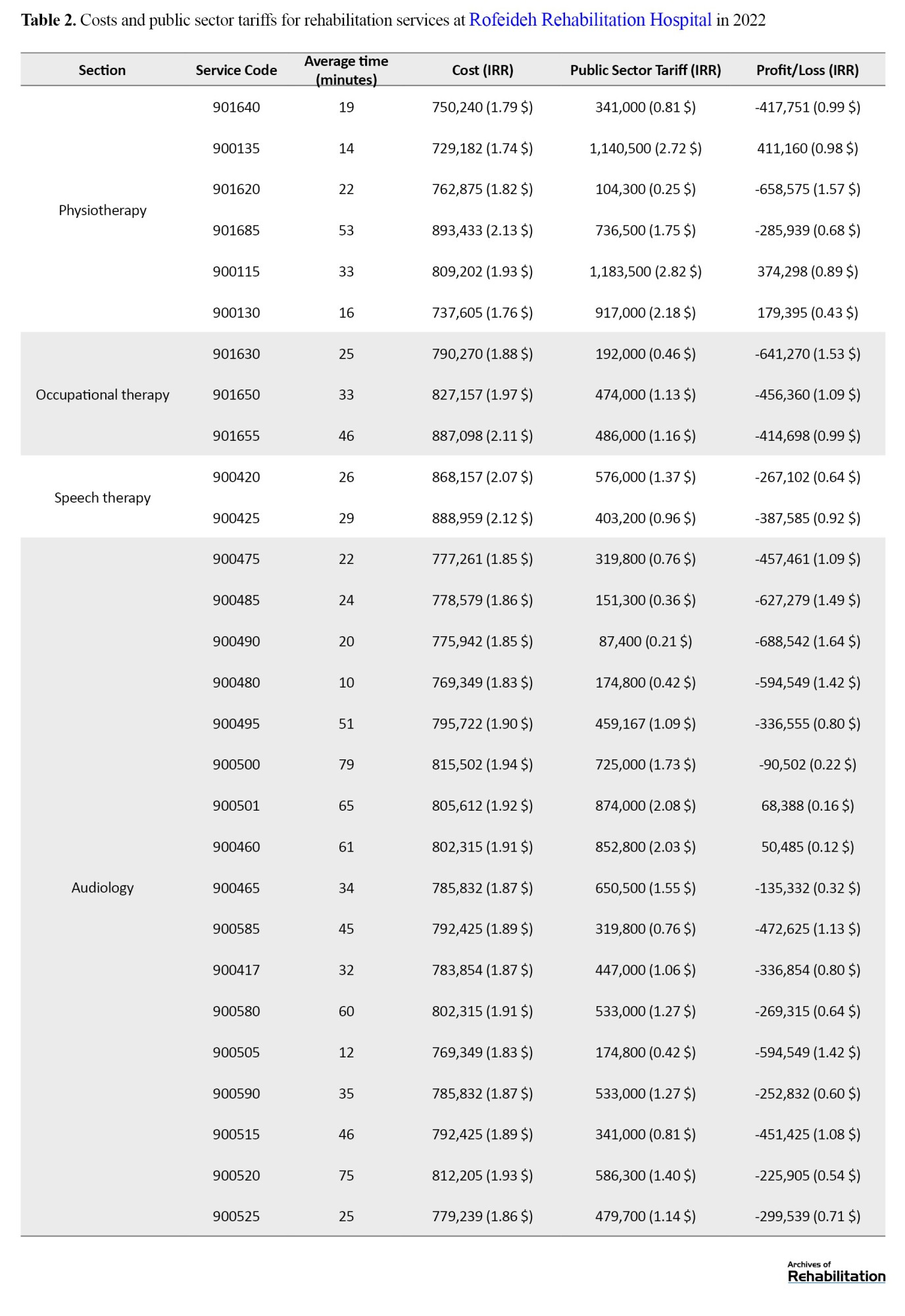
The largest gaps were observed for audiology code 900490 (775,942 IRR; $1.85), physiotherapy code 901620 (762,875 IRR; $1.82), and occupational therapy code 901630 (790,270 IRR; $1.88). Services such as physiotherapy code 900135 and audiology codes 900501 and 900460 had tariffs higher than their costs and thus produced a positive margin.
The Iranian Health Insurance Organization uses a case-mix package model to cover inpatient rehabilitation services. These packages are structured into three consecutive 21-day periods, during which the insurance program theoretically covers all inpatient rehabilitation costs. The insurance organization reimburses healthcare providers based on official public tariffs set by the Ministry of Health. Table 3 provides official tariffs to actual costs per bed-day for case-mix packages for different patient groups.
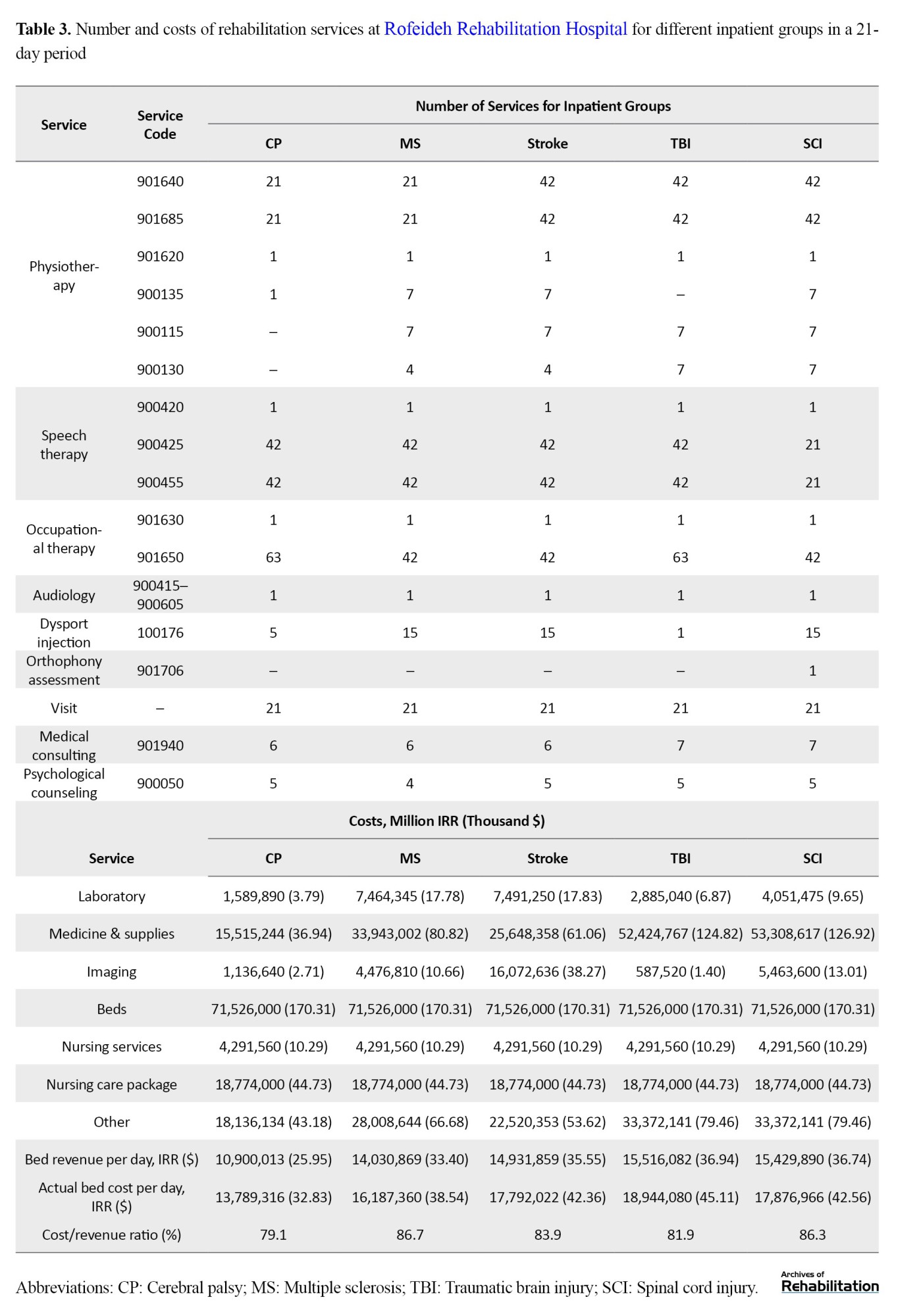
For cerebral palsy (CP) patients, the rehabilitation package cost was 10.9 million IRR ($25.95) per bed-day based on official tariffs and 12.789 million IRR ($30.45) based on actual costs, indicating a 26.5% gap. Over a maximum stay (three 21-day periods), total costs were obtained at 228.9 million IRR ($545) under tariffs and 289.576 million IRR ($690) based on actual cost.
For patients with multiple sclerosis (MS), the official tariff per bed-day was 14.021 million IRR ($33.38) compared with an actual cost of 16.187 million IRR ($38.54), indicating a 15.4% gap. For a 63-day period, the total cost was 294.648 million IRR ($702) based on the official tariff vs. 339.934 million IRR ($809) based on actual cost.
In stroke patients, the tariff rate was 14.931 million IRR ($35.55) and the actual cost was 17.792 million IRR ($42.36), a 19.2% increase. Over three 21-day cycles, the cumulative cost gap reached 180.19 million IRR ($429).
Similarly, for traumatic brain injury (TBI) patients, the official tariff was 15.516 million IRR ($36.94) and the actual cost was 18.944 million IRR ($45.10), indicating a 22.1% gap. For a 21-day period, the total cost was 325.838 million IRR ($776) based on the official tariff vs. 397.826 million IRR ($948) based on actual cost. For spinal cord injury (SCI) patients, the official tariff per bed-day was 15.429 million IRR ($36.73), whereas the actual cost was 17.878 million IRR ($42.57), representing a 15.9% gap. For a 63-day period, the cumulative gap reached 154.165 million IRR ($367).
USD values were converted using the market exchange rate (1 USD = 420,000 IRR) and rounded to two decimal places.
Discussion
The costing studies, especially the TDABC-based applied studies, are limited in the field of rehabilitation services [23]. This lack of evidence has reduced cost transparency for hospitals, rehabilitation centers, service providers, social insurance organizations, and regulatory bodies, making service delivery, rehabilitation activity development, and tariff-setting difficult. The present study was thus conducted using the TDABC method and showed that the actual cost of most rehabilitation services at Rofeideh Rehabilitation Hospital in Tehran was higher than the official tariffs of the public sector. Although this hospital is a governmental center and its operational deficit is covered by the public budget, other rehabilitation centers likely face similar financial conditions [22, 24]. Similar findings have been reported in other studies; in many countries, the actual cost of services exceeds the insurance reimbursement amount [25-27]. However, some studies have found the opposite [28, 29], suggesting that cost structure depends on contextual factors such as organizational scale, resource consumption patterns, and efficiency.
Our results also indicated that technical, organizational, and economic factors influence the cost of rehabilitation services at Rofeideh Rehabilitation Hospital. Analyzing the cost structure of service delivery can help managers identify cost drivers and optimize resource utilization. In the study hospital, overhead costs constituted the largest share of total costs, in contrast to many previous studies in Iran and other countries [22, 28, 30, 31]. One main factor behind this finding is suboptimal service-delivery capacity: the number of patients admitted and served was less than the center’s actual capacity; as a result, fixed overhead costs were divided among fewer services. This scale effect significantly increases the unit cost of services, a pattern also emphasized in studies by Mohammadpour et al. [22] and Basakha et al. [31]. From a human resources perspective, administrative staff at Rofeideh Rehabilitation Hospital had the highest cost per minute of work. Other studies in small and medium healthcare centers have also reported a disproportionate share of administrative staff wages in total costs [21, 31].
Consistent with this research, previous evidence also confirms a significant gap between the actual cost of rehabilitation services and official tariffs [1, 32-35]. This gap may indicate that current tariffs are not aligned with the actual cost structure of service delivery, or that rehabilitation centers lack sufficient operational efficiency to manage costs within existing tariffs.
Analysis of inpatient rehabilitation service packages provided at Rofeideh Rehabilitation Hospital also showed that insurance reimbursement does not fully cover the actual cost of service provision. For the CP, MS, stroke, TBI, and SCI patients, the national health insurance reimbursement covered only 79.1%, 86.7%, 83.9%, 81.9%, and 86.3% of the actual cost, respectively. In other words, the gap between the actual cost and the revenue from public sector tariffs threatens the financial sustainability of this hospital and may limit its ability to expand services or maintain service quality standards.
The findings of this study, conducted for the first time in Iran, can serve as a basis for using complex insurance reimbursement systems, including diagnosis-related groups. However, this study had some limitations. First, although it is also a teaching center, the economic value of Rofeideh Rehabilitation Hospital’s educational activities was not included in the analysis. As a result, the hospital’s operational efficiency may appear lower than that of purely clinical centers because part of its resources is spent on academic activities that do not directly generate revenue. Another limitation was that the hospital provided all financial data, and the researchers did not verify them. Therefore, bias or estimation errors in the financial data may exist.
Conclusion
The present study used the TDABC approach to calculate the cost of inpatient rehabilitation service packages at Rofeideh Rehabilitation Hospital, which are used by the Iranian Health Insurance Organization for service purchase. The findings showed that inpatient packages for different patients (including those with SCI, MS, CP, TBI, and stroke) were reimbursed at amounts below actual cost, indicating a financial gap between the actual cost of services and the insurance reimbursement amount. These results emphasize the necessity of revising the pricing system of rehabilitation services based on the actual cost of services. To improve the financial sustainability and efficiency of rehabilitation centers, tariff reform should be pursued through negotiation between service providers and insurance organizations so that official reimbursement rates cover actual costs while maintaining patient access and affordability. Moreover, the hospital needs to establish cost-management systems to control major cost items (especially staff costs, contracted services, and consumable materials). Implementing structured resource and inventory management systems can help monitor and optimize the consumption of materials, as this section constitutes a significant share of the hospital’s total costs. Health policymakers should also develop non-inpatient rehabilitation service models, such as home-based or community-based rehabilitation programs, to reduce hospital overhead costs and expand service coverage.
This study provides a transparent, evidence-based analysis of rehabilitation service costs in Iran and can serve as a valuable basis for reforming the tariff system and optimizing resource allocation in this sector. Aligning reimbursement policies with empirical cost data, improving cost-control mechanisms, and diversifying service-delivery models are essential to improving the economic efficiency and long-term sustainability of rehabilitation services in the country.
Ethical Considerations
Compliance with ethical guidelines
This study was approved by the Research Ethics Committee of the University of Social Welfare and Rehabilitation Sciences, Tehran, Iran (Code: IR.USWR.REC.1400.324). Because there were no participants, informed consent was not required.
Funding
This research was funded by the University of Social Welfare and Rehabilitation Sciences, Tehran, Iran (Grant No.: 01-T-2670.).
Authors' contributions
Conceptualization: Mehdi Basakha, Bijan Khorasani, and Seyed Hossein Mohaqeqi Kamal; Study design: Mehdi Basakha, Farhad Azadi; Data collection and analysis: Mehdi Basakha, Seyedeh Mahboubeh Hosseini Zare, and Seyed Mehdi Mohsenzadeh; Writing the original draft: Mehdi Basakha and Seyed Hossein Mohaqeqi Kamal; Review and editing: All authors.
Conflict of interest
The authors declared no conflict of interest.
Statement on the use of AI tools
The authors used ChatGPT-4o solely to translate the abstract and improve the manuscript's linguistic accuracy.
Acknowledgments
The authors thank the Clinical Research Development Unit and the Financial Department of Rofeideh Rehabilitation Hospital, as well as tthe Deputy for Research and Technology of the University of Social Welfare and Rehabilitation Sciences, and the hospital staff who facilitated this research.
References
Health is one of the fundamental pillars of well-being; however, many countries—especially developing and less developed countries—still face serious challenges in meeting health standards. Given these limitations, over the past two decades, the global emphasis on efficiency and cost-effectiveness in healthcare has led to widespread reforms in health systems [1, 2]. The need for access to accurate financial and cost data has led to the development and implementation of advanced costing systems that are capable of calculating the actual cost of services in real-time and providing data for decision-making [3, 4]. Accurate analysis of costs and expenses of healthcare organizations can help managers and policymakers to be informed about the actual costs of healthcare services and can make service delivery more efficient through the optimal allocation of factors of production [5, 6].
The need to know the detailed cost structure has caused organizations to move away from traditional—and sometimes opaque—costing methods and adopt more advanced methods such as activity-based costing (ABC) and its evolved version, time-driven activity-based costing (TDABC) [7, 8]. The TDABC method offers significant advantages, including effective use of operational capacity data and identification of unused capacity, which reveals inefficiencies more clearly than the classic ABC method [9, 10]. Although traditional methods provide a precise view of operational costs, implementation is often difficult because they require large volumes of data and extensive human resource involvement [11]. The TDABC method addresses this challenge by using time equations and resource capacity, enabling the correction of cost management approaches [8]. Moreover, TDABC treats unused capacity costs as a direct result of managerial inefficiency, increasing accountability and driving organizational improvement [12]. Accurate cost estimation not only ensures financial transparency but also helps insurers allocate resources optimally and ultimately improves health outcomes [13]. However, heterogeneity in patients’ service utilization patterns complicates cost analysis, as aggregate cost allocation can lead to oversimplification and flawed policymaking [14].
Rehabilitation services play a vital role in restoring functional capacity and facilitating the social integration of diverse groups, including people with disabilities and the elderly. Despite existing legal frameworks, the accessibility and affordability of rehabilitation services are strongly influenced by their pricing strategies. In other words, pricing plays a decisive role in the behavior of service providers and recipients; therefore, determining fair and sensitive tariffs for rehabilitation services is a fundamental challenge in health policymaking [15]. In Iran and many other countries, a significant portion of rehabilitation services is excluded from insurance coverage; this increases patients’ out-of-pocket payments and, consequently, the financial burden of disability for individuals and society [16].
In recent years, innovations aimed at integrating digital time recording and automated data collection have been introduced to increase the accuracy of the TDABC method and reduce observer bias in time measurement [17]. Also, hybrid models that combine TDABC with machine learning algorithms have been developed to predict resource consumption patterns and dynamically optimize cost drivers [18]. These technologies help overcome traditional limitations in identifying and allocating cost drivers. Furthermore, studies emphasize the importance of considering patient complexity and service diversity in costing models to provide more accurate estimates of costs, especially in rehabilitation environments where patient treatment methods differ significantly [19].
Like other developing countries, Iran’s rehabilitation sector also faces informational and structural challenges, including a lack of comprehensive insurance coverage for many rehabilitation services. Improving cost transparency through rigorous costing studies can help reform the insurance system and facilitate more effective decision-making regarding resource allocation. Accordingly, the present study aimed to calculate the total cost of inpatient and outpatient rehabilitation services at Rofeideh Rehabilitation Hospital in Tehran, Iran, in 2022. The findings can support evidence-based decision-making, improve financial efficiency, and inform reforms to rehabilitation service delivery policies.
Materials and Methods
This is a cross-sectional study using retrospective performance and financial data. The TDABC method determined costs by multiplying the time required to perform each activity by the cost of the consumed resource. Cost components were divided into two categories: fixed costs and variable costs. Fixed costs included the depreciation expense of buildings and equipment, which were extracted from the hospital’s accounting system. Variable costs included the expenses associated with human resources, contracted services, and consumable materials. Regarding inpatient services, the study also examined predefined case-mix packages approved by the Iran Health Insurance Organization. These packages represent standard 21-day rehabilitation care programs with a fixed set of daily services. The actual cost of providing each package was estimated using the TDABC-derived data and then compared with the insurance reimbursement amount based on official government tariffs.
We obtained data from three sources: the Deputy for Treatment and Rehabilitation, the Financial Information System, and the Staff Attendance System of the University of Social Welfare and Rehabilitation Sciences (USWRS). Rehabilitation services were first identified and coded based on the resource-based relative value units (RBRVUs) reference book to maintain alignment with the national tariff and insurance reimbursement system. To develop time equations for each rehabilitation code, the service delivery process for each code was directly observed in 5-7 patients. Using a stopwatch, the duration of each activity, including treatment sessions, patient preparation, and documentation, was measured. The observed mean time for each code was multiplied by the capacity cost rate of the respective resource to calculate the actual cost of each service. Resource utilization was mapped across cost centers, and a distinction was made between direct and indirect costs. Cost drivers included employee working time (in minutes), equipment operating time, the number of patients in support services, and room area for facilities (in square meters). Overhead costs were allocated proportionally based on these drivers [20]. Finally, the final cost of each service was obtained by aggregating the cost of all activities related to each code/service, providing a standard and comparable basis for cost estimation. To maintain temporal comparability, these figures were also calculated and reported in US dollars (USD) based on the average real exchange rate (each USD was equivalent to 420,660 Iranian Rials [IRR] in the study year). Given the study’s objective, data analysis was descriptive in nature and focused on estimating and explaining the cost structure; therefore, inferential statistical methods were not used.
Results
Overhead costs were allocated to each hospital department using appropriate drivers in TDABC, including employee working time (in minutes for human resources), equipment operating time (for machinery), the number of patients (for maintenance and administrative services), and physical area (for facility costs). The total cost in each category was calculated separately by department. For each resource, the capacity cost rate was calculated by dividing the total cost of that resource by its practical capacity [21]. Time data (5-7 observations for each service code) provided the average minutes spent on each activity; multiplying these times by the respective capacity cost rate determined the cost of each unit of rehabilitation service. This method has also been used in other studies [22].
Table 1 shows the non-personnel costs of Rofeideh Rehabilitation Hospital in 2022.
The largest cost items in this hospital were related to contracted services (115,314 million IRR, equivalent to 274,005 USD), consumable materials (78,470 million IRR, equivalent to 187,071 USD), and asset maintenance (8,715 million IRR, equivalent to 20,750 USD). Depreciation costs were negligible because of the building’s ownership and age. Human resource costs made up the largest share of total costs.
The personnel cost per minute was calculated by dividing the total personnel cost by the total activity time for each service (Table 1). The resulting cost per minute was highest for managers (984,000 IRR per minute, equivalent to 2.34 USD) but lower for nurses (25,000 IRR per minute, equivalent to 0.06 USD) and emergency staff (22,000 IRR per minute, equivalent to 0.05 USD). Among specialized therapists, the cost per minute of service was much lower: audiology (659 IRR per minute, equivalent to 0.0016 USD), physiotherapy (4,212 IRR per minute, equivalent to 0.010 USD), occupational therapy (4,611 IRR per minute, equivalent to 0.011 USD), and speech therapy (6,934 IRR per minute, equivalent to 0.017 USD).
To calculate the cost of rehabilitation services based on RBRVUs, we aggregated each department’s expenditures and adjusted them for necessary service-provision drivers. Costs were then calculated per resource unit to determine the actual cost of delivering one unit of each rehabilitation service. These costs were subsequently compared with official tariffs applied in the public sector. The cost comparison showed that the actual cost of nearly all rehabilitation services, except two audiology codes, exceeded the official tariffs for public sector providers (Table 2).
The largest gaps were observed for audiology code 900490 (775,942 IRR; $1.85), physiotherapy code 901620 (762,875 IRR; $1.82), and occupational therapy code 901630 (790,270 IRR; $1.88). Services such as physiotherapy code 900135 and audiology codes 900501 and 900460 had tariffs higher than their costs and thus produced a positive margin.
The Iranian Health Insurance Organization uses a case-mix package model to cover inpatient rehabilitation services. These packages are structured into three consecutive 21-day periods, during which the insurance program theoretically covers all inpatient rehabilitation costs. The insurance organization reimburses healthcare providers based on official public tariffs set by the Ministry of Health. Table 3 provides official tariffs to actual costs per bed-day for case-mix packages for different patient groups.
For cerebral palsy (CP) patients, the rehabilitation package cost was 10.9 million IRR ($25.95) per bed-day based on official tariffs and 12.789 million IRR ($30.45) based on actual costs, indicating a 26.5% gap. Over a maximum stay (three 21-day periods), total costs were obtained at 228.9 million IRR ($545) under tariffs and 289.576 million IRR ($690) based on actual cost.
For patients with multiple sclerosis (MS), the official tariff per bed-day was 14.021 million IRR ($33.38) compared with an actual cost of 16.187 million IRR ($38.54), indicating a 15.4% gap. For a 63-day period, the total cost was 294.648 million IRR ($702) based on the official tariff vs. 339.934 million IRR ($809) based on actual cost.
In stroke patients, the tariff rate was 14.931 million IRR ($35.55) and the actual cost was 17.792 million IRR ($42.36), a 19.2% increase. Over three 21-day cycles, the cumulative cost gap reached 180.19 million IRR ($429).
Similarly, for traumatic brain injury (TBI) patients, the official tariff was 15.516 million IRR ($36.94) and the actual cost was 18.944 million IRR ($45.10), indicating a 22.1% gap. For a 21-day period, the total cost was 325.838 million IRR ($776) based on the official tariff vs. 397.826 million IRR ($948) based on actual cost. For spinal cord injury (SCI) patients, the official tariff per bed-day was 15.429 million IRR ($36.73), whereas the actual cost was 17.878 million IRR ($42.57), representing a 15.9% gap. For a 63-day period, the cumulative gap reached 154.165 million IRR ($367).
USD values were converted using the market exchange rate (1 USD = 420,000 IRR) and rounded to two decimal places.
Discussion
The costing studies, especially the TDABC-based applied studies, are limited in the field of rehabilitation services [23]. This lack of evidence has reduced cost transparency for hospitals, rehabilitation centers, service providers, social insurance organizations, and regulatory bodies, making service delivery, rehabilitation activity development, and tariff-setting difficult. The present study was thus conducted using the TDABC method and showed that the actual cost of most rehabilitation services at Rofeideh Rehabilitation Hospital in Tehran was higher than the official tariffs of the public sector. Although this hospital is a governmental center and its operational deficit is covered by the public budget, other rehabilitation centers likely face similar financial conditions [22, 24]. Similar findings have been reported in other studies; in many countries, the actual cost of services exceeds the insurance reimbursement amount [25-27]. However, some studies have found the opposite [28, 29], suggesting that cost structure depends on contextual factors such as organizational scale, resource consumption patterns, and efficiency.
Our results also indicated that technical, organizational, and economic factors influence the cost of rehabilitation services at Rofeideh Rehabilitation Hospital. Analyzing the cost structure of service delivery can help managers identify cost drivers and optimize resource utilization. In the study hospital, overhead costs constituted the largest share of total costs, in contrast to many previous studies in Iran and other countries [22, 28, 30, 31]. One main factor behind this finding is suboptimal service-delivery capacity: the number of patients admitted and served was less than the center’s actual capacity; as a result, fixed overhead costs were divided among fewer services. This scale effect significantly increases the unit cost of services, a pattern also emphasized in studies by Mohammadpour et al. [22] and Basakha et al. [31]. From a human resources perspective, administrative staff at Rofeideh Rehabilitation Hospital had the highest cost per minute of work. Other studies in small and medium healthcare centers have also reported a disproportionate share of administrative staff wages in total costs [21, 31].
Consistent with this research, previous evidence also confirms a significant gap between the actual cost of rehabilitation services and official tariffs [1, 32-35]. This gap may indicate that current tariffs are not aligned with the actual cost structure of service delivery, or that rehabilitation centers lack sufficient operational efficiency to manage costs within existing tariffs.
Analysis of inpatient rehabilitation service packages provided at Rofeideh Rehabilitation Hospital also showed that insurance reimbursement does not fully cover the actual cost of service provision. For the CP, MS, stroke, TBI, and SCI patients, the national health insurance reimbursement covered only 79.1%, 86.7%, 83.9%, 81.9%, and 86.3% of the actual cost, respectively. In other words, the gap between the actual cost and the revenue from public sector tariffs threatens the financial sustainability of this hospital and may limit its ability to expand services or maintain service quality standards.
The findings of this study, conducted for the first time in Iran, can serve as a basis for using complex insurance reimbursement systems, including diagnosis-related groups. However, this study had some limitations. First, although it is also a teaching center, the economic value of Rofeideh Rehabilitation Hospital’s educational activities was not included in the analysis. As a result, the hospital’s operational efficiency may appear lower than that of purely clinical centers because part of its resources is spent on academic activities that do not directly generate revenue. Another limitation was that the hospital provided all financial data, and the researchers did not verify them. Therefore, bias or estimation errors in the financial data may exist.
Conclusion
The present study used the TDABC approach to calculate the cost of inpatient rehabilitation service packages at Rofeideh Rehabilitation Hospital, which are used by the Iranian Health Insurance Organization for service purchase. The findings showed that inpatient packages for different patients (including those with SCI, MS, CP, TBI, and stroke) were reimbursed at amounts below actual cost, indicating a financial gap between the actual cost of services and the insurance reimbursement amount. These results emphasize the necessity of revising the pricing system of rehabilitation services based on the actual cost of services. To improve the financial sustainability and efficiency of rehabilitation centers, tariff reform should be pursued through negotiation between service providers and insurance organizations so that official reimbursement rates cover actual costs while maintaining patient access and affordability. Moreover, the hospital needs to establish cost-management systems to control major cost items (especially staff costs, contracted services, and consumable materials). Implementing structured resource and inventory management systems can help monitor and optimize the consumption of materials, as this section constitutes a significant share of the hospital’s total costs. Health policymakers should also develop non-inpatient rehabilitation service models, such as home-based or community-based rehabilitation programs, to reduce hospital overhead costs and expand service coverage.
This study provides a transparent, evidence-based analysis of rehabilitation service costs in Iran and can serve as a valuable basis for reforming the tariff system and optimizing resource allocation in this sector. Aligning reimbursement policies with empirical cost data, improving cost-control mechanisms, and diversifying service-delivery models are essential to improving the economic efficiency and long-term sustainability of rehabilitation services in the country.
Ethical Considerations
Compliance with ethical guidelines
This study was approved by the Research Ethics Committee of the University of Social Welfare and Rehabilitation Sciences, Tehran, Iran (Code: IR.USWR.REC.1400.324). Because there were no participants, informed consent was not required.
Funding
This research was funded by the University of Social Welfare and Rehabilitation Sciences, Tehran, Iran (Grant No.: 01-T-2670.).
Authors' contributions
Conceptualization: Mehdi Basakha, Bijan Khorasani, and Seyed Hossein Mohaqeqi Kamal; Study design: Mehdi Basakha, Farhad Azadi; Data collection and analysis: Mehdi Basakha, Seyedeh Mahboubeh Hosseini Zare, and Seyed Mehdi Mohsenzadeh; Writing the original draft: Mehdi Basakha and Seyed Hossein Mohaqeqi Kamal; Review and editing: All authors.
Conflict of interest
The authors declared no conflict of interest.
Statement on the use of AI tools
The authors used ChatGPT-4o solely to translate the abstract and improve the manuscript's linguistic accuracy.
Acknowledgments
The authors thank the Clinical Research Development Unit and the Financial Department of Rofeideh Rehabilitation Hospital, as well as tthe Deputy for Research and Technology of the University of Social Welfare and Rehabilitation Sciences, and the hospital staff who facilitated this research.
References
- Javanbakht M, Mashayekhi A, Salavati S, Mohammadzadeh A. [Applying Activity-Based Costing (ABC) Method in Determining the Cost of Hospital Imaging Services (Persian)]. Journal of The Medical System Organization of the Islamic Republic of Iran. 2013; 31(1):15-23. [Link]
- World Health Organization. Improving efficiency across health programmes. Geneva: World Health Organization; 2023. [Link]
- Ibrahim R, Nur AM, Hassan NH, Am H, Aljunid SM. The cost of radiological procedures at Universiti Kebangsaan Malaysia Medical Centre: Applying activity based costing methodology. BMC Public Health. 2014; 14(S1):O21. [DOI:10.1186/1471-2458-14-S1-O21] [PMCID]
- Smith JM, Patel N, Larson E. Financial information systems in developing healthcare economies: A case study analysis. Journal of Health Economics and Finance. 2022; 15(2):101-14. [Link]
- Mobasheri M, Sami H, Rafiei A. [Calculating the cost of services provided in the stone crushing unit of Ayatollah Kashani Hospital Shahrekord using activity-based costing technique (Persian)]. Health Information Management. 2014; 11(7):889-95. [DOI:10.22122/him.v11i7.1378]
- Lee J, Park Y. The impact of cost transparency on hospital management decisions. Healthcare Management Science. 2021; 24(2):300-12. [Link]
- Amini MR, Tavakoli Mohammadi M, Khosravanian HR. Time-based activity-based costing: A customer-oriented approach to cost calculation. Accounting Research. 2012; 1(4):135-63. [Link]
- Kaplan RS, Anderson SR. Time-Driven Activity-Based Costing. Harvard Business Review. 2004; 82(11):131-8. [DOI:10.2139/ssrn.485443]
- Öker F, Özyapici H. A new costing model in hospital management: time-driven activity-based costing system. The Health Care Manager. 2013; 32(1):23-36. [DOI:10.1097/HCM.0b013e31827ed898] [PMID]
- Kundu S, Sarkar S, Chakraborty R. Evaluating cost efficiencies in healthcare: Comparative perspectives of ABC and TDABC in developing countries. Journal of Health Management. 2024; 26(1):56-67. [Link]
- Khani A, Mehrani S, Ghane E. [Applying Time-Driven Activity-Based Costing in the ICU Ward of Shariati Hospital of Isfahan Province (Persian)]. Journal of Health Accounting. 2013; 2(4):40-57. [DOI:10.30476/jha.2013.16931]
- Defourny N, Hoozée S, Daisne JF, Lievens Y. Developing time-driven activity-based costing at the national level to support policy recommendations for radiation oncology in Belgium. Journal of Accounting and Public Policy. 2023; 42(1):107013. [Link]
- Shakya S, Bohingamu Mudiyanselage S, Robinson S, Randall S, Gao L. Time-Driven Activity-Based Costing and Its Use in Health Economic Analysis: A Systematic Literature Review. Applied Health Economics and Health Policy. 2025; 23(6):989-1004.[DOI:10.1007/s40258-025-00988-3] [PMID]
- Ruger JP, Richter CJ, Spitznagel EL, Lewis LM. Analysis of costs, length of stay, and utilization of emergency department services by frequent users: Implications for health policy. Academic Emergency Medicine. 2004; 11(12):1311-7. [DOI:10.1197/j.aem.2004.07.008] [PMID]
- Nguyen HT, Tran BX, Ho RC. Pricing challenges in rehabilitation services: A review of international practices. Global Health Journal. 2023; 7(3):24-31. [Link]
- World Bank. Disability inclusion and rehabilitation services financing. Washington: World Bank Publications; 2021. [Link]
- Chen L, Martinez R, Zhou Y. Enhancing Time-Driven Activity-Based Costing Accuracy Using Digital Time-Tracking Tools in Healthcare. Journal of Health Informatics. 2024; 36(2):147-60. [Link]
- Rivera N, Singh R. Integration of Machine Learning with TDABC: A Novel Approach to Predictive Costing in Health Services. Health Economics and Data Analytics. 2023; 15(1):33-52. [Link]
- Thompson J, Ward P. Patient Complexity in Rehabilitation Costing: Incorporating Risk Adjustment into TDABC Models. Journal of Rehabilitation Economics. 2022; 18(4):275-88. [Link]
- Tan RY, Met-Domestici M, Zhou K, Guzman AB, Lim ST, Soo KC, et al. Using Quality Improvement Methods and Time-Driven Activity-Based Costing to Improve Value-Based Cancer Care Delivery at a Cancer Genetics Clinic. Journal of Oncology Practice. 2016; 12(3):e320-31. [DOI:10.1200/JOP.2015.007765] [PMID]
- Dubron K, Verschaeve M, Roodhooft F. A time-driven activity-based costing approach for identifying variability in costs of childbirth between and within types of delivery. BMC Pregnancy and Childbirth. 2021; 21(1):705. [DOI:10.1186/s12884-021-04134-4]
- Mohammadpour F, Basakha M, Kamal SHM, Azari N. Costing the Outpatient Rehabilitation Services: Time-Driven Activity Based Costing Approach. Cost Effectiveness and Resource Allocation. 2022; 20(1):31. [DOI:10.1186/s12962-022-00366-z] [PMID]
- Van den Berg M, van Elten H, Spaan J, Franx A, Ahaus K. Exploring cost changes with time-driven activity-based costing after service delivery redesign in Dutch maternity care. Health Services Management Research. 2025; 38(4):219-27. [DOI:10.1177/09514848241265770] [PMID]
- Golmohammad A, EbadifardAzar F, Abutorabi A. The cost of services provided in the physiotherapy department of Shafa Yahyaian hospital. Journal of Health Based Research. 2020; 5(4):355-67. [Link]
- Demeere N, Stouthuysen K, Roodhooft F. Time-driven activity-based costing in an outpatient clinic environment: development, relevance and managerial impact. Health Policy. 2009; 92(2):296-304. [DOI:10.1016/j.healthpol.2009.05.003] [PMID]
- Koolmees D, Bernstein DN, Makhni EC. Time-Driven Activity-Based Costing Provides a Lower and More Accurate Assessment of Costs in the Field of Orthopaedic Surgery as Compared to Traditional Accounting Methods. Arthroscopy: The Journal of Arthroscopic & Related Surgery. 2021;3 7(5):1620-7. [DOI:10.1016/j.arthro.2020.11.028] [PMID]
- Pezzi TA, Ning MS, Thaker NG, Boyce-Fappiano D, Gjyshi O, Olivieri ND, et al. Evaluating single-institution resource costs of consolidative radiotherapy for oligometastatic non-small cell lung cancer using time-driven activity-based costing. Clinical and Translational Radiation Oncology. 2020; 23:80-4. [DOI:10.1016/j.ctro.2020.05.007] [PMID]
- French KE, Guzman AB, Rubio AC, Frenzel JC, Feeley TW. Value based care and bundled payments: Anesthesia care costs for outpatient oncology surgery using time-driven activity-based costing. Healthcare. 2016; 4(3):173-80. [DOI:10.1016/j.hjdsi.2015.08.007] [PMID]
- Sabharwal S, Carter AW, Rashid A, Darzi A, Reilly P, Gupte CM. Cost analysis of the surgical treatment of fractures of the proximal humerus: an evaluation of the determinants of cost and comparison of the institutional cost of treatment with the national tariff. The Bone & Joint Journal. 2016; 98(2):249-59. [DOI:10.1302/0301-620X.98B2.36255] [PMID]
- Khezri A, Nosratjejad S, Sattari A, Zakariyazadeh S. [Costing Hospital Services through Top-Down Costing Approach(Persian)]. Health Research Journal. 2020; 5(4):211-23. [Link]
- Basakha M, Khorasani B, Zare SMH, Mohsenzadeh SM, Mohammadpour F, Izanloo M. Determining the Unit Cost of Outpatient Rehabilitation Services in the Nezam-Mafi Rehabilitation Center in Tehran, Iran Using the Time-driven Activity-based Costing Method. Archievs of Rehabilitation 2023; 24(3):346-63. [DOI:10.32598/RJ.24.3.3211.2]
- Mazibuko SM, Govender P, Nadasan T. Stakeholders’ views on public-private partnerships for rehabilitation services in South Africa ahead of National Health Insurance. South African Family Practice. 2025; 67(1):e1-e10. [DOI:10.4102/safp.v67i1.6013] [PMID]
- Laviana AA, Ilg AM, Veruttipong D, Tan HJ, Burke MA, Niedzwiecki DR, et al. Utilizing time-driven activity-based costing to understand the short-and long-term costs of treating localized, low-risk prostate cancer. Cancer. 2016; 122(3):447-55. [DOI:10.1002/cncr.29743] [PMID]
- Arab M, Yousefvand M, Zahavi M. [Survey and Calculating the Bed-Day cost and Day-Patient Cost of Orthopedi Department of Khomeiny Hospital ofTehran University of Medical Science by Using Activity Based Costing (ABC) Method -2008 (Pesian)]. Hospital. 2013; 12(1):29-38. [Link]
- Yarikkaya E, Özekinci S, Sargan A, Durmuş ŞE, Yildiz FR. A Comparative Study of Activity-Based Costing vs. Current Pricing System for Pathology Examinations at Okmeydani Training and Research Hospital, Turkey. Turkish Journal of Pathology. 2017; 33(1):17-24. [DOI:10.5146/tjpath.2016.01372] [PMID]
Type of Study: Original |
Subject:
Health Economics
Send email to the article author
| Rights and permissions | |
 |
This work is licensed under a Creative Commons Attribution-NonCommercial 4.0 International License. |

Copyright © The Author(s);
This is an open access article distributed under the terms of the Creative Commons Attribution-NonCommercial 4.0 (CC-By-NC 4.0), which permits use, distribution, and reproduction in any medium, provided the original work is properly cited and is not used for commercial purposes.
Contact Information
This is an open access article distributed under the terms of the Creative Commons Attribution-NonCommercial 4.0 (CC-By-NC 4.0), which permits use, distribution, and reproduction in any medium, provided the original work is properly cited and is not used for commercial purposes.
Contact Information