
Volume 27, Issue 1 (5-2026)
Arch Rehabil 2026, 27(1): 2-15 |
Back to browse issues page



Ethics code: IR.UMA.REC.1404.019


Download citation:
BibTeX | RIS | EndNote | Medlars | ProCite | Reference Manager | RefWorks
Send citation to:


BibTeX | RIS | EndNote | Medlars | ProCite | Reference Manager | RefWorks
Send citation to:
Piri E, Jafarnezhadgero A. A Multidimensional Model for Return to Sport Decision-making After Anterior Cruciate Ligament Reconstruction: Editorial. Arch Rehabil 2026; 27 (1) :2-15
URL: http://rehabilitationj.uswr.ac.ir/article-1-3789-en.html
URL: http://rehabilitationj.uswr.ac.ir/article-1-3789-en.html

1- Department of Sports Biomechanics, Faculty of Educational Sciences and Psychology, University of Mohaghegh Ardabili, Ardabil, Iran. & Department of Molecular Medicine and Surgery, Karolinska Institutet, Solna, Sweden.
2- Department of Sports Biomechanics, Faculty of Educational Sciences and Psychology, University of Mohaghegh Ardabili, Ardabil, Iran. ,Amiralijafarnezhad@gmail.com
2- Department of Sports Biomechanics, Faculty of Educational Sciences and Psychology, University of Mohaghegh Ardabili, Ardabil, Iran. ,
Keywords: Anterior cruciate ligament reconstruction (ACLR), Return to sport (RTS), Biomechanics, Gait, Running
Full-Text [PDF 2341 kb]
(386 Downloads)
| Abstract (HTML) (720 Views)
Full-Text: (206 Views)
Introduction
Anterior cruciate ligament (ACL) rupture is one of the most prevalent and debilitating orthopedic injuries worldwide, with global incidence estimated at approximately 1 per 3,500, equating to nearly 95,000 new ACL reconstruction (ACLR) cases annually in the United States alone [1]. Alarmingly, incidence rates among high-risk populations, particularly adolescents and young adults aged 16–39 years, are even higher, reaching 85 per 100,000, with Australia reporting the highest global incidence of 91 per 100,000 people under the age of 25 [2]. Given that these figures are derived predominantly from surgical databases, the true incidence of ACL injury is likely substantially greater, reflecting a global epidemic that continues to expand across athletic populations [2]. In the United States, approximately 60,000–75,000 ACLRs are performed annually, with reported long-term success rates ranging from 75 to 95% [1]. However, the ability to successfully return to sport (RTS) following ACLR remains highly variable and, for many patients, it is elusive. Evidence demonstrates that while approximately 80% of patients return to some form of sports activity, only 65% return to their pre-injury level of performance, and 55% successfully return to competitive-level sport [3]. Among soccer players, up to 40% do not believe they will return to their sport following ACL injury, reflecting the profound psychological and physical barriers to successful RTS [4]. Among those who have successful RTS, reinjury rates remain alarmingly high, with 23.5% experiencing reinjury and 24.5% requiring reoperation. These sobering statistics underscore a fundamental question: what distinguishes a high-quality, sustained RTS from a dangerous, injury-prone one?
A growing body of literature has identified several key determinants of successful RTS. The Delaware-Oslo ACL cohort study established international consensus on six measures defining successful outcome after ACL injury and reconstruction: absence of knee joint giving way, RTS, quadriceps and hamstrings’ strength >90% of the uninvolved limb, having no more than mild knee joint effusion, and patient-reported outcomes [5]. Moreover, prospective evidence has demonstrated that premature RTS, specifically before 9 months postoperatively, may increase the risk of a second ACL injury by up to 7-fold, whereas delaying clearance by each additional month up to 9 months can reduce reinjury risk by approximately 50%.
The consequences of incomplete or inadequate rehabilitation are profound and enduring. Inadequate rehabilitation, combined with an unprepared RTS, not only limits athletic performance but also significantly increases the reinjury risk [6]. Persistent gait abnormalities are frequently observed even at 6–12 months postoperatively and may last up to 2 years or longer [7]. Such biomechanical impairments, including reduced peak knee flexion angles, diminished knee flexion moments, and altered gait symmetry, are associated not only with heightened ACL reinjury risk but also with early-onset post-traumatic osteoarthritis (PTOA) [7]. Alarmingly, over 80% of patients undergoing ACLR with hamstring tendon autografts exhibit radiographic evidence of PTOA during a 15.6-year follow-up [8].
This editorial introduces a novel conceptual framework that bridges the critical gap between structured rehabilitation programming and systematic biomechanical assessment. Specifically, we propose the integration of comprehensive kinematic and kinetic analyses during walking and running at three distinct postoperative milestones, 6, 12, and 18 months, to differentiate the biomechanical trajectory of patients who adhere to rigorous, criteria-based rehabilitation protocols from those who do not. While numerous studies have characterized gait abnormalities following ACLR [9], no study has systematically mapped the temporal evolution of locomotor mechanics in relation to adherence to structured rehabilitation, nor prospectively compared these biomechanical outcomes with the timing of surgical intervention. This editorial further contributes a unique examination of the temporal relationship between injury and surgery, specifically, whether immediate ACLR (<6 weeks after injury) confers biomechanical advantages over delayed reconstruction (>6 months), or whether prolonged pre-surgical periods with inadequate rehabilitation engender persistent, unfavorable gait and running mechanics that undermine long-term joint health.
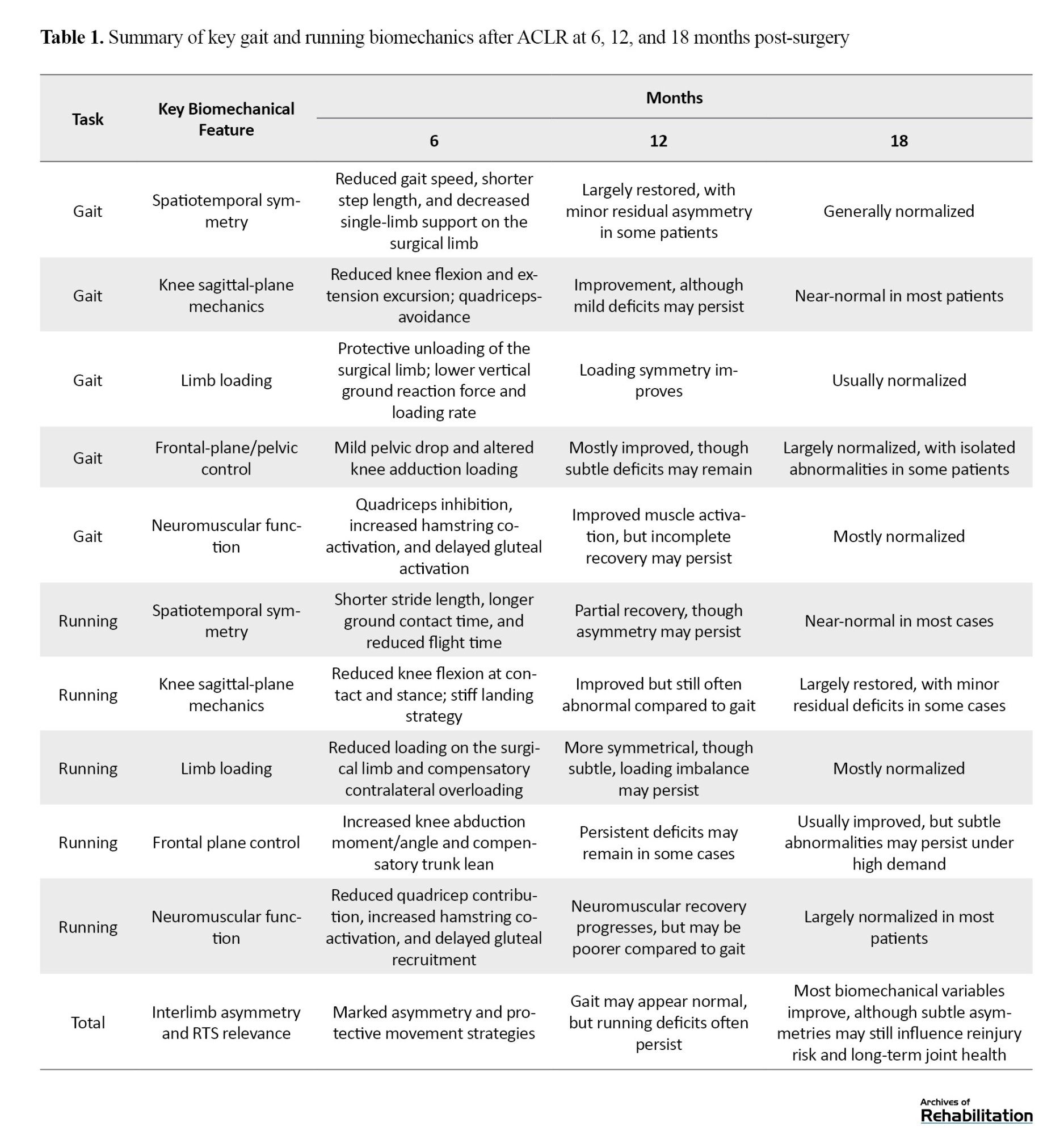
Emerging evidence suggests that early ACLR may be more beneficial in improving knee extension movement and knee extension moment during walking at 12 months postoperatively compared to delayed surgery [10]. Conversely, other studies have reported that >80% of early and delayed ACLR patients ultimately develop PTOA at long-term follow-up, with no significant differences between groups [8]. These conflicting findings highlight the urgent need for a granular, timespecific analysis of when and for whom surgical timing truly matters. Accordingly, the primary goal of this editorial is twofold: (a) to establish a bridge between comprehensive rehabilitation adherence and serial biomechanical assessment at 6, 12, and 18 months postsurgery; and (b) to critically evaluate the influence of the injurytosurgery time on walking and running mechanics. By linking process (rehabilitation fidelity) to outcome (biomechanical recovery), this editorial seeks to provide clinicians, surgeons, and sports scientists with actionable, evidencebased guidelines for determining not only the time of RTS, but also how the patient should return with quality, resilience, and sustained joint health as the ultimate endpoints. Six months after ACLR, patients commonly demonstrate protective walking and running patterns characterized by unloading of the surgical limb, reduced knee extensor moment, marked neuromuscular inhibition, and substantial interlimb asymmetry. After 12 months, many spatiotemporal gait parameters return to normal values; however, running mechanics often remain impaired, particularly in loading symmetry and knee control, indicating that apparently normal gait may mask persistent deficits during higher-demand tasks. By 18 months, gait biomechanics are typically near normal in most individuals, and many gait variables improve substantially, although subtle asymmetries, especially in frontal-plane knee mechanics and hip control, may persist in some patients, potentially contributing to reinjury risk and long-term joint degeneration [9].
Table 1 synthesize evidence-based, time-specific biomechanical findings after ACLR, at 6, 12, and 18 months post-surgery, with emphasis on limb-to-limb asymmetry, locomotor loading strategies, and neuromuscular control during walking and running factors central to RTS quality and reinjury risk.
Integrating biomechanical recovery with RTS testing
Although the time since surgery is frequently used as a practical benchmark in ACLR rehabilitation, it is not a sufficient criterion. Biomechanical recovery after ACLR is task-specific and nonlinear. Gait mechanics may be normal up to 12 months, whereas running mechanics, frontal-plane control, limb-loading symmetry, and neuromuscular coordination may remain impaired beyond this time. Accordingly, RTS decision-making should not be based solely on chronological recovery but rather on a multidimensional framework that integrates graft status, knee function, psychological readiness, strength recovery, movement quality, and sport-specific performance.
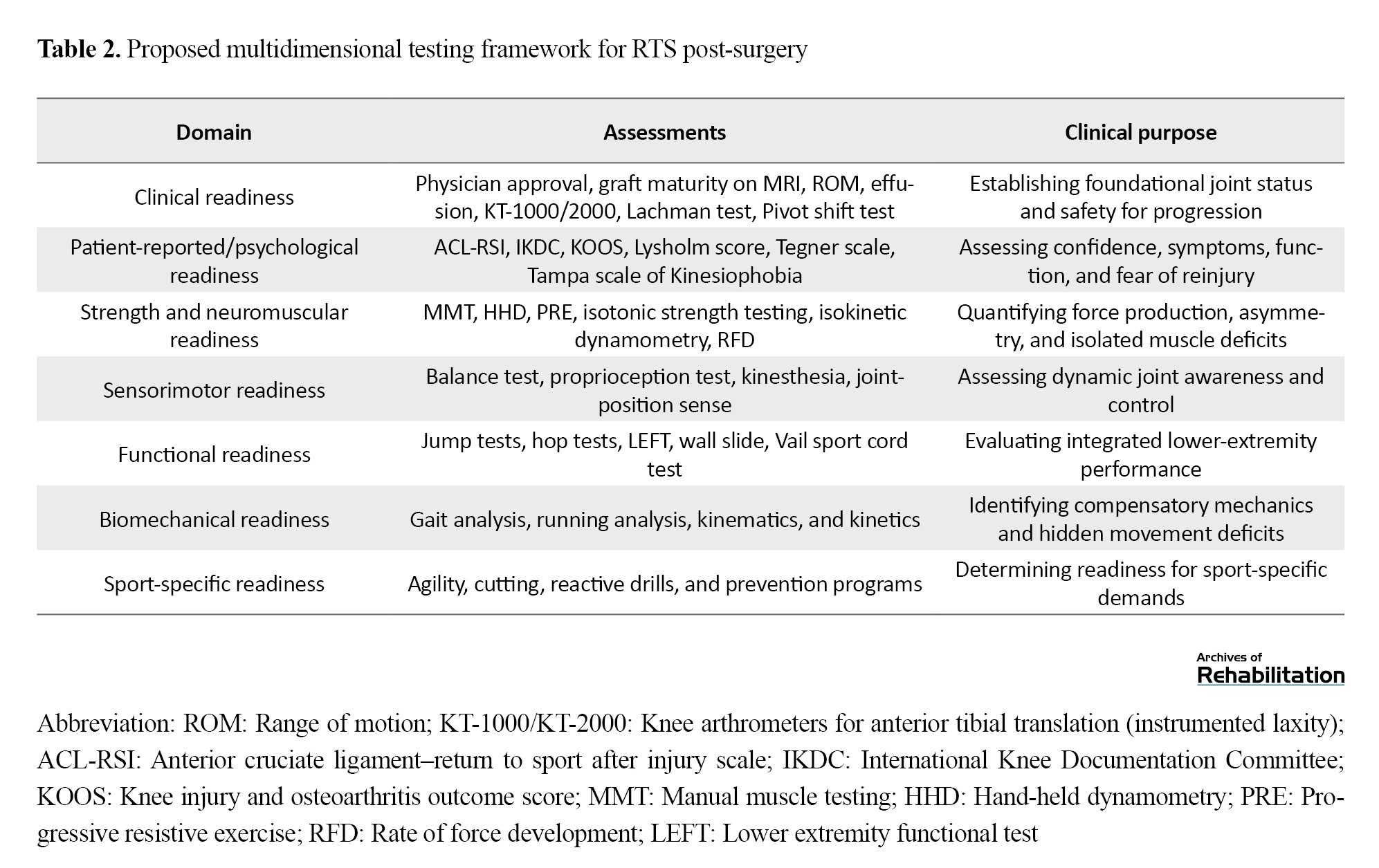
A major limitation of conventional RTS decision-making is the overreliance on isolated pass/fail criteria, particularly when these criteria are assessed without consideration of underlying movement strategies. For example, an athlete may demonstrate acceptable hop test or quadriceps limb symmetry while still exhibiting altered landing mechanics, reduced knee extensor contribution, compensatory trunk motion, or persistent underloading of the surgical limb. In other words, the athlete may be able to resume sports exposure while still maintaining a movement pattern that can increase reinjury risk or accelerate long-term joint degeneration [11]. To address this gap, we propose that RTS testing after ACLR should be interpreted within three interrelated domains: clinical readiness, functional/neuromuscular readiness, and biomechanical readiness.
Clinical readiness includes physician approval; evidence of adequate graft healing or, when available, graft maturity; restoration of knee range of motion (ROM); minimal or absent effusion; a stable ligament examination; and acceptable anterior knee laxity measured with devices such as the KT-1000 or KT-2000 arthrometer [12]. These indicators provide a necessary foundation for progression, but they do not confirm readiness for high-demand athletic activity.
Functional/neuromuscular readiness includes patient-reported outcome measures, muscle performance testing, proprioceptive assessment, and progressively demanding functional tasks [13]. Relevant self-reported measures include the ACL-return to sport after injury (ACL-RSI) scale, the International Knee Documentation Committee (IKDC) score, the knee injury and osteoarthritis outcome score (KOOS), the Tegner activity scale, the Lysholm score, kinesiophobia scales such as the Tampa Scale, activities of daily living measures, and sport-specific questionnaires where appropriate [14]. These tools are particularly important because fear of reinjury, low confidence, and perceived instability frequently persist even when objective impairments appear mild. Psychological readiness is therefore not an adjunct consideration, but a central determinant of successful and sustainable RTS. Muscle performance testing should encompass both open kinetic chain (OKC) and closed kinetic chain (CKC) assessments. OKC testing (manual muscle testing, hand-held dynamometry, progressive resistive exercise testing, and especially isokinetic dynamometry) allows more isolated examination of quadriceps and hamstring function [15]. This is particularly relevant after ACLR because isolated weakness may remain hidden during compound tasks through compensatory changes at the hip, ankle, or contralateral limb. Isokinetic testing remains especially valuable despite criticism of its functional relevance, as it provides quantifiable information on peak torque, angle-specific torque, strength asymmetry, and, in some cases, rate of force development. These variables are highly relevant to restoring dynamic knee stability and enabling controlled deceleration. In contrast, CKC assessments are more reflective of coordinated lower-extremity function because they challenge multiple joints and muscle groups simultaneously [16]. However, their interpretive limitation is equally important. When a deficit is detected in a CKC task, the exact source of impairment may be unclear. For this reason, isolated and integrated testing should be viewed as complementary rather than competing approaches. A patient who performs well during a squat-based or hopping task may still possess deficits in isolated quadriceps’ force production, whereas another may demonstrate good isolated strength but poor movement quality under dynamic conditions. Functional testing should therefore progress from basic movement competency toward high-demand athletic tasks. This progression may include balance and proprioceptive testing, kinesthesia or joint position sense assessment, quality-of-movement evaluations, jump and hop tests, lower-extremity functional test, and sport-specific tests under realistic conditions.
Importantly, performance outcomes alone are not sufficient. The qualitative execution of each task should also be assessed, with particular attention to frontal-plane knee control, pelvic stability, trunk alignment, landing strategy, and interlimb loading symmetry. This is where three-dimensional kinematic analysis, kinetic analysis, gait assessment, and running analysis offer substantial clinical value. These methods can detect residual deficits that conventional clinical tests may overlook, particularly in individuals who have learned to compensate successfully enough to pass standard RTS batteries. From a rehabilitation perspective, integrating serial gait and running analyses at 6, 12, and 18 months after ACLR offers a practical and conceptually powerful framework. At approximately 6 months, many individuals remain in a protective biomechanical state characterized by underloading of the surgical limb, reduced knee extensor moments, elevated co-contraction, and cautious locomotor strategies [17].
At this stage, rehabilitation should continue to prioritize graft protection, restoration of quadriceps function, progressive resistive exercise, proprioceptive retraining, and foundational movement quality. Advancement to higher-level functional tasks should be contingent on acceptable clinical stability, adequate ROM, and demonstrable improvement in asymmetry. By 12 months, many athletes appear clinically improved and may subjectively feel ready to return; however, this stage may represent a particularly deceptive phase of recovery. Gait parameters often normalize earlier than running mechanics, and standard strength or hop tests may suggest acceptable progress even while deficits remain in frontal-plane control, knee loading strategy, and neuromuscular timing during more demanding tasks [18].
Accordingly, athletes at this phase should undergo more challenging testing, including running analysis, jump-landing test, unilateral functional tasks, and, if feasible, isokinetic evaluation of residual deficits in quadriceps and hamstring performance. A patient who demonstrates acceptable basic function but persistent compensatory mechanics should not be considered fully ready for unrestricted RTS. After 18 months, most gross biomechanical deficits are expected to improve substantially, particularly in individuals who have completed structured, criteria-based rehabilitation. Nevertheless, subtle impairments may remain in a subset of patients, especially under conditions of speed, fatigue, cutting, or sport-specific unpredictability [18]. These residual deficits may be low but clinically meaningful, particularly with respect to the risk of a second ACL injury and the cumulative joint-loading patterns associated with PTOA. Therefore, RTS testing at later stages should extend beyond laboratory symmetry thresholds and include sport-specific power, repeated-effort performance, reactive control, and movement quality under high-demand conditions.
Based on the mentioned framework detailed in Table 2, we propose that RTS after ACLR should be considered as a continuum rather than a single clearance event.
Return to full sport participation should ideally reflect convergence across several dimensions: physician approval, graft and knee stability, adequate ROM, satisfactory patient-reported outcomes, low psychological avoidance, acceptable strength symmetry, restored proprioceptive and balance performance, high-quality movement mechanics, and appropriate sport-specific capacity. In this model, biomechanical analysis of gait and running is not an optional research tool, but a clinically meaningful bridge between the rehabilitation process and the RTS decision-making. A patient may be able to return to sport before they are truly ready to return safely. If walking is normalized but running remains asymmetrical, if hop distance is restored but landing control is poor, or if strength symmetry is acceptable but frontal-plane knee mechanics remain altered, the athlete may return not to sports, but to injury risk. For this reason, clinicians should move beyond time-based milestones and isolated test thresholds toward a more integrated, longitudinal, and biomechanically informed RTS model after ACLR.
Conclusion
We suggest that successful RTS after ACLR is not defined merely by elapsed postoperative time or isolated functional performance, but by the restoration of high-quality, symmetrical, and task-appropriate movement across clinical, neuromuscular, and biomechanical domains.
Ethical Considerations
Compliance with ethical guidelines
All ethical principles were considered in this study. This is a systematic review study. No experiments were conducted on human or animal samples. Accordingly, there was no need for an ethical code.
Funding
This research did not receive any specific grant from funding agencies in the public, commercial, or not-for-profit sectors.
Authors' contributions
Conceptualization, Methodology, sources for writing the draft, visualization, validation, Analysis, and research and review: Ebrahim Piri; Editing and finalizing the text: All authors; Supervision, and Project management: AmirAli Jafarnejadgro.
Conflict of interest
The authors declared no conflict of interest.
References
Anterior cruciate ligament (ACL) rupture is one of the most prevalent and debilitating orthopedic injuries worldwide, with global incidence estimated at approximately 1 per 3,500, equating to nearly 95,000 new ACL reconstruction (ACLR) cases annually in the United States alone [1]. Alarmingly, incidence rates among high-risk populations, particularly adolescents and young adults aged 16–39 years, are even higher, reaching 85 per 100,000, with Australia reporting the highest global incidence of 91 per 100,000 people under the age of 25 [2]. Given that these figures are derived predominantly from surgical databases, the true incidence of ACL injury is likely substantially greater, reflecting a global epidemic that continues to expand across athletic populations [2]. In the United States, approximately 60,000–75,000 ACLRs are performed annually, with reported long-term success rates ranging from 75 to 95% [1]. However, the ability to successfully return to sport (RTS) following ACLR remains highly variable and, for many patients, it is elusive. Evidence demonstrates that while approximately 80% of patients return to some form of sports activity, only 65% return to their pre-injury level of performance, and 55% successfully return to competitive-level sport [3]. Among soccer players, up to 40% do not believe they will return to their sport following ACL injury, reflecting the profound psychological and physical barriers to successful RTS [4]. Among those who have successful RTS, reinjury rates remain alarmingly high, with 23.5% experiencing reinjury and 24.5% requiring reoperation. These sobering statistics underscore a fundamental question: what distinguishes a high-quality, sustained RTS from a dangerous, injury-prone one?
A growing body of literature has identified several key determinants of successful RTS. The Delaware-Oslo ACL cohort study established international consensus on six measures defining successful outcome after ACL injury and reconstruction: absence of knee joint giving way, RTS, quadriceps and hamstrings’ strength >90% of the uninvolved limb, having no more than mild knee joint effusion, and patient-reported outcomes [5]. Moreover, prospective evidence has demonstrated that premature RTS, specifically before 9 months postoperatively, may increase the risk of a second ACL injury by up to 7-fold, whereas delaying clearance by each additional month up to 9 months can reduce reinjury risk by approximately 50%.
The consequences of incomplete or inadequate rehabilitation are profound and enduring. Inadequate rehabilitation, combined with an unprepared RTS, not only limits athletic performance but also significantly increases the reinjury risk [6]. Persistent gait abnormalities are frequently observed even at 6–12 months postoperatively and may last up to 2 years or longer [7]. Such biomechanical impairments, including reduced peak knee flexion angles, diminished knee flexion moments, and altered gait symmetry, are associated not only with heightened ACL reinjury risk but also with early-onset post-traumatic osteoarthritis (PTOA) [7]. Alarmingly, over 80% of patients undergoing ACLR with hamstring tendon autografts exhibit radiographic evidence of PTOA during a 15.6-year follow-up [8].
This editorial introduces a novel conceptual framework that bridges the critical gap between structured rehabilitation programming and systematic biomechanical assessment. Specifically, we propose the integration of comprehensive kinematic and kinetic analyses during walking and running at three distinct postoperative milestones, 6, 12, and 18 months, to differentiate the biomechanical trajectory of patients who adhere to rigorous, criteria-based rehabilitation protocols from those who do not. While numerous studies have characterized gait abnormalities following ACLR [9], no study has systematically mapped the temporal evolution of locomotor mechanics in relation to adherence to structured rehabilitation, nor prospectively compared these biomechanical outcomes with the timing of surgical intervention. This editorial further contributes a unique examination of the temporal relationship between injury and surgery, specifically, whether immediate ACLR (<6 weeks after injury) confers biomechanical advantages over delayed reconstruction (>6 months), or whether prolonged pre-surgical periods with inadequate rehabilitation engender persistent, unfavorable gait and running mechanics that undermine long-term joint health.
Emerging evidence suggests that early ACLR may be more beneficial in improving knee extension movement and knee extension moment during walking at 12 months postoperatively compared to delayed surgery [10]. Conversely, other studies have reported that >80% of early and delayed ACLR patients ultimately develop PTOA at long-term follow-up, with no significant differences between groups [8]. These conflicting findings highlight the urgent need for a granular, timespecific analysis of when and for whom surgical timing truly matters. Accordingly, the primary goal of this editorial is twofold: (a) to establish a bridge between comprehensive rehabilitation adherence and serial biomechanical assessment at 6, 12, and 18 months postsurgery; and (b) to critically evaluate the influence of the injurytosurgery time on walking and running mechanics. By linking process (rehabilitation fidelity) to outcome (biomechanical recovery), this editorial seeks to provide clinicians, surgeons, and sports scientists with actionable, evidencebased guidelines for determining not only the time of RTS, but also how the patient should return with quality, resilience, and sustained joint health as the ultimate endpoints. Six months after ACLR, patients commonly demonstrate protective walking and running patterns characterized by unloading of the surgical limb, reduced knee extensor moment, marked neuromuscular inhibition, and substantial interlimb asymmetry. After 12 months, many spatiotemporal gait parameters return to normal values; however, running mechanics often remain impaired, particularly in loading symmetry and knee control, indicating that apparently normal gait may mask persistent deficits during higher-demand tasks. By 18 months, gait biomechanics are typically near normal in most individuals, and many gait variables improve substantially, although subtle asymmetries, especially in frontal-plane knee mechanics and hip control, may persist in some patients, potentially contributing to reinjury risk and long-term joint degeneration [9].
Table 1 synthesize evidence-based, time-specific biomechanical findings after ACLR, at 6, 12, and 18 months post-surgery, with emphasis on limb-to-limb asymmetry, locomotor loading strategies, and neuromuscular control during walking and running factors central to RTS quality and reinjury risk.
Integrating biomechanical recovery with RTS testing
Although the time since surgery is frequently used as a practical benchmark in ACLR rehabilitation, it is not a sufficient criterion. Biomechanical recovery after ACLR is task-specific and nonlinear. Gait mechanics may be normal up to 12 months, whereas running mechanics, frontal-plane control, limb-loading symmetry, and neuromuscular coordination may remain impaired beyond this time. Accordingly, RTS decision-making should not be based solely on chronological recovery but rather on a multidimensional framework that integrates graft status, knee function, psychological readiness, strength recovery, movement quality, and sport-specific performance.
A major limitation of conventional RTS decision-making is the overreliance on isolated pass/fail criteria, particularly when these criteria are assessed without consideration of underlying movement strategies. For example, an athlete may demonstrate acceptable hop test or quadriceps limb symmetry while still exhibiting altered landing mechanics, reduced knee extensor contribution, compensatory trunk motion, or persistent underloading of the surgical limb. In other words, the athlete may be able to resume sports exposure while still maintaining a movement pattern that can increase reinjury risk or accelerate long-term joint degeneration [11]. To address this gap, we propose that RTS testing after ACLR should be interpreted within three interrelated domains: clinical readiness, functional/neuromuscular readiness, and biomechanical readiness.
Clinical readiness includes physician approval; evidence of adequate graft healing or, when available, graft maturity; restoration of knee range of motion (ROM); minimal or absent effusion; a stable ligament examination; and acceptable anterior knee laxity measured with devices such as the KT-1000 or KT-2000 arthrometer [12]. These indicators provide a necessary foundation for progression, but they do not confirm readiness for high-demand athletic activity.
Functional/neuromuscular readiness includes patient-reported outcome measures, muscle performance testing, proprioceptive assessment, and progressively demanding functional tasks [13]. Relevant self-reported measures include the ACL-return to sport after injury (ACL-RSI) scale, the International Knee Documentation Committee (IKDC) score, the knee injury and osteoarthritis outcome score (KOOS), the Tegner activity scale, the Lysholm score, kinesiophobia scales such as the Tampa Scale, activities of daily living measures, and sport-specific questionnaires where appropriate [14]. These tools are particularly important because fear of reinjury, low confidence, and perceived instability frequently persist even when objective impairments appear mild. Psychological readiness is therefore not an adjunct consideration, but a central determinant of successful and sustainable RTS. Muscle performance testing should encompass both open kinetic chain (OKC) and closed kinetic chain (CKC) assessments. OKC testing (manual muscle testing, hand-held dynamometry, progressive resistive exercise testing, and especially isokinetic dynamometry) allows more isolated examination of quadriceps and hamstring function [15]. This is particularly relevant after ACLR because isolated weakness may remain hidden during compound tasks through compensatory changes at the hip, ankle, or contralateral limb. Isokinetic testing remains especially valuable despite criticism of its functional relevance, as it provides quantifiable information on peak torque, angle-specific torque, strength asymmetry, and, in some cases, rate of force development. These variables are highly relevant to restoring dynamic knee stability and enabling controlled deceleration. In contrast, CKC assessments are more reflective of coordinated lower-extremity function because they challenge multiple joints and muscle groups simultaneously [16]. However, their interpretive limitation is equally important. When a deficit is detected in a CKC task, the exact source of impairment may be unclear. For this reason, isolated and integrated testing should be viewed as complementary rather than competing approaches. A patient who performs well during a squat-based or hopping task may still possess deficits in isolated quadriceps’ force production, whereas another may demonstrate good isolated strength but poor movement quality under dynamic conditions. Functional testing should therefore progress from basic movement competency toward high-demand athletic tasks. This progression may include balance and proprioceptive testing, kinesthesia or joint position sense assessment, quality-of-movement evaluations, jump and hop tests, lower-extremity functional test, and sport-specific tests under realistic conditions.
Importantly, performance outcomes alone are not sufficient. The qualitative execution of each task should also be assessed, with particular attention to frontal-plane knee control, pelvic stability, trunk alignment, landing strategy, and interlimb loading symmetry. This is where three-dimensional kinematic analysis, kinetic analysis, gait assessment, and running analysis offer substantial clinical value. These methods can detect residual deficits that conventional clinical tests may overlook, particularly in individuals who have learned to compensate successfully enough to pass standard RTS batteries. From a rehabilitation perspective, integrating serial gait and running analyses at 6, 12, and 18 months after ACLR offers a practical and conceptually powerful framework. At approximately 6 months, many individuals remain in a protective biomechanical state characterized by underloading of the surgical limb, reduced knee extensor moments, elevated co-contraction, and cautious locomotor strategies [17].
At this stage, rehabilitation should continue to prioritize graft protection, restoration of quadriceps function, progressive resistive exercise, proprioceptive retraining, and foundational movement quality. Advancement to higher-level functional tasks should be contingent on acceptable clinical stability, adequate ROM, and demonstrable improvement in asymmetry. By 12 months, many athletes appear clinically improved and may subjectively feel ready to return; however, this stage may represent a particularly deceptive phase of recovery. Gait parameters often normalize earlier than running mechanics, and standard strength or hop tests may suggest acceptable progress even while deficits remain in frontal-plane control, knee loading strategy, and neuromuscular timing during more demanding tasks [18].
Accordingly, athletes at this phase should undergo more challenging testing, including running analysis, jump-landing test, unilateral functional tasks, and, if feasible, isokinetic evaluation of residual deficits in quadriceps and hamstring performance. A patient who demonstrates acceptable basic function but persistent compensatory mechanics should not be considered fully ready for unrestricted RTS. After 18 months, most gross biomechanical deficits are expected to improve substantially, particularly in individuals who have completed structured, criteria-based rehabilitation. Nevertheless, subtle impairments may remain in a subset of patients, especially under conditions of speed, fatigue, cutting, or sport-specific unpredictability [18]. These residual deficits may be low but clinically meaningful, particularly with respect to the risk of a second ACL injury and the cumulative joint-loading patterns associated with PTOA. Therefore, RTS testing at later stages should extend beyond laboratory symmetry thresholds and include sport-specific power, repeated-effort performance, reactive control, and movement quality under high-demand conditions.
Based on the mentioned framework detailed in Table 2, we propose that RTS after ACLR should be considered as a continuum rather than a single clearance event.
Return to full sport participation should ideally reflect convergence across several dimensions: physician approval, graft and knee stability, adequate ROM, satisfactory patient-reported outcomes, low psychological avoidance, acceptable strength symmetry, restored proprioceptive and balance performance, high-quality movement mechanics, and appropriate sport-specific capacity. In this model, biomechanical analysis of gait and running is not an optional research tool, but a clinically meaningful bridge between the rehabilitation process and the RTS decision-making. A patient may be able to return to sport before they are truly ready to return safely. If walking is normalized but running remains asymmetrical, if hop distance is restored but landing control is poor, or if strength symmetry is acceptable but frontal-plane knee mechanics remain altered, the athlete may return not to sports, but to injury risk. For this reason, clinicians should move beyond time-based milestones and isolated test thresholds toward a more integrated, longitudinal, and biomechanically informed RTS model after ACLR.
Conclusion
We suggest that successful RTS after ACLR is not defined merely by elapsed postoperative time or isolated functional performance, but by the restoration of high-quality, symmetrical, and task-appropriate movement across clinical, neuromuscular, and biomechanical domains.
Ethical Considerations
Compliance with ethical guidelines
All ethical principles were considered in this study. This is a systematic review study. No experiments were conducted on human or animal samples. Accordingly, there was no need for an ethical code.
Funding
This research did not receive any specific grant from funding agencies in the public, commercial, or not-for-profit sectors.
Authors' contributions
Conceptualization, Methodology, sources for writing the draft, visualization, validation, Analysis, and research and review: Ebrahim Piri; Editing and finalizing the text: All authors; Supervision, and Project management: AmirAli Jafarnejadgro.
Conflict of interest
The authors declared no conflict of interest.
References
- Taylor KS, Achar SA. 5 Minute Sports Medicine Consult. Netherlands: Wolters Kluwer Health; 2025. [Link]
- Dubé MO, Crossley KM, Bruder AM, Patterson BE, Haberfield MJ, Culvenor AG. Addressing rising knee injury and surgery rates with real-word data; the need for a clinical knee injury registry. JSAMS Plus. 2024; 4:100077. [DOI:10.1016/j.jsampl.2024.100077] [PMID] [PMCID]
- Andriolo L, Filardo G, Kon E, Ricci M, Della Villa F, Della Villa S, et ak. Revision anterior cruciate ligament reconstruction: clinical outcome and evidence for return to sport. Knee Surgery, Sports Traumatology, Arthroscopy. 2015; 23(10):2825-45. [DOI:10.1007/s00167-015-3702-9] [PMID]
- Hållén I, Kvist J, Forssblad M, Sandon A. Return to soccer after anterior cruciate ligament reconstruction: an outcome or a decision? Orthopaedic Journal of Sports Medicine. 2024; 12(12):23259671241295834. [DOI:10.1177/23259671241295834] [PMID] [PMCID]
- Lynch AD, Logerstedt DS, Grindem H, Eitzen I, Hicks GE, Axe MJ, et al. Consensus criteria for defining ‘successful outcome’after ACL injury and reconstruction: A Delaware-Oslo ACL cohort investigation. British Journal of Sports Medicine. 2015; 49(5):335-42. [DOI:10.1136/bjsports-2013-092299] [PMID] [PMCID]
- Bien DP, Dubuque TJ. Considerations for late stage ACL rehabilitation and return to sport to limit re‐injury risk and maximize athletic performance. International Journal of Sports Physical Therapy. 2015; 10(2):256-71. [PMID]
- Chen S, Gong H, Lyu C, Li K, Shaharudin S. Time to normalization of gait following ACL reconstruction compared with healthy controls: A systematic review and meta-analysis. Gait & Posture. 2026; 123:109972. [DOI:10.1016/j.gaitpost.2025.109972] [PMID]
- Cruz CA, Pruneski JA, McAllister RN, Riopelle D, Bottoni CR. Fifteen-year radiographic follow-up comparison of early versus delayed ACL reconstruction: A retrospective review of a previous prospective randomized clinical trial. Orthopaedic Journal of Sports Medicine. 2024; 12(12):23259671241298753. [DOI:10.1177/23259671241298753] [PMID] [PMCID]
- Piri E, Jafarnezhadgero A. Walking and Running Mechanics After Anterior Cruciate Ligament Reconstruction: An Editorial Review. Physical Treatments-Specific Physical Therapy Journal. 2026; 16(2):127-32. [DOI:10.32598/ptj.2026.348.19]
- Kono Y, Deie M, Hirata K, Asaeda M, Terai C, Kimura H, et al. Influence of time from injury to surgery on knee biomechanics during walking in patients with anterior cruciate ligament reconstruction. Sports Biomechanics. 2024; 23(12):3112-20. [DOI:10.1080/14763141.2023.2236978] [PMID]
- Paterno MV, Schildmeyer C, Thomas S, Kronenberg J, Fitzgerald KG. Booster Visits Assist Return to Sport Progression After ACL Reconstruction: A pilot study: SPL28. Journal of Orthopaedic & Sports Physical Therapy. 2023; 53(2):38-9. [Link]
- Davies GJ, McCarty E, Provencher M, Manske RC. ACL return to sport guidelines and criteria. Current Reviews in Musculoskeletal Medicine. 2017; 10(3):307-14. [DOI:10.1007/s12178-017-9420-9] [PMID] [PMCID]
- Voet N, Pater R, Garmendia J, Sistiaga A, Labayru G, Gallais B, et al. Patient-Reported outcome measures in neuromuscular diseases: A scoping review. Journal of Neuromuscular Diseases. 2024; 11(3):567-77. [DOI:10.3233/JND-240003] [PMID] [PMCID]
- Kim Y, Kubota M, Sato T, Inui T, Ohno R, Ishijima M. Psychological Patient-reported outcome measure after anterior cruciate ligament reconstruction: Evaluation of subcategory in ACL-Return to Sport after Injury (ACL-RSI) scale. Orthopaedics & Traumatology: Surgery & Research. 2022; 108(3):103141. [DOI:10.1016/j.otsr.2021.103141] [PMID]
- Mulligan T. What are the Effects of Open and Closed Kinetic Chain Exercises on Knee Laxity, Functional Performance, Self-Report Function Questionnaires, and Muscle Strength of ACL Deficient or Reconstructed Patients? A systematic review [Bachelor thesis]. Ohio: Walsh University; 2018. [Link]
- Rivera JE. Open versus closed kinetic chain rehabilitation of the lower extremity: a functional and biomechanical analysis. Journal of Sport Rehabilitation. 1994; 3(2):154-67. [DOI:10.1123/jsr.3.2.154]
- Piri E, Jafarnezhadgero A, Dehghani M, Sajedi H, Dionisio VC. Effect of foot orthotics on running kinetics in adults with anterior cruciate ligament reconstruction: A controlled laboratory study. Scientific Reports. 2026. [DOI:10.1038/s41598-026-55763-8]
- Piri E, Jafarnezhadgero A, Dehghani M, Dionisio VC. Response to fatigue protocol on running ground reaction forces in individuals with anterior cruciate ligament reconstruction and pronated feet: A cross-sectional observational study. BMC Musculoskeletal Disorders. 2026; 27(1):501. [DOI:10.1186/s12891-026-09876-w] [PMID] [PMCID]
Type of Study: Editorial |
Subject:
Sport Pathology and Corrective Movements
Send email to the article author
| Rights and permissions | |
 |
This work is licensed under a Creative Commons Attribution-NonCommercial 4.0 International License. |

Copyright © The Author(s);
This is an open access article distributed under the terms of the Creative Commons Attribution-NonCommercial 4.0 (CC-By-NC 4.0), which permits use, distribution, and reproduction in any medium, provided the original work is properly cited and is not used for commercial purposes.
Contact Information
This is an open access article distributed under the terms of the Creative Commons Attribution-NonCommercial 4.0 (CC-By-NC 4.0), which permits use, distribution, and reproduction in any medium, provided the original work is properly cited and is not used for commercial purposes.
Contact Information